

On this page
In 1988, French physicist Albert Fert and German physicist Peter Grünberg independently discovered an unexpected quantum effect that fundamentally transformed data storage. Computer hard disks had long been throttled by the challenge of reading faint magnetic signals from tiny disk sectors. Fert and his team at Université Paris-Sud discovered that sandwiching nanometre-thin alternating sheets of iron and chromium caused electrical resistance to plunge when an external magnetic field aligned the layers. For their discovery of giant magnetoresistance (GMR), Fert and Grünberg received the 2007 Nobel Prize in Physics, launching the field of spintronics.
What is giant magnetoresistance?
Ordinary magnetoresistance, identified by Lord Kelvin in 1857, shifts resistance in bulk metals by only 1% to 2% under a magnetic field, as noted in the Nobel Prize summary. This weak response limited sensors for a century.
In November 1988, Albert Fert and his team reported measurements in Physical Review Letters. Using molecular beam epitaxy, they layered up to 60 alternating sheets of iron (3 nanometres thick) and chromium (0.9 to 1.8 nanometres thick). At 4.2 kelvin, applying a 2-tesla field aligned the opposing iron layers, cutting electrical resistance by nearly 50%.
Independently, Peter Grünberg's group at Forschungszentrum Jülich observed a 1.5% drop at room temperature in an Fe/Cr/Fe sandwich, publishing in Physical Review B. Because this response dwarfed ordinary magnetoresistance, researchers called it giant magnetoresistance. Just as 2D semiconductor sheets set resistance standards in Klaus von Klitzing and a resistance set by nature's constants, Fert showed that transport across atomic interfaces obeys quantum rules distinct from bulk conductors.
How does electron spin change electrical resistance?
GMR relies on electron spin and the two-current conduction model developed by Sir Nevill Mott in 1936. As explored in Uhlenbeck, Goudsmit and the spin of the electron, electrons carry intrinsic spin: either spin-up or spin-down.
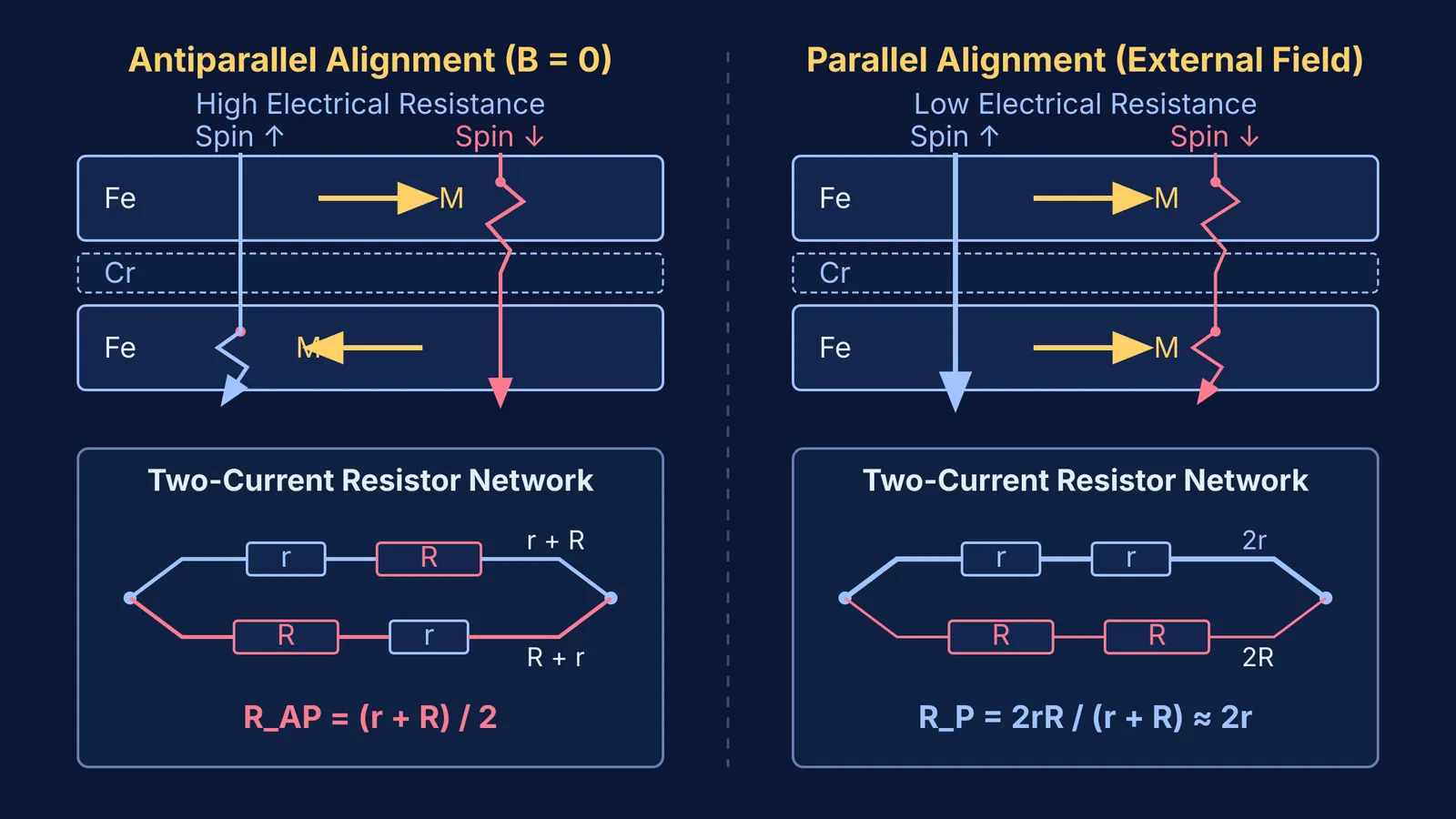
In ferromagnetic metals like iron, internal exchange fields split electron energy bands, as explained in Dia-, para- and ferromagnetism explained, with hysteresis loops. Electrons with spins parallel to the local magnetisation experience low scattering and low resistance (r). Electrons with opposed spins scatter frequently into empty states, facing high resistance (R).
According to the Nobel Prize scientific background, chromium spacers force adjacent iron layers into antiparallel alignment in zero field. Here, spin-up electrons glide through the first iron layer but scatter in the second; spin-down electrons scatter in the first. Both channels face high resistance. When an external field aligns both layers, spin-up electrons pass unhindered. This low-resistance channel acts as a short circuit, causing total resistance to plummet.
How did GMR transform computer hard disks?
To store more data, hard drives needed smaller magnetic bits. But smaller bits emit weaker magnetic flux that older inductive or anisotropic sensors could not detect cleanly.
In 1991, Bernard Dieny, Stuart Parkin, and colleagues at IBM Almaden designed the spin valve, published in Physical Review B. Pinning one magnetic layer with an antiferromagnet while leaving the other free to rotate produced a 5.0% resistance change at room temperature in fields of just 10 oersteds.
In 1997, IBM launched the Deskstar 16GP drive, the first commercial unit with a GMR head, documented by the Royal Swedish Academy of Sciences. GMR sensors accelerated annual areal density growth from 25% to 30% up to 60% to 100% per year, enabling high-capacity drives for laptops, music players, and cloud servers.
Worked example: calculating the two-current resistor network
You can model GMR using Mott's framework, detailed in the Nobel Prize scientific background, as a parallel circuit of two spin channels. Suppose an electron traversing a magnetic layer faces low resistance r = 1 Ω when aligned with the magnetisation and high resistance R = 9 Ω when opposed:
Parallel alignment: Both layers share one magnetisation. The spin-up channel has low resistance in both layers: R_up = 1 Ω + 1 Ω = 2 Ω. The spin-down channel faces high resistance: R_down = 9 Ω + 9 Ω = 18 Ω. Combining them in parallel gives 1/R_P = 1/2 + 1/18 = 10/18 Ω⁻¹, so R_P = 1.8 Ω.
Antiparallel alignment: Spin-up electrons face low resistance in layer 1 and high in layer 2: R_up = 1 Ω + 9 Ω = 10 Ω. Spin-down electrons face the opposite: R_down = 9 Ω + 1 Ω = 10 Ω. In parallel, 1/R_AP = 1/10 + 1/10 = 2/10 Ω⁻¹, so R_AP = 5.0 Ω.
Resistance drop: The fractional change is (R_AP − R_P) / R_AP = (5.0 Ω − 1.8 Ω) / 5.0 Ω = 64%. The 2 Ω channel shunts current in the parallel state.
Connecting concepts to practice
Visualising how quantum spin produces macroscopic changes in resistance helps ground abstract electromagnetic theory. The Fermi Simulation Lab offers interactive simulations for ideas that are easier to see than to read, letting you observe charges, currents, and magnetic fields dynamically.
To master resistor circuits and magnetic forces, the Fermi Problem Library provides worked problems with a step-by-step solver that explains the reasoning rather than printing an answer. For a complete map of electromagnetism and modern physics, the Fermi Concept Library covers every concept in physics, chemistry, biology, mathematics and computing, each with its own lesson and its place in the map.


