

On this page
During World War II, the German military relied on the Enigma machine to encode its most secret messages. To read them, the codebreakers at Bletchley Park faced an impossible wall of mathematics.
The standard Enigma machine could be set up in approximately 15 quintillion (1.5 × 10¹⁹) ways, according to historical data on the Bombe. If a human tried to test them one by one, the war would end long before they found the answer.
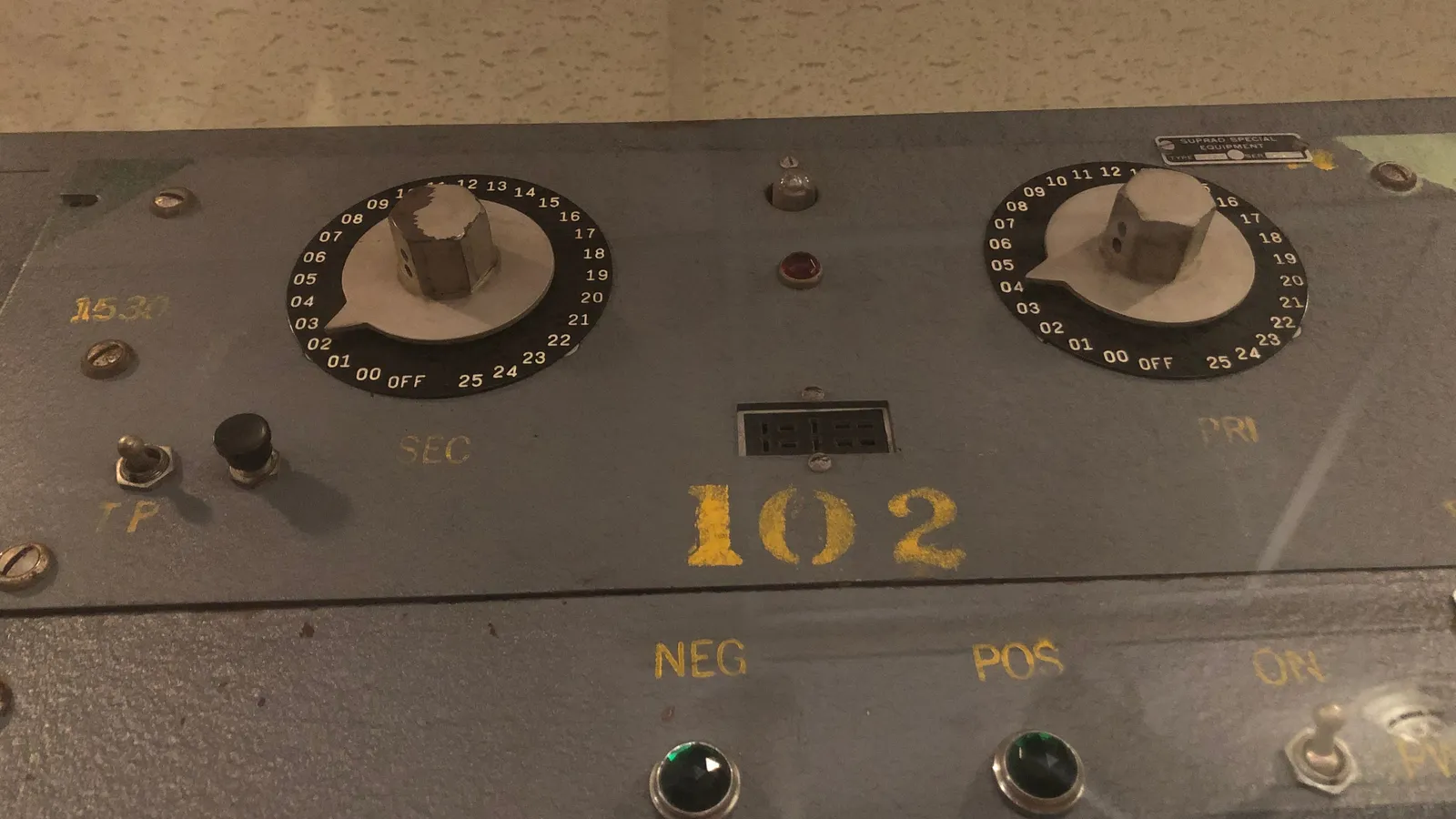
Alan Turing realised that brute force was not the answer. Instead, he designed an electromechanical machine called the Bombe. Its genius lay not in finding the right answer directly, but in using pure logic to instantly rule out the wrong ones.
What made the Enigma code so hard to break?
The Enigma machine was formidable because its complexity grew exponentially with every added feature. The machine used a series of rotating wheels, or rotors, to scramble letters. Finding the day's setting meant choosing the correct rotors from a set, determining the exact order they were placed in, and setting their starting positions.
Finally, operators had to configure a plugboard at the front of the machine that swapped pairs of letters before they even reached the rotors. The plugboard alone accounted for 150,738,274,937,250 possible ways to connect the cables.
Turing and his team knew that checking every option was a dead end. This is a trap many students fall into when facing complex multiple-choice questions or debugging a piece of code: guessing answers or testing every possibility without a system. This is often why some JEE aspirants plateau despite studying every day, as brute-force practice rarely builds deep understanding.
How did the Bombe cut down possibilities?
To build a machine that could find the answer, Turing started with what he already knew.
The Bletchley Park team looked for a "crib"—a short phrase they expected to find in the intercepted message. Because the German military often sent highly formatted messages, such as a routine weather report or a standard greeting, codebreakers could guess a segment of the plaintext. This gave them a known link between the scrambled ciphertext and the original German words.
Turing's Bombe then functioned as a large electrical circuit that used the principle of contradiction (or *reductio ad absurdum*). It hypothesized a specific setting for the machine and traced the electrical implications of that guess. If that assumption led to a logical impossibility—such as the circuit deducing that the letter 'A' must be plugged to both 'Y' and 'Q' simultaneously, or a letter plugging to itself—the circuit remained open. The Bombe immediately rejected that setting and its drums kept spinning.
Instead of looking for the needle, the Bombe used logic to burn down the haystack. The machine only stopped when a setting did *not* lead to a contradiction. A single British Bombe could test all 17,576 possible positions for a single rotor order and narrow the possibilities down to a handful of plausible options in about 20 minutes. Later models built by the US Navy were even faster, completing a 3-rotor run in just 50 seconds.
How can you solve problems the Bletchley way?
Turing's approach is a masterclass in holding a line of reasoning. When you are stuck on a difficult physics problem or a tough mathematical proof, you do not need to try every random formula. You need a systematic way to eliminate what cannot be true. In an exam setting like JEE or NEET, the multiple-choice format often presents distractors that can be logically eliminated before you even touch a calculator.
Here is how you can apply the Bombe's logic to your own studies:
Find your crib: Start with what you know for certain. Identify the given values, the constants, and the strict boundaries of the problem. If a question asks for the speed of a falling object, you know the answer must be positive.
Make an assumption: Propose a path forward, a hypothesis, or test one of the multiple-choice options.
Trace the logic: Follow your assumption step by step through the formulas. If you reach a contradiction (like a negative mass, a violation of energy conservation, or a fraction where a whole number is required), drop that path immediately without looking back.
Use reciprocal rules: Just as Welchman used the two-way nature of the plugboard, use symmetry and conservation laws to cut your workload in half. If a projectile's upward journey takes two seconds, its downward journey takes the same amount of time.
If you struggle to apply this kind of systematic thinking, the Fermi Problem Library has worked problems with a step-by-step solver that explains the reasoning rather than printing an answer. Seeing how an expert traces logic can help you build a study routine that lasts.
Similarly, Fermi's AI tutor teaches by holding a line of reasoning across a whole session. It works out what you already know and builds a plan, noticing where you are stuck and deciding whether to explain, ask, or show—much like how the codebreakers chipped away at the impossible until only the truth remained.


