

On this page
Long before Galileo pointed a spyglass skyward or Edwin Hubble measured extragalactic distances, medieval astronomers mapped the heavens with geometry and naked-eye vision. In 964 CE, Persian astronomer Abd al-Rahman al-Sufi recorded a faint celestial smudge that became humanity's first documented observation of another galaxy: Andromeda.
Who was Abd al-Rahman al-Sufi?
Abd al-Rahman al-Sufi (903–986 CE), known in Western Europe as Azophi, worked in Isfahan and Shiraz under the Buyid ruler Adud al-Dawla. In 964 CE, he completed *Kitāb Ṣuwar al-Kawākib al-Thābitah* (*The Book of Fixed Stars*).
For centuries, astronomers had relied on Ptolemy's Almagest, written around 150 CE. Rather than copying Ptolemy's tables, al-Sufi systematically re-observed the night sky. As detailed in records at the Library of Congress, al-Sufi verified all 48 constellations. He added 12° 42' to stellar longitudes to correct for 827 years of precession between 137 and 964 CE and identified 132 additional stars missing from the Greek tables, as documented by Hafez, Stephenson, and Orchiston.
How did Al-Sufi discover and record the Andromeda galaxy?
Observing the northern sky, al-Sufi examined the constellation Andromeda, which overlapped with an indigenous Arabic figure called *al-Hūt* (the Big Fish). Near the fish's mouth, beside Andromeda's waist, he identified an enduring smudge that did not flicker like a point star.
He described it in Arabic as *al-latkhā al-sahābiya*, or "the little cloud." According to the NASA Hubble Messier Catalog, this is the earliest surviving written record of Messier 31 (M31), the Andromeda Galaxy. Today, NASA confirms that Andromeda lies 2.5 million light-years from Earth with an apparent visual magnitude of 3.1, making it the most distant permanent object visible without optics.
As preserved in historical manuscripts documented by the Library of Congress, al-Sufi illustrated the constellations from dual perspectives: once as seen directly in the sky, and once reversed as viewed on a physical celestial globe, placing the cloud beside Nu Andromedae.
Why did ancient Greek catalogs miss the Andromeda cloud?
Ptolemy cataloged several "nebulous stars" in the *Almagest*—such as the Beehive Cluster—yet missed Andromeda entirely. The omission stems from surface brightness. While a magnitude 3.1 star focuses light into a point, Andromeda's brightness spreads across an area six times the diameter of the full Moon, as noted by NASA. Under hazy Mediterranean skies, low-surface-brightness targets vanish.
Photometric research by Bradley E. Schaefer confirms that al-Sufi achieved superior observational clarity by accounting for atmospheric extinction. Al-Sufi also refined star magnitudes into three-step intermediate grades, anticipating Norman Pogson's magnitude scale. His stellar data was so accurate that Ulugh Beg's Samarkand observatory adopted his magnitudes five centuries later, as demonstrated by Verbunt and van Gent.
When physics students struggle to separate total flux from surface brightness, the Fermi Concept Library clarifies the inverse-square law and magnitude equations with step-by-step visual lessons.
How can students spot the Andromeda galaxy today?
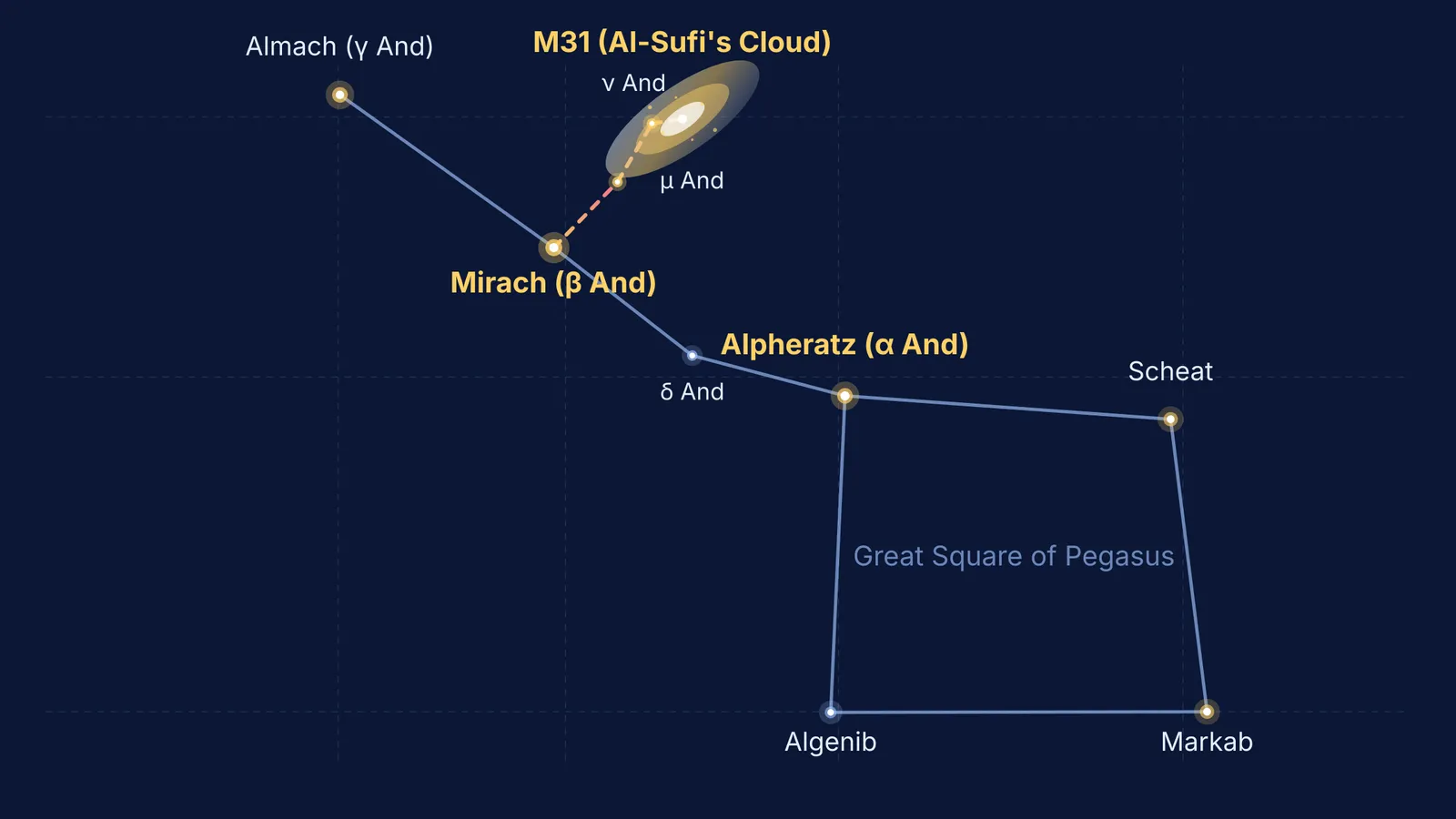
Under dark, moonless autumn or winter skies, you can spot the Andromeda Galaxy without optical aid using a simple star-hop documented by NASA:
Identify the Great Square of Pegasus: Look high overhead for four stars forming a large celestial diamond.
Follow the Andromeda chain: Start at Alpheratz (Alpha Andromedae), the square's northeastern corner, and trace east through Delta Andromedae to reddish Mirach (Beta Andromedae).
Hop two stars north: Turn 90 degrees north from Mirach to Mu Andromedae, then continue along the line to Nu Andromedae.
Catch the cloud with averted vision: Look slightly beside Nu Andromedae. Your peripheral rod cells will detect an oval, ghostly patch: light that began traveling 2.5 million years ago.
For ideas that are easier to see than read, the Fermi Simulation Lab offers interactive simulations that let students explore celestial coordinates and spatial geometry dynamically.
What does Al-Sufi teach us about scientific discovery?
Al-Sufi's discovery was the natural outcome of treating authoritative texts as testable hypotheses rather than dogma. By checking Ptolemy's ancient catalog against direct measurement, he uncovered an entire galaxy hiding in plain sight.
For students tackling physics and astronomy problems, this habit of active verification is essential. When working through complex problems, verify boundary conditions and check steps yourself rather than skimming solutions. Real mastery begins when you look closely enough to see what others missed.


