

On this page
While many medieval clocks relied on basic pulleys and falling water, Andalusian engineer Ibn Khalaf al-Muradi built something much more sophisticated in the 11th century [[1]](https://en.wikipedia.org/wiki/Ibn_Khalaf_al-Muradi). His groundbreaking manuscript, *Kitab al-Asrar fi Nata'ij al-Afkar* (The Book of Secrets in the Results of Thoughts), detailed many ingenious devices, from complicated clocks to intricate automata [[1]](https://en.wikipedia.org/wiki/Ibn_Khalaf_al-Muradi). Today, his work stands as a missing link in the history of mechanics, bridging ancient hydraulics and later clockmaking.
Who was Ibn Khalaf al-Muradi?
Very little is known about al-Muradi's personal life, aside from his presence in 11th-century Islamic Iberia (al-Andalus). His legacy survives entirely through a single copy of his manuscript, which was copied and used at the court of Alfonso VI of León and Castile in 11th-century Christian Spain [[1]](https://en.wikipedia.org/wiki/Ibn_Khalaf_al-Muradi).
His work predated the famous engineer Al-Jazari, who wrote his treatise on mechanical devices in 1206 [[2]](https://en.wikipedia.org/wiki/Water_clock). Many of the complex mechanisms Al-Jazari later perfected found their earliest descriptions in al-Muradi’s text.
What machines were in the Book of Secrets?
The manuscript focused on mechanical devices meant to solve specific problems or create awe-inspiring displays. Among the most famous of these was the "Castle and Gazelle Clock" (or Gazelles Clepsydra).
This monumental water clock used hydraulic power to drive a series of automata—figures of gazelles and girls that would move at the turn of every hour. The passage of time was marked not by hands on a dial, but by the coordinated actions of these figures.
How did the geared water clock work?
To orchestrate the exact timing and motion of his automata—long before physicists mapped how a simple pendulum's string tension changes during its swing—al-Muradi had to translate the continuous flow of water into intermittent, complex mechanical movements. He achieved this through the earliest recorded use of complex gear trains.
Segmental gears: These are gears that are not full circles. Because teeth are only present on a segment of the wheel, they transmit motion in specific, discrete intervals, which is essential for triggering an action exactly once per hour.
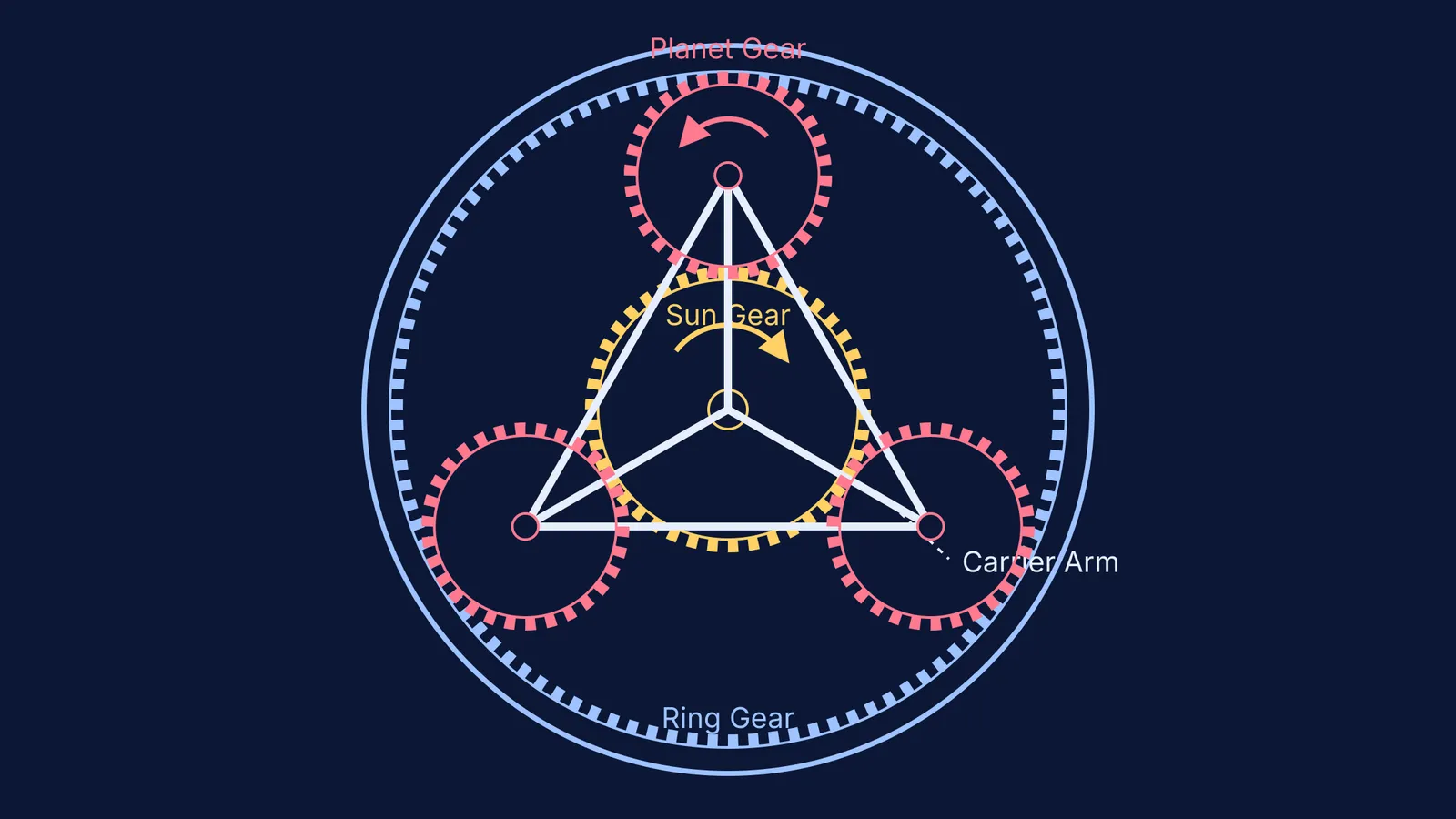
Epicyclic (planetary) gearing: Epicyclic gearing is a complex system where one or more "planet" gears revolve around a central "sun" gear, allowing for high torque transmission and intricate movements [[2]](https://en.wikipedia.org/wiki/Water_clock). This highly advanced technology did not widely appear in European astronomical clocks until the 14th century [[3]](https://en.wikipedia.org/wiki/History_of_timekeeping_devices).
If you struggle to picture how gears step up torque or how intermittent motion works, the Fermi Simulation Lab has interactive simulations for the ideas that are easier to see than to read.
How did engineers solve temperature changes?
The precision of any water clock (clepsydra) is limited by the physical properties of water itself. Water changes its flow rate based on temperature due to slight variations in viscosity. In an intricate clock running year-round, these small changes can compound into significant inaccuracies over time.
While al-Muradi used water, other engineers of the era found a different liquid. In 976, the Chinese astronomer and engineer Zhang Sixun improved upon previous clock designs by using liquid mercury instead of water [[2]](https://en.wikipedia.org/wiki/Water_clock). Mercury provided a stable, highly dense medium that remained liquid at much lower temperatures, preventing the clock mechanism from freezing in winter [[2]](https://en.wikipedia.org/wiki/Water_clock).
When studying the physics of fluids in similar closed systems, such as Pascal's law in hydraulic machines, the Fermi Problem Library has worked problems with a step-by-step solver that explains the reasoning rather than printing an answer.
Deconstructing a historical machine
When studying an ancient device like al-Muradi's clock, engineers use a three-part framework to understand how it worked before modern electronics:
Power source: Identify the prime mover (falling water, descending weights, or winding springs).
Transmission: Trace how continuous power is stepped down or converted (such as epicyclic gears creating torque, or segmental gears creating intermittent stops).
Actuation: Look at the final output (a gazelle moving or a ball dropping to signal the hour).
Al-Muradi's *Book of Secrets* proves that the integration of hydraulic power and complex mechanical gearing has roots stretching much further back than previously thought, laying the groundwork for the mechanical clocks that would eventually define the modern world.


