

On this page
In the 10th century, a young Persian doctor named Ali ibn Abbas al-Majusi (c. 925–994 AD) faced a problem that modern students know well: too much information, badly organised. At the time, the Islamic Golden Age was translating and absorbing vast amounts of Greek, Roman, and Indian medical knowledge. The standard medical text of his era, Rhazes's *Al-Hawi* (*Liber Continens*), was a massive, encyclopedic collection of clinical notes and case studies. However, it was famously disorganised, making it incredibly difficult for medical students to actually learn from it.
To fix this, Al-Majusi set out to write a new kind of textbook. He wrote *Kamil al-Sina'a al-Tibbiyya* (The Complete Book of the Medical Art), which he dedicated to the Buyid ruler 'Adud al-Dawla, earning it the popular name *The Royal Book* (*Kitab al-Maliki*).
How did Al-Majusi structure medical theory and practice?
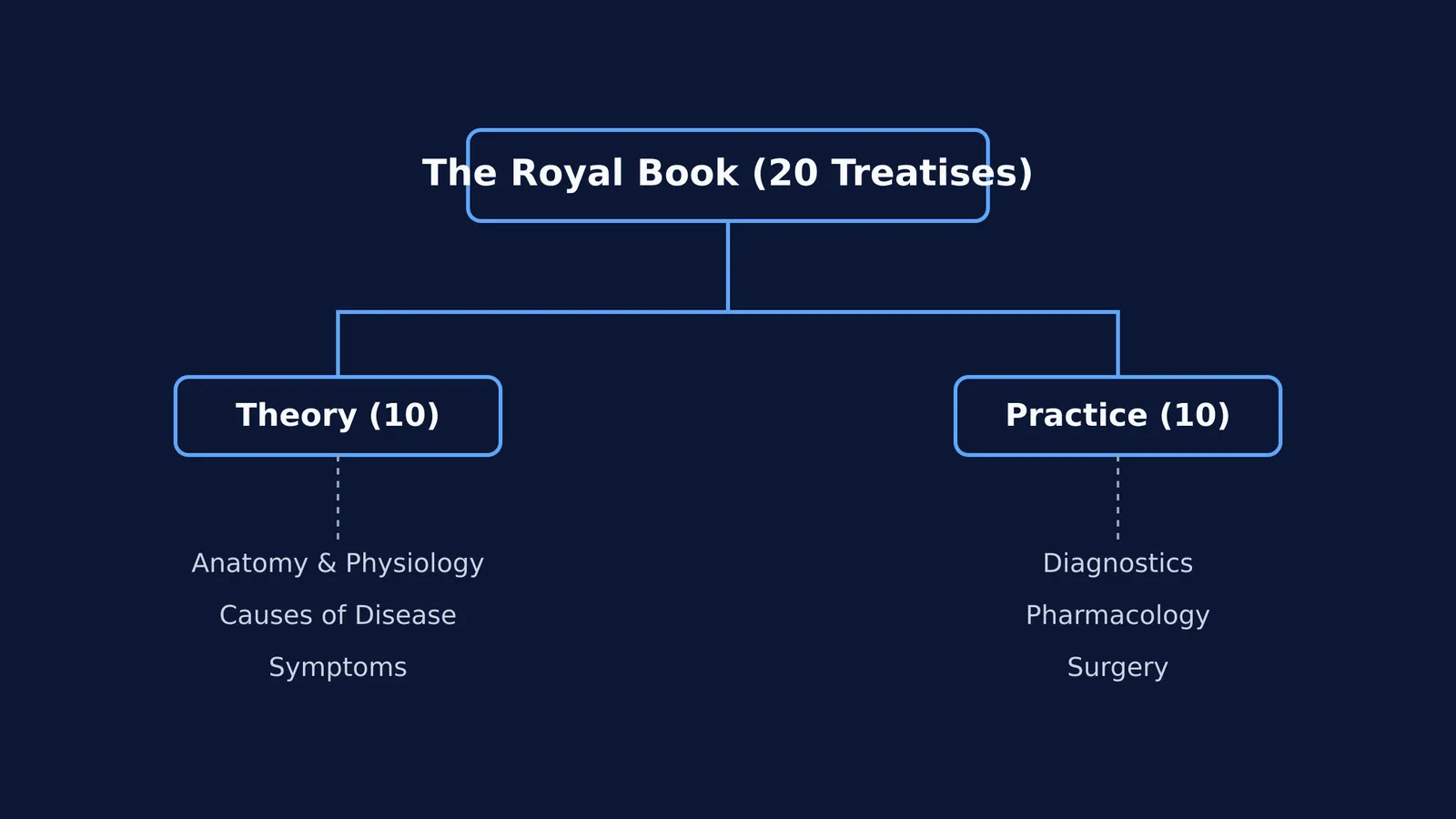
Al-Majusi realised that memory relies on structure. He divided his encyclopedia into exactly 20 treatises, splitting medicine neatly down the middle.
The first 10 treatises focused exclusively on medical theory. This section covered the fundamental principles of the human body, including detailed anatomy, physiology, and the domains of health and disease. The second 10 treatises focused on practical medicine. This half covered diagnostics, therapeutics, pharmacology, and surgical techniques.
By doing this, he created a framework where every fact had its place. You learned the theory first, and then you learned how to apply it in the real world. His clear, logical organisation made *The Royal Book* an instant success. It became the standard medical textbook in Europe and the Islamic world for over a century, and was translated into Latin twice (famously as the *Pantegni* by Constantine the African).
For a modern science student preparing for board exams, the historical lesson is clear: disorganised facts are incredibly hard to remember. You need a structure where ideas connect to each other logically. The Fermi Concept Library does exactly this, showing you every concept in physics, chemistry, and biology and its place in the map, rather than just giving you isolated facts to rote-learn.
Why did he insist on bedside observation?
Despite his emphasis on a structured theoretical foundation, Al-Majusi warned that theory alone is useless without practical experience. He insisted that students must spend time in hospitals, learning by doing and directly observing patients at the bedside.
His own careful bedside observation led to major medical discoveries centuries ahead of their time. In *The Royal Book*, he observed the contractions of the uterus and became the first to explain that the organ actively pushes the baby out during childbirth, refuting the ancient belief that the infant simply swims out on its own.
He was also a pioneer in neurosurgery and the treatment of trauma. In the 10th century, he provided some of the earliest detailed descriptions of surgical approaches to skull fractures, advocating for techniques that bridged ancient traditions and modern surgery. Through careful clinical observation, he even correlated the level of spinal injury with specific neurological deficits like paralysis of the limbs or loss of bowel control.
How can you apply Al-Majusi's method to your studies?
Al-Majusi's separation of theory and practice, and his insistence on doing both, is a powerful blueprint for your own study routine. Reading a textbook builds the map in your head, but "bedside observation" — solving actual numericals, attempting past papers, and using your mock test data to find weak spots — tests how well that map matches reality.
If you want to study like a master physician, follow this simple framework:
Build the foundation: Spend half your time understanding the core concepts from your textbooks and lectures. Do not skip the theory.
Test in practice: Spend the other half applying those concepts to unfamiliar problems. Never assume that understanding the theory means you can automatically solve the exam questions.
If you find yourself stuck when you try to move from theory to practice, Fermi's AI tutor can work out what you already know and build a plan for the session. It teaches you by explaining the reasoning rather than just printing an answer. This keeps you actively engaged, ensuring your theoretical knowledge successfully translates into real-world problem-solving skills.


