

On this page
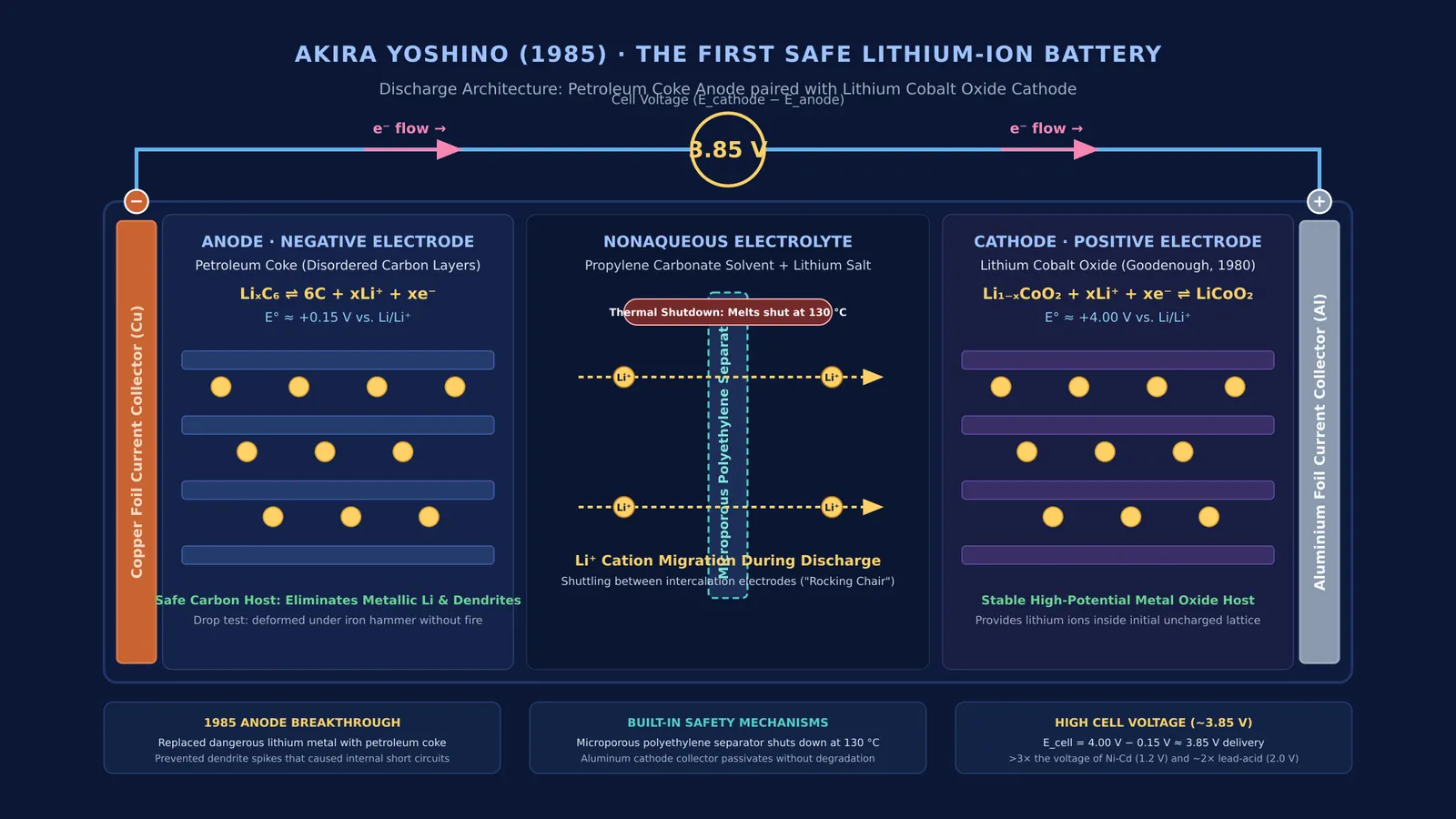
In 1985, Japanese chemist Akira Yoshino built a prototype cell at Asahi Kasei that transformed energy storage. For over a decade, scientists knew lithium was theoretically the best battery anode: it has the lowest standard reduction potential (−3.04 V vs. SHE) and a light atomic mass (6.94 g/mol). Yet every commercial attempt to make rechargeable batteries with pure metallic lithium had failed due to dangerous fires. Yoshino's breakthrough was replacing metallic lithium with a carbonaceous material: petroleum coke. By storing lithium as intercalated ions rather than reactive metal, he created the first practical lithium-ion battery (Yoshino, 2012).
Why did early rechargeable lithium batteries catch fire?
In 1976, M. Stanley Whittingham built the first functional rechargeable lithium cell at Exxon, pairing a titanium disulfide (TiS₂) cathode with a metallic lithium anode (Whittingham, 1976). The cell delivered roughly 2.0 volts. However, repeatedly recharging the cell caused lithium metal to deposit unevenly as microscopic, needle-like crystals called dendrites.
These conductive spikes grew across the electrolyte until they pierced the separator, creating an internal short circuit. Massive current surged through the contact point, causing rapid Joule heating that vaporised the organic solvents and triggered thermal runaway (Nobel Prize Popular Information, 2019). Early commercial trials in the 1980s ended in fires and product recalls, stalling development.
How did a carbon anode solve the lithium dendrite problem?
To stop dendrites, researchers needed to store lithium without forming pure metal. In 1980, John B. Goodenough's team at Oxford discovered that lithium cobalt oxide (LiCoO₂) could act as a stable cathode delivering roughly 4.0 volts vs. Li/Li⁺ (Mizushima et al., 198090012-4)). Crucially, LiCoO₂ contained lithium within its own crystal lattice, eliminating the need for metallic lithium foil in an uncharged cell.
Yoshino realised this enabled a metal-free anode. In 1985, after finding conductive polymers too bulky, he discovered that petroleum coke—a disordered carbonaceous byproduct of oil refining—could reversibly intercalate lithium ions between aromatic carbon layers without decomposing the carbonate electrolyte (Yoshino, 2012).
What happened during Yoshino's 1986 safety drop test?
In 1986, Yoshino took his prototype cells to an explosive-testing facility in Nobeoka, Japan (Nobel Prize Advanced Information, 2019). A heavy iron drop hammer was dropped directly onto the batteries to test extreme physical impact.
When the hammer struck conventional cells containing metallic lithium, they exploded violently. When it struck Yoshino's carbon-anode prototype, the battery deformed without catching fire or exploding. Yoshino later described this as "the moment when the lithium-ion battery was born" (Nobel Prize Popular Information, 2019).
Yoshino incorporated two further safety innovations into his 1985 design. He introduced a microporous polyethylene separator that melted shut if internal temperatures reached 130 °C, cutting off ion flow before thermal runaway could start. He also used aluminium foil for the positive current collector because it formed a protective oxide film at 4.0 volts. Yoshino filed the core patent on May 10, 1985 (Japanese Patent 1989293), which Sony commercialised in 1991.
How do you calculate cell voltage from half-reactions?
For students analyzing electrochemical cells in Class 12 and JEE Main, Yoshino's prototype follows a 4-step framework:
Cathode reduction: During discharge, Li₁₋ₓCoO₂ + xLi⁺ + xe⁻ ⇌ LiCoO₂ at roughly +4.0 V vs. Li/Li⁺ (Nobel Prize Advanced Information, 2019).
Anode oxidation: During discharge, LiₓC₆ ⇌ 6C + xLi⁺ + xe⁻ at roughly +0.15 V vs. Li/Li⁺.
Cell potential: E_cell = E_cathode − E_anode gives 4.0 V − 0.15 V ≈ 3.85 V.
Output comparison: At roughly 3.8 V, a single cell delivers over three times the 1.2 V of a nickel-cadmium cell and nearly twice the 2.0 V of a lead-acid cell.
Reviewing how electrode potentials of transition metals vary helps explain why cobalt produces high voltage. You can also practice using the electrochemical series to predict redox reactions and verify reaction stoichiometry with balancing redox reactions.
How can students master electrochemical concepts?
Mastering electrochemistry requires moving beyond memorising cell diagrams to understanding ion mobility and electrode equilibria. The Fermi Problem Library provides worked problems with a step-by-step solver that explains the reasoning rather than printing an answer. To observe lithium ions shuttling through separators rather than guessing from static textbook figures, the Fermi Simulation Lab offers interactive simulations for ideas that are easier to see than to read. When planning revision, Fermi's AI tutor can work out what you already know and build a plan for the session, so you sit down to a clear next step.


