

On this page
Geology is a science built on observation, and just as Arthur Holmes and the convection currents inside the Earth would later reshape our understanding of the planet's interior, mapping the history of the Earth required pioneers willing to hike through rugged terrain to read the story written in stone. One such pioneer was the British geologist Adam Sedgwick (1785–1873). His fieldwork helped establish the geological time scale, giving a name to a key chapter in the history of life on Earth.
How did Adam Sedgwick name the Cambrian period?
In 1835, Adam Sedgwick proposed the Cambrian system based on his extensive fieldwork in North Wales. He had spent the summer of 1831 examining ancient, fossil-poor strata that sat below the known geological layers of the time.
Because these rock sequences were most prominent in Wales, Sedgwick chose the name "Cambrian", derived from *Cambria*, the Latinized name for Wales. By classifying these rocks according to their physical structure and stratigraphic position (lithology), he successfully identified the oldest known sequence of sedimentary rocks. This broad view of Earth's systems is essential for understanding concepts like Vladimir Vernadsky and the biosphere: life as a geological force.
Understanding geological time can be challenging for students today. The Fermi Concept Library contains every concept in physics, chemistry, biology, mathematics and computing, each with its own lesson and its place in the map, helping you connect historical geology to modern biology.
What was the Great Cambrian-Silurian dispute?
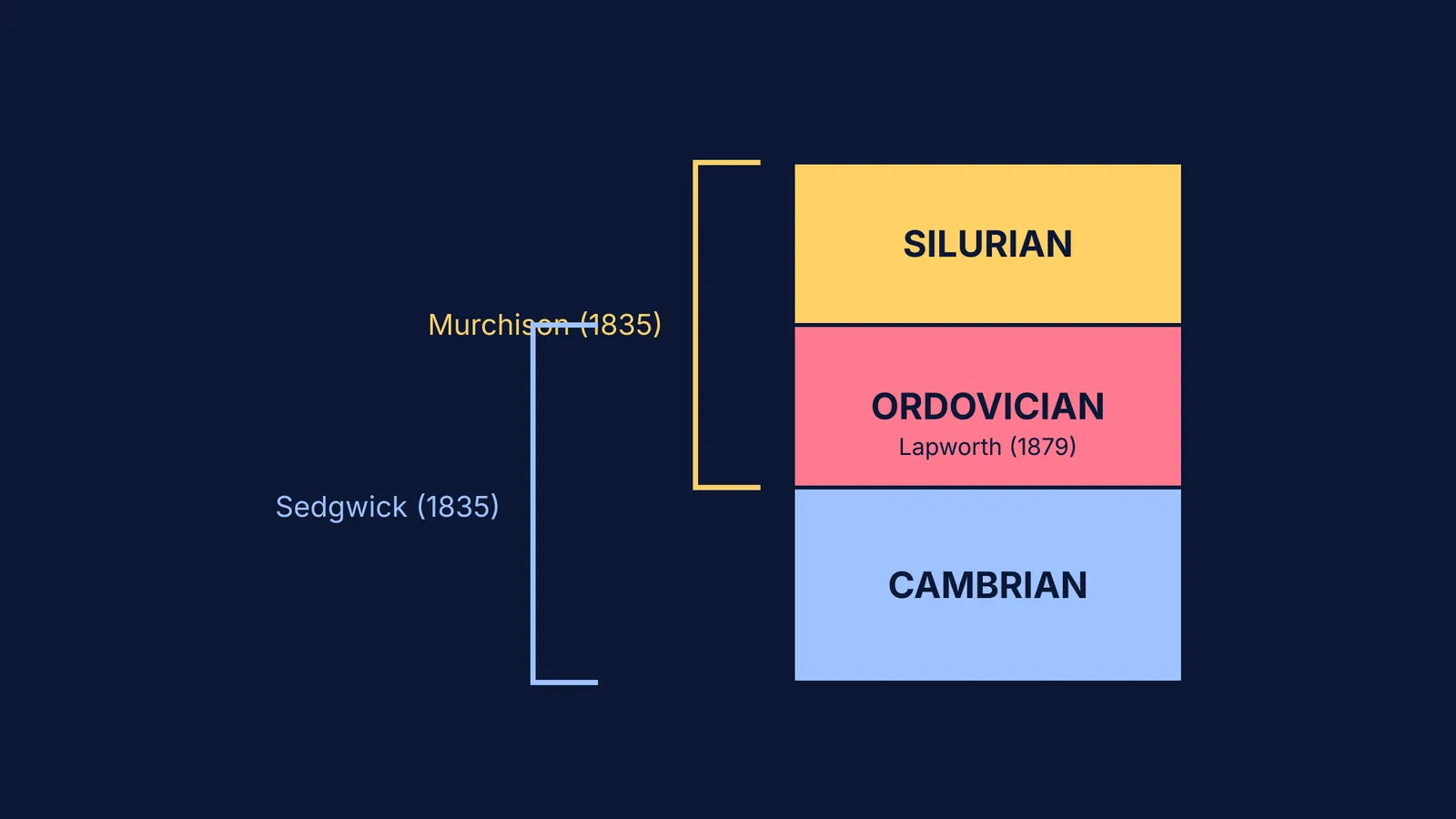
Sedgwick formally presented his Cambrian system in 1835 in a joint publication alongside his colleague Roderick Murchison. While Sedgwick proposed the Cambrian system for the older strata, Murchison proposed the Silurian system for a younger, fossil-rich layer of rocks.
Because Sedgwick's Cambrian rocks lacked clear fossils, he relied heavily on rock types. Murchison, however, used fossils to track his Silurian layer. As Murchison found his signature fossils deeper and deeper in the ground, he began to argue that Sedgwick's "Upper Cambrian" was actually part of the Silurian. This sparked a bitter, decades-long dispute that outlived both men.
The conflict was finally resolved in 1879 by the geologist Charles Lapworth. Lapworth realised that the overlapping rock layers contained a distinct set of fossils of their own. He proposed a third system—the Ordovician period—to sit neatly between the Cambrian and the Silurian.
Why are the Wales rocks important for biology?
Today, the Cambrian Period is officially recognised as the first period of the Paleozoic Era, lasting from approximately 538.8 to 486.85 million years ago. While Sedgwick’s original Welsh rocks were relatively sparse in fossils, his classification laid the groundwork for one of the most significant concepts in evolutionary biology: the Cambrian Explosion.
During this period, life on Earth underwent a rapid increase in fossil diversity that produced the first representatives of most modern animal phyla.
If you are trying to picture how sedimentary layers form or how these early organisms evolved, you can explore interactive simulations for the ideas that are easier to see than to read in the Fermi Simulation Lab.
How can you learn like a field geologist?
Sedgwick’s success came from active learning and direct observation rather than simply reading textbooks. When studying complex science topics, adopting a field geologist's mindset can transform how you prepare for exams or build a career in STEM:
Map the territory first: Before diving into details, look at the big picture. Sedgwick understood the overall sequence of rocks before worrying about microscopic differences.
Look for boundaries: Pay attention to where one concept ends and another begins, just like the transition from the Cambrian to the Ordovician rocks.
Record your observations: Keep a detailed notebook. Write down what you see, where you struggle, and the questions you need to ask.
When you hit a conceptual wall in your own studies, you don't have to figure it out alone. Fermi's AI tutor works out what you already know, builds a plan for the session, and teaches through it—writing on a board, drawing the figure, running the simulation, and checking understanding as it goes.


