

On this page
Vectors are usually introduced as arrows with a length (magnitude) and a way they point (direction). But this raises an immediate question: what happens if the length is zero? Does a zero vector still point somewhere?
Understanding the edge cases of vector algebra helps when setting up problems in mechanics or geometry. Let's look at what the zero vector actually is, and why physics draws a line between vectors tied to the origin and vectors that can slide.
Does the zero vector have a direction?
According to the NCERT Class 12 Mathematics textbook, a zero vector (or null vector) has zero magnitude, so it cannot be assigned a definite direction. Instead, its direction is mathematically considered arbitrary.
Because its length is zero, its initial point and terminal point are the same. It is essentially just a point on your graph. If an object is completely at rest, its velocity is the zero vector; asking which way it is not moving has no physical meaning.
In calculations, this arbitrary direction is actually useful. Since the zero vector has no fixed direction of its own, it can be treated as perpendicular or parallel to any other vector if a proof or a geometric rule requires it.
What is a position vector?
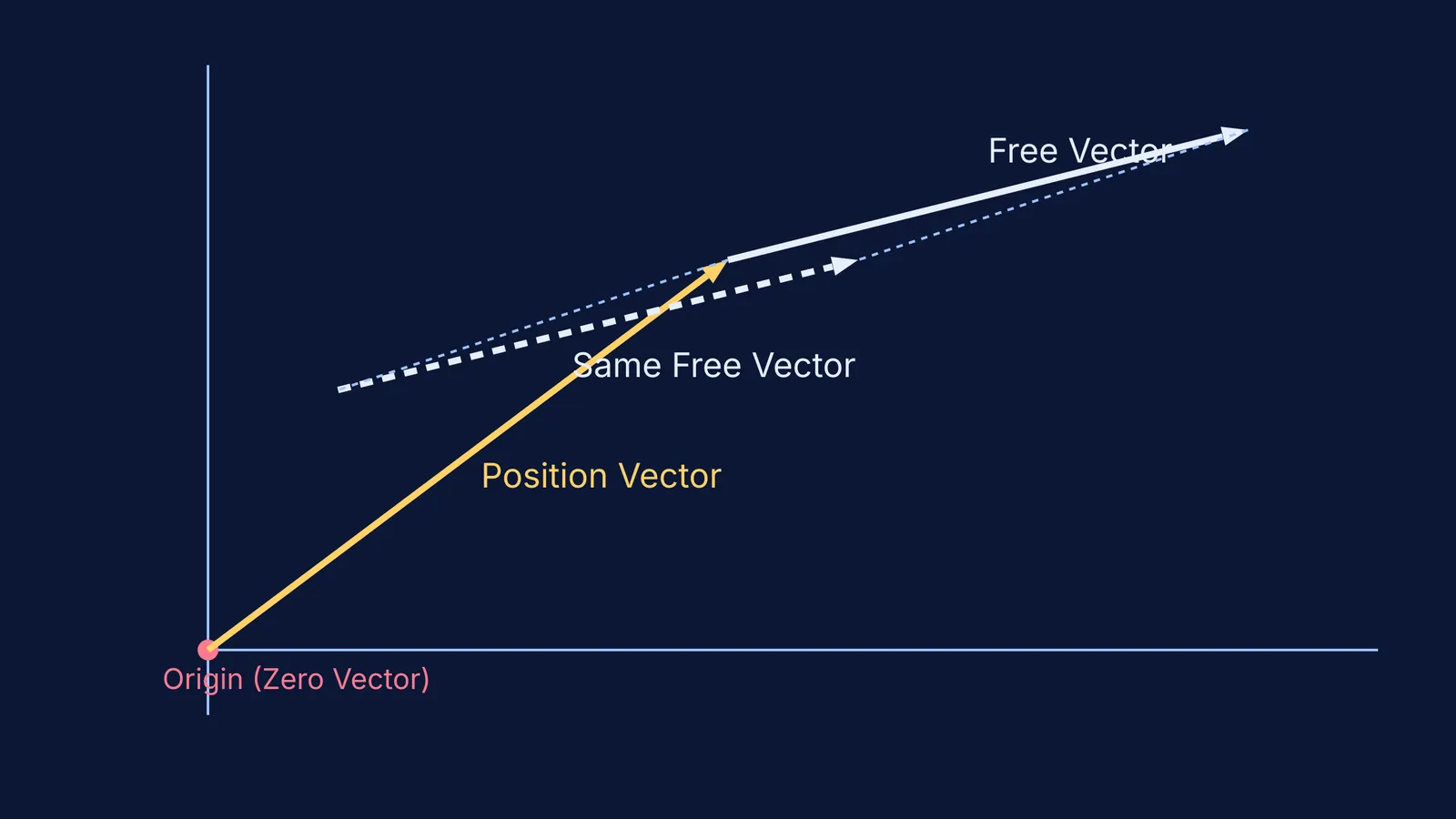
A position vector is used to pinpoint exactly where an object is in space. It is permanently tied to a chosen origin, usually (0,0,0).
If a particle is at coordinates (x, y, z), its position vector always starts at the origin and ends at that particle. You cannot move a position vector around without changing its meaning, because shifting its tail away from the origin would make it point to a different location in space. This makes it a "bound" or "localized" vector.
Free vectors that can slide
Most other vectors you meet in physics and mathematics—such as displacement, velocity, or acceleration—are free vectors.
The NCERT textbook notes that a free vector can undergo parallel displacement without changing its magnitude and direction. This means you can slide the arrow anywhere on your page or coordinate system. A wind blowing at 10 m/s due East is the exact same vector whether it blows in Delhi or Mumbai.
This sliding property is why the triangle law of vector addition works. To add two vectors, you just slide the tail of the second vector to the head of the first, without turning it or stretching it. If you find these sliding operations tricky to picture, the Fermi Concept Library maps out vector algebra with interactive lessons that let you see the geometry.
How do you test if two free vectors are equal?
Because free vectors can slide, two vectors are considered strictly equal if they share the exact same magnitude and direction, regardless of where they start.
For example, if a car travels from point A to point B covering 50 kilometres due North, its displacement is a free vector. If a second car travels from point C to point D covering 50 kilometres due North, its displacement is the exact same vector. In coordinate form, if both displacements are written as 50ĵ, they are mathematically identical. You do not need to know where the cars started to know their displacement vectors are equal.
This is a core assumption in most introductory physics. Unless a problem specifically deals with torques or rotating rigid bodies, you can assume every vector you are given—velocity, momentum, or electric field—is a free vector that you can shift to the origin to make the maths easier.
When does the difference matter?
If you mix up position vectors and free vectors, you will quickly run into trouble in mechanics. Here is a practical framework for keeping them straight:
Adding positions makes no sense: You can subtract two position vectors to find the displacement between them, which gives you a free vector. But adding two position vectors together has no physical meaning.
Where you apply force matters: While force is often treated as a free vector when calculating F = ma for a point mass, it becomes a *sliding vector* on an extended rigid body. Pushing a door at the hinge does not have the same effect as pushing the handle, even if the force vector has the same magnitude and direction.
Cross products depend on position: When calculating torque (τ = r × F), r is the position vector of the point where the force F is applied. You cannot slide r around, and you can only slide F along its own line of action.
Knowing which vectors you can slide and which ones you cannot will save you from the most common setup mistakes in physics. If you are preparing for exams like the JEE and want to spot these mistakes before you make them, review these common errors with vectors in JEE physics. Or, if you prefer to learn by doing, Fermi's AI tutor can work out what you already know and build a plan for the session, teaching you the rules of vector algebra by working through problems alongside you.


