

On this page
Why do two basic math patterns give opposite answers for 0⁰?
Ask a classroom to evaluate 0⁰, and two logical arguments collide immediately.
The first examines powers of zero: 0³ = 0, 0² = 0, and 0¹ = 0. Lowering the exponent toward zero suggests that 0⁰ should equal 0.
The second examines zero exponents: 3⁰ = 1, 2⁰ = 1, and 1⁰ = 1. Shrinking the base toward zero suggests that 0⁰ should equal 1.
These patterns clash at (0, 0). Because an exponent represents repeated multiplication, xⁿ represents multiplying the identity 1 by x for n factors. For n = 0, multiplying zero factors leaves the multiplicative identity 1. But when the base is 0, any multiplication by 0 yields 0. This structural clash is why mathematics avoids a single universal answer.
Why is zero raised to zero undefined in calculus limits?
In calculus, expressions describe dynamic limits rather than isolated static numbers. Here, 0⁰ represents a limit of the form f(x) raised to g(x), where both functions approach zero simultaneously.
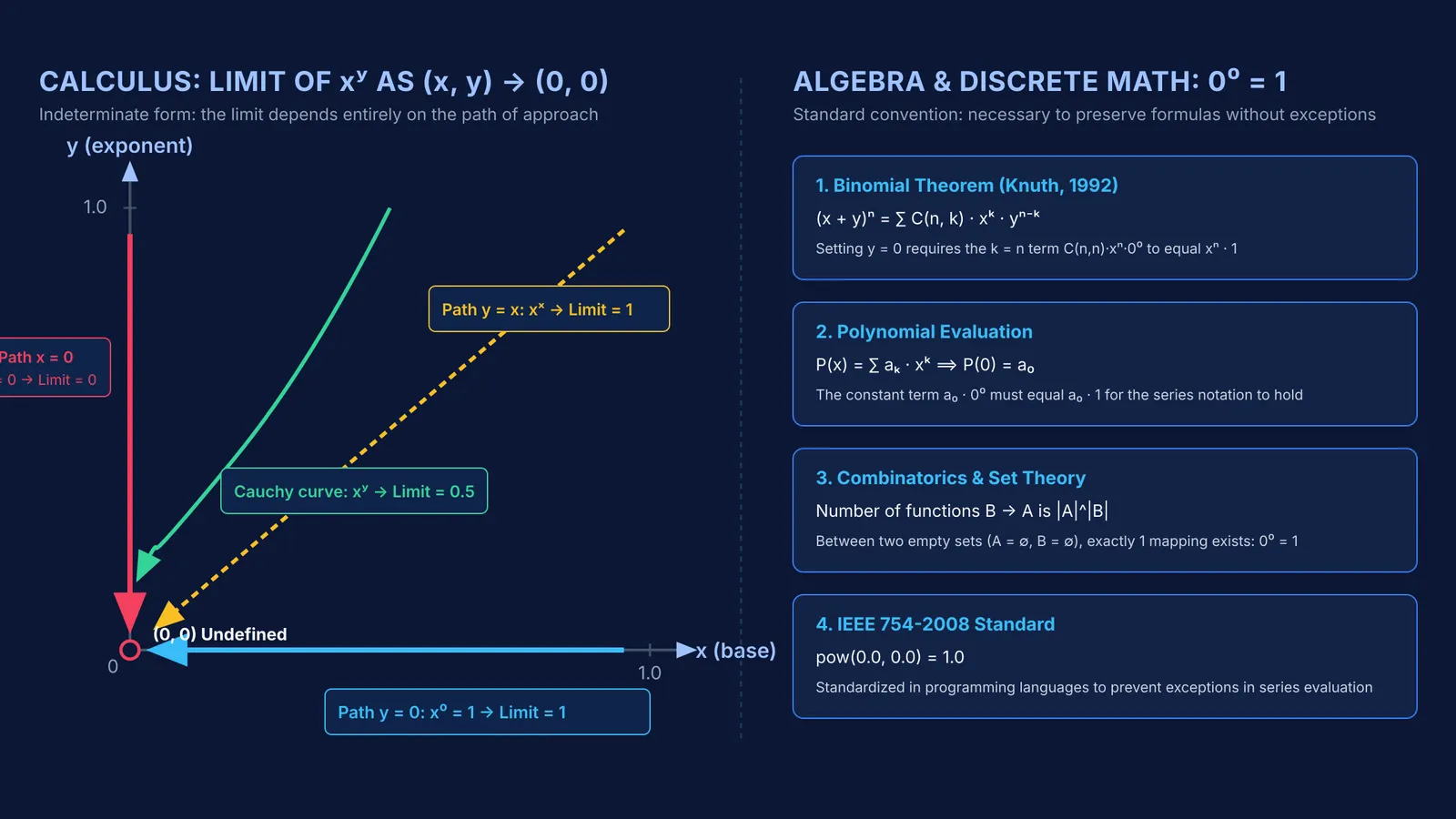
In his 1821 text Cours d'Analyse, French mathematician Augustin-Louis Cauchy classified 0⁰ among seven indeterminate forms alongside 0/0. Cauchy demonstrated that as the base and exponent both approach zero, the limit depends entirely on the path taken.
Consider how the limit changes with different functions:
If f(x) = x and g(x) = x as x approaches 0 from the right, the limit of x raised to x equals 1 because x ln(x) approaches 0.
If f(x) = 0 for positive x while g(x) = x, the expression is identically 0 raised to x, which stays 0 throughout, giving a limit of 0.
If f(x) = x and g(x) = a / ln(x) for any real constant a as x approaches 0 from the right, then f(x) raised to g(x) equals e raised to a. By choosing a, this limit can equal any positive real number.
Because different paths yield different limits, calculus cannot define a fixed value for 0⁰. When solving limits and continuity for JEE, you must treat 0⁰ as an indeterminate form that requires logarithms and L'Hôpital's rule, just like limits of the form 1^∞.
The Fermi Problem Library provides worked problems with a step-by-step solver that explains the reasoning rather than printing an answer.
Why must algebra and the binomial theorem treat 0⁰ as 1?
In algebra, combinatorics, and computer science, mathematics evaluates exact formulas rather than limiting paths. Here, leaving 0⁰ undefined creates widespread breakdown.
Computer scientist Donald E. Knuth defended this distinction in a 1992 paper in The American Mathematical Monthly, arguing that 0⁰ must equal 1 in discrete settings.
Consider the binomial theorem for JEE: (x + y)ⁿ = ∑ C(n, k) × xᵏ × yⁿ⁻ᵏ from k = 0 to n.
Setting y = 0 makes the left side (x + 0)ⁿ = xⁿ. On the right side, the final term where k = n is C(n, n) × xⁿ × 0⁰. If 0⁰ were undefined or 0, this formula would fail whenever x = 0 or y = 0. Defining 0⁰ = 1 keeps the expansion exact for all real inputs.
The same convention powers other branches of mathematics:
Polynomial evaluation: A polynomial P(x) = ∑ aₖ × xᵏ gives P(0) = a₀ only because a₀ × 0⁰ equals a₀ × 1.
Set theory: The number of functions from a set of size B to a set of size A is A raised to B. Between two empty sets, exactly one function exists (the empty mapping), giving 0⁰ = 1.
Software standards: The IEEE 754-2008 standard defines pow(0.0, 0.0) as 1.0, ensuring numerical programs evaluate polynomials without throwing unnecessary exceptions.
The Fermi Concept Library covers every concept in physics, chemistry, biology, mathematics and computing, each with its own lesson and its place in the map.
How should you handle 0⁰ in exam problems?
For CBSE and JEE Main questions, apply this three-step decision rule:
Identify limits: If a problem involves lim f(x) raised to g(x) where base and exponent both tend to 0, treat it as an indeterminate form. Never plug in 1 directly.
Apply logarithms: Set L equal to the limit, take the natural logarithm to obtain ln(L) = lim [g(x) × ln(f(x))], and rewrite the resulting 0 × (-∞) product as a quotient for L'Hôpital's rule.
Apply discrete rules: When expanding binomial series, differentiating polynomials, or counting combinations, set 0⁰ = 1 directly.
Knowing which setting applies resolves the debate and prevents lost marks on exam day.


