

On this page
In short
A non-zero number to the power of zero equals 1 because of the quotient rule of exponents. If you divide a number by itself, the rules say to subtract the exponents to get zero, but basic arithmetic tells us the result is 1. This logical necessity keeps algebra consistent.
When students first encounter algebra, the rules of exponents can feel like arbitrary laws memorised for a test. You learn that 2³ is 2 × 2 × 2, which makes intuitive sense. But then you are told that 2⁰ is 1, and 2⁻¹ is 1/2. Suddenly, exponents no longer mean "how many times to multiply the number by itself."
This shift often causes confusion during exam preparation, leaving students wondering if they have missed a critical step. However, the rule that a non-zero number to the power of zero equals 1 is not a random convention—it is a logical necessity that keeps the entire system of mathematics from breaking down.
Why is a power zero equal to 1?
To understand why a⁰ = 1, we have to look at the quotient rule of exponents. This rule states that when you divide two terms with the same base, you subtract their exponents: a^m / a^n = a^(m-n).
Imagine applying this rule when m and n are the same number, such as 3. If you have 2³ / 2³, the exponent rule gives you 2^(3-3), which simplifies to 2⁰.
However, basic arithmetic tells us that 2³ is 8. So, the expression is exactly the same as 8 / 8. Any non-zero number divided by itself is exactly 1. Because the rules of algebra must remain perfectly consistent with basic arithmetic, 2⁰ is forced to equal 1.
If this rule were anything else, algebra would fail. The French mathematician Nicolas Chuquet was among the first to recognise this mathematical necessity. In his 1484 manuscript Triparty en la science des nombres, he pioneered the use of zero and negative numbers as exponents, establishing a framework that allowed algebraic notation to scale accurately across all values (Wikipedia). This consistency ensures that formulas do not break down the moment they reach zero.
How do negative exponents work?
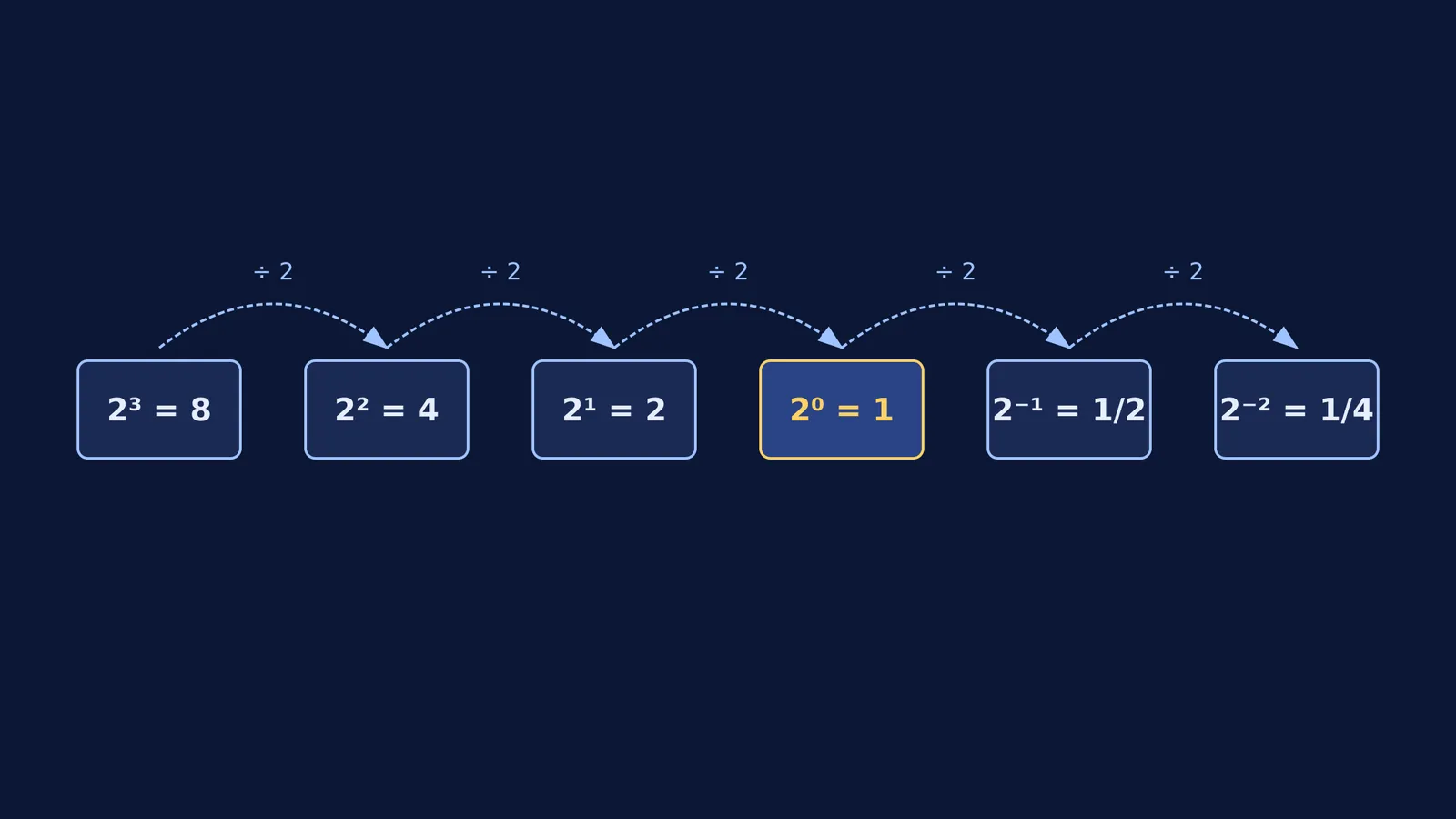
If you map out a sequence of powers, a clear arithmetic pattern emerges. Each time the exponent drops by 1, the overall value is divided by the base number. In base 10, which we use for scientific notation, this pattern is particularly clear:
10³ = 1000
10² = 100 (divide by 10)
10¹ = 10 (divide by 10)
10⁰ = 1 (divide by 10)
Following this exact pattern, dropping the exponent below zero means we continue dividing by the base:
10⁻¹ = 1/10 or 0.1
10⁻² = 1/100 or 0.01
A negative exponent does not result in a negative number; instead, it indicates division or a reciprocal. This continuous chain allows sequences to scale infinitely in both directions. For example, finding Aⁿ for a matrix by spotting the pattern relies on similar logic, where identifying the step-by-step sequence gives you the general rule. It is a fundamental property of mathematics that once a sequence is established, it must hold true forwards and backwards.
If you find yourself plugging in the wrong formula or losing track of these reciprocal relationships during practice, the Fermi Problem Library has worked problems with a step-by-step solver that explains the reasoning rather than printing an answer.
Why is 0⁰ undefined?
If a⁰ = 1, does that mean 0⁰ = 1 as well? At the school level, 0⁰ is left undefined because it creates a mathematical contradiction.
We have two clashing rules:
Any non-zero number to the power of 0 is 1.
Zero to any positive power is 0.
If you approach the problem using combinations and algebra, defining 0⁰ = 1 makes vital formulas like the Binomial Theorem function correctly. The computer scientist Donald Knuth strongly advocated in 1992 that 0⁰ must be exactly 1 to preserve these algebraic identities (Wikipedia).
However, in calculus and mathematical analysis, 0⁰ is considered an indeterminate form (Wikipedia). If you look at a function like x^y as both variables approach zero, the result changes depending on the path you take. Because no single value satisfies all limiting processes, analysts leave it undefined to prevent errors. Much like recovering aₙ from a formula for Sₙ, the right outcome depends on carefully handling the boundaries.
When mathematical rules feel disjointed or conflicting, taking a wider view helps. Exploring the Concept Library shows every concept in mathematics with its own lesson and its place in the map, helping you connect each formula to the broader rules of calculus and algebra instead of relying on rote memorisation. This clarity is often the difference between struggling with equations and confidently mastering them.


