

On this page
When you first study complex numbers for exams like the JEE, equations involving the complex conjugate, z̄, can look tricky. Standard polynomials behave predictably, but adding a conjugate changes the rules.
A classic example is the equation z² = z̄. At first glance, it looks like a quadratic, so you might expect it to have two roots. But because it contains the complex conjugate, it is not a standard polynomial equation. This allows it to have four distinct solutions in the complex plane.
To find them, we break the complex variable into its real and imaginary parts.
Why does z² = z̄ have four roots?
The Fundamental Theorem of Algebra states that every single-variable polynomial of degree n with complex coefficients has exactly n roots. Thus, a standard degree-2 polynomial like z² - z = 0 has exactly two roots: 0 and 1.
However, the equation z² = z̄ includes z̄, which is not an analytic function of z. Because it is not a polynomial in z, the Fundamental Theorem of Algebra does not limit its solutions to two.
How do we split the equation with z = x + iy?
The most reliable way to solve equations containing both z and z̄ is the Cartesian method. We start by solving equations in complex numbers by putting z = x + iy, where x and y are real numbers.
Substituting this into our equation gives: (x + iy)² = x - iy
Next, expand the left side using the binomial expansion and the fact that i² = -1: x² + i(2xy) + i²y² = x - iy x² - y² + i(2xy) = x - iy
For two complex numbers to be equal, their real parts must match, and their imaginary parts must match. Equating these gives us a system of two equations:
Real part: x² - y² = x
Imaginary part: 2xy = -y
How do you solve the real and imaginary equations?
We now solve this system algebraically. It is easiest to start with the second equation because we can factor it: 2xy + y = 0 y(2x + 1) = 0
This gives us two distinct cases to check: either y = 0, or 2x + 1 = 0 (which means x = -1/2). We must test both cases in the first equation.
Case 1: When y = 0
If y = 0, the complex number z has no imaginary part, so it is purely real. Substitute y = 0 into the first equation: x² - 0 = x x² - x = 0 x(x - 1) = 0
This gives x = 0 or x = 1. Since y = 0 in both cases, we have found our first two solutions:
z = 0 + 0i = 0
z = 1 + 0i = 1
Case 2: When x = -1/2
If x = -1/2, substitute this value into the first equation: (-1/2)² - y² = -1/2 1/4 - y² = -1/2
Rearranging this to solve for y²: y² = 1/4 + 1/2 y² = 3/4
Taking the square root gives two possible values for y: y = √3/2 or y = -√3/2
This gives us two more complex solutions:
z = -1/2 + i√3/2
z = -1/2 - i√3/2
Checking the roots with polar form
To verify this using polar coordinates, let z = r e^(iθ). Its conjugate is z̄ = r e^(-iθ).
Substituting these into z² = z̄ gives: r² e^(i2θ) = r e^(-iθ)
Equating the magnitudes (the moduli) on both sides: r² = r r² - r = 0 r(r - 1) = 0
This tells us that the distance from the origin is either r = 0 (which gives z = 0) or r = 1.
For the non-zero solutions where r = 1, we can equate the angles (the arguments): e^(i2θ) = e^(-iθ) e^(i3θ) = 1
This means 3θ must be a multiple of 2π. The three angles between -π and π that satisfy this are 0, 2π/3, and -2π/3. Converting these angles and r = 1 back to Cartesian form gives exactly 1, -1/2 + i√3/2, and -1/2 - i√3/2.
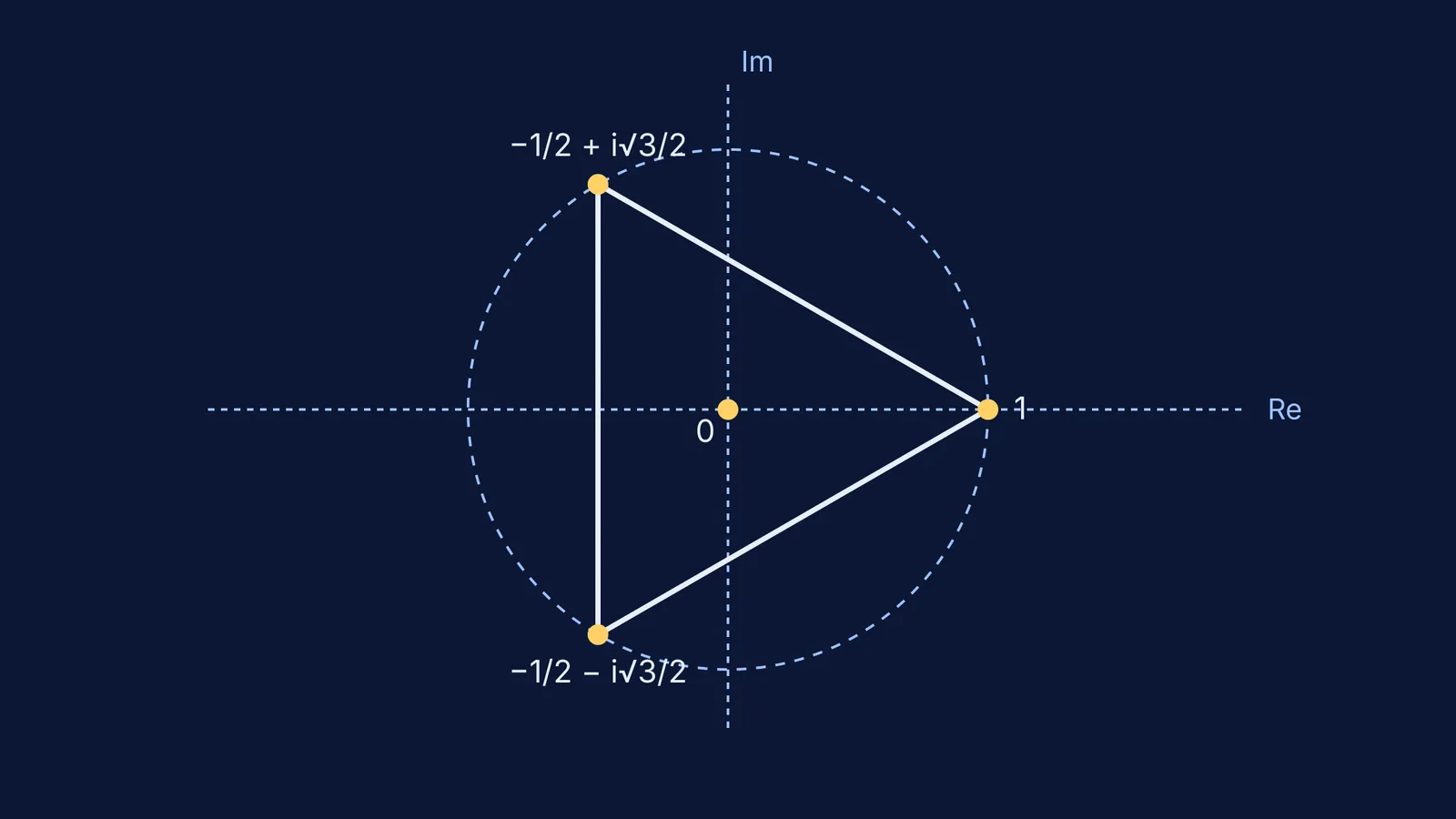
What do the four solutions look like on the Argand plane?
We have found all four roots of the equation z² = z̄:
0
1
-1/2 + i√3/2
-1/2 - i√3/2
The non-zero solutions are 1 and the two complex cube roots of unity. Graphed on the Argand plane, these three roots sit exactly on the unit circle. You can confirm their positions by finding arg z in each quadrant: the principal value rules. With arguments 0, 2π/3, and -2π/3, they form an equilateral triangle around the origin.
Breaking down equations into real and imaginary parts is a reliable tool for complex algebra, whether finding roots or applying the triangle inequality for complex numbers: max and min of |z|. To practise solving equations step-by-step, the Fermi Problem Library explains the reasoning behind each substitution.


