

On this page
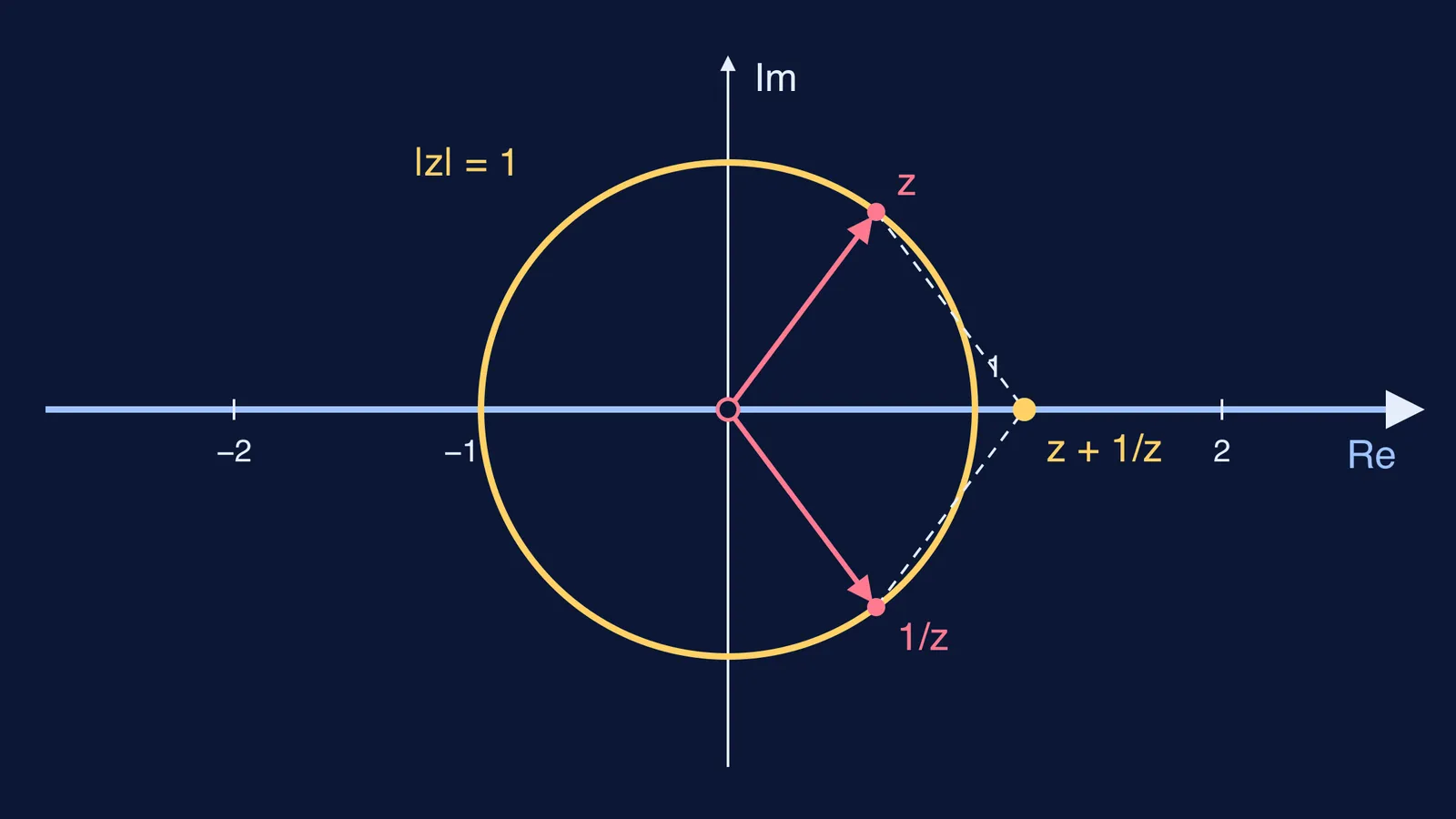
On the Argand plane, the answer is two sets joined by "or": the real axis without the origin, and the unit circle.
If z + 1/z is real, what does that tell you about z?
The proof needs three facts. The first two are in Section 4.4 of the NCERT Class 11 mathematics textbook (NCERT Mathematics Class 11, Chapter 4: Complex Numbers and Quadratic Equations).
The conjugate of z = a + ib is z̄ = a − ib, and z·z̄ = |z|².
The conjugate of a sum is the sum of the conjugates, and the conjugate of a quotient is the quotient of the conjugates.
A complex number equals its own conjugate exactly when its imaginary part is zero, that is, when it is real (Complex conjugate, Wikipedia).
You can check the third fact yourself: a − ib = a + ib forces b = 0. It turns "w is real" into an equation you can work with: w = w̄.
How do you prove it with the conjugate method?
Since z ≠ 0, 1/z exists. Call w = z + 1/z.
w is real exactly when w = w̄. Using the conjugate rules, that means z + 1/z = z̄ + 1/z̄.
Bring everything to one side: (z − z̄) + (1/z − 1/z̄) = 0.
Combine the fractions: 1/z − 1/z̄ = (z̄ − z)/(z·z̄) = −(z − z̄)/|z|².
Take out the common factor: (z − z̄)(1 − 1/|z|²) = 0.
A product is zero only when one factor is zero. Either z = z̄, so z is real, or |z|² = 1, so |z| = 1.
Every step works in both directions, so the converse holds too: any non-zero real z, and any z on the unit circle, makes z + 1/z real. On the unit circle there is a shortcut: z·z̄ = 1, so 1/z = z̄, and z + 1/z = z + z̄ = 2 Re z.
If step 5 is where you get stuck, the Fermi Problem Library has worked problems with a step-by-step solver that explains the reasoning rather than printing an answer.
Does the answer check out with real numbers?
Test four values:
z = 2: 1/z = 1/2, so z + 1/z = 5/2. Real, and z is real.
z = 3/5 + (4/5)i: |z| = 1, so 1/z = 3/5 − (4/5)i and z + 1/z = 6/5. Real.
z = 1 + i: 1/z = (1 − i)/2, so z + 1/z = 3/2 + i/2. Not real: z is not real and |z| = √2.
z = 2i: 1/z = −i/2, so z + 1/z = 3i/2. Not real.
The second check is the picture at the top of this post. For a point on the unit circle, 1/z is its mirror image in the real axis, so the two add up to a point on that axis.
Can you prove it without conjugates?
Yes, two ways, and both make good cross-checks in an exam.
Cartesian form. Write z = x + iy. Then 1/z = (x − iy)/(x² + y²), so the imaginary part of z + 1/z is y − y/(x² + y²) = y(1 − 1/(x² + y²)). It is zero when y = 0 or x² + y² = 1: the same two cases.
Polar form. Write z = r(cos θ + i sin θ). Then z + 1/z = (r + 1/r) cos θ + i(r − 1/r) sin θ. The imaginary part is zero when sin θ = 0 (z real) or r = 1.
The polar form also tells you which real values come out. On the unit circle, z + 1/z = 2 cos θ, which runs from −2 to 2. For real z, x + 1/x is at least 2 when x is positive and at most −2 when x is negative. Together, the two cases reach every real number.
What mistakes cost marks on this question?
Writing "z is real and |z| = 1". That describes only z = 1 and z = −1.
Cancelling (z − z̄) and keeping only |z| = 1. Watch for an option that says "|z| = 1 only": it is the answer this slip produces.
Forgetting z ≠ 0. The expression 1/z is undefined at the origin, which is why the origin is left out of the real-axis case.
Carrying the answer over to the "purely imaginary" version. If z + 1/z is purely imaginary, set w = −w̄. You get (z + z̄)(1 + 1/|z|²) = 0, and the second factor is never zero, so Re z = 0. That gives one case, not two.
If conjugates and the modulus still feel shaky, the Fermi Concept Library gives every mathematics concept its own lesson and its place in the map, so you can go back one step at a time.
Try this next: when is z/(1 + z²) real? Hint: flip it upside down, but check z = 0 and z = ±i separately.


