

On this page
Algebra problems often ask you to find the value of expressions like x³ + 1/x³ or x⁴ + 1/x⁴ given only the simple sum x + 1/x. This pattern appears constantly in algebra because the x and 1/x terms cancel each other out when multiplied.
Instead of trying to solve the quadratic equation to find the exact value of x—which is usually a messy number with square roots or imaginary parts—you can jump straight to the answers using standard algebraic identities. This relies on the same logic used when evaluating symmetric functions of roots without solving the underlying equation.
If x + 1/x = 3, how do you find the x cube terms?
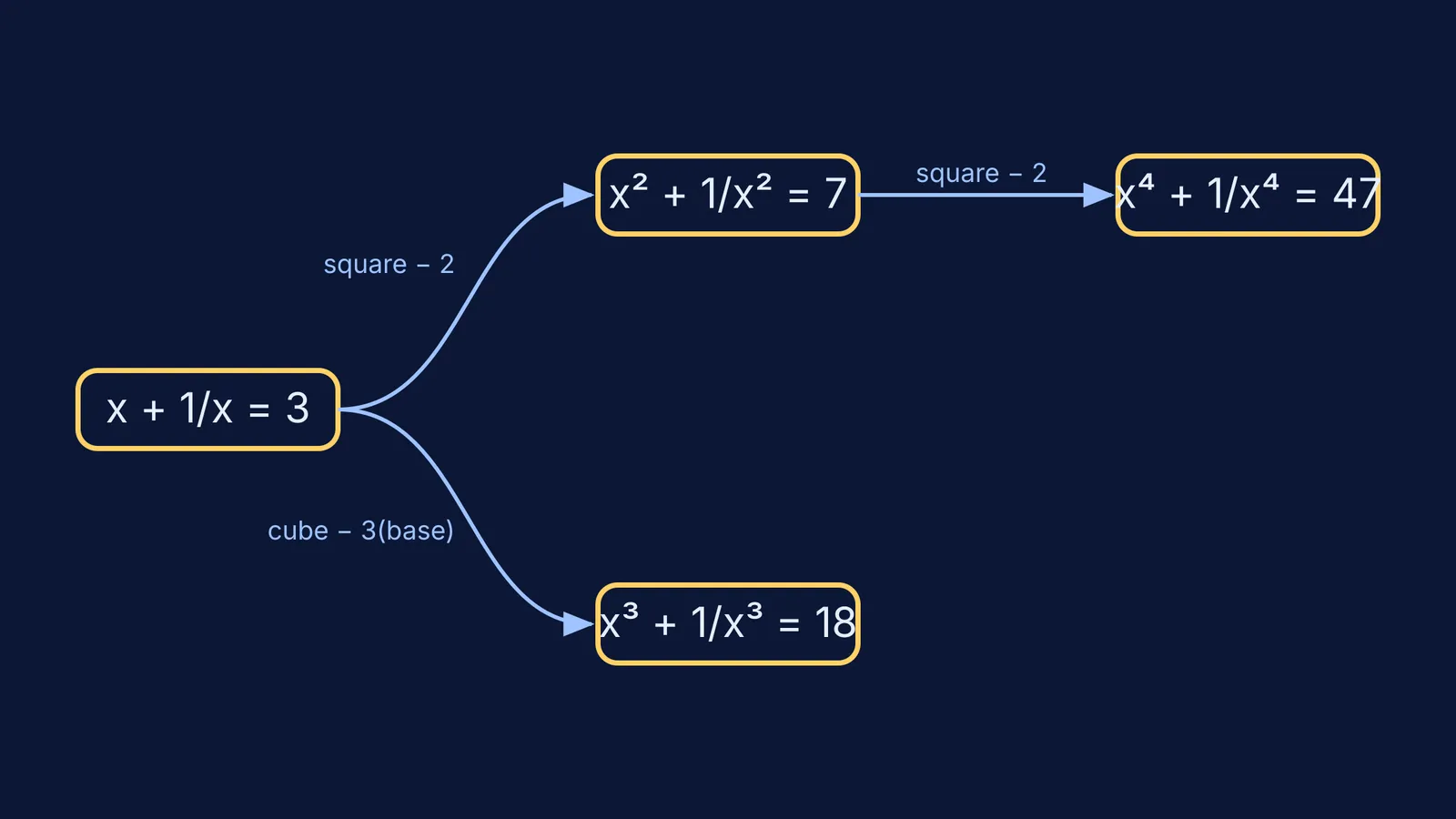
To find the x cube terms, you start by cubing both sides of the given equation. The algebraic identity for the cube of a sum is (a + b)³ = a³ + b³ + 3ab(a + b).
If you replace a with x and b with 1/x, the product term (x)(1/x) cancels out to 1. This simplifies the identity to: (x + 1/x)³ = x³ + 1/x³ + 3(x + 1/x)
By substituting x + 1/x = 3 into this formula, the calculation becomes a simple arithmetic step: 3³ = x³ + 1/x³ + 3(3) 27 = x³ + 1/x³ + 9 x³ + 1/x³ = 18
This approach works for any starting number. You cube the given sum and subtract three times the given sum.
How do you calculate x² + 1/x² and x⁴ + 1/x⁴?
For the even powers, you use the squaring identity (a + b)² = a² + b² + 2ab. Again, because x and 1/x multiply to 1, the formula simplifies perfectly.
1. Finding the square Squaring x + 1/x gives: (x + 1/x)² = x² + 1/x² + 2(x)(1/x) (x + 1/x)² = x² + 1/x² + 2
If x + 1/x = 3, substitute that value in: 3² = x² + 1/x² + 2 9 = x² + 1/x² + 2 x² + 1/x² = 7
2. Finding the fourth power Once you have the value for x² + 1/x², you can repeat the exact same trick to build x⁴ + 1/x⁴. Treat x² as your new base term and square both sides again: (x² + 1/x²)² = x⁴ + 1/x⁴ + 2(x²)(1/x²) (x² + 1/x²)² = x⁴ + 1/x⁴ + 2
Substitute the 7 we found earlier: 7² = x⁴ + 1/x⁴ + 2 49 = x⁴ + 1/x⁴ + 2 x⁴ + 1/x⁴ = 47
When learning these sequential steps, it helps to see how each power is built. The Fermi Problem Library has a step-by-step solver that explains the reasoning, letting you trace the logic without losing the thread of the calculation.
What about the x − 1/x version and its sign ambiguity?
A common variation of this problem asks you to find the value of the difference, x − 1/x, instead of the sum. You can link the sum and difference by comparing their squares.
Notice the difference between the two identities: (x + 1/x)² = x² + 1/x² + 2 (x − 1/x)² = x² + 1/x² − 2
Because we already know that x² + 1/x² = 7, we can substitute that into the second equation: (x − 1/x)² = 7 − 2 = 5
To find x − 1/x, take the square root of both sides. However, introducing a square root creates a sign ambiguity: x − 1/x = ±√5
Both positive and negative √5 are mathematically correct answers unless the problem gives you extra information, such as stating that x is greater than 1, which would force the answer to be positive.
A framework for higher powers
You can keep combining these terms to reach any power, just as you might expand algebraic expressions using the binomial theorem. For example, if you need to find x⁵ + 1/x⁵, you can multiply the square and cube results together: (x² + 1/x²)(x³ + 1/x³) = x⁵ + 1/x⁵ + x + 1/x
Using our previous answers for x + 1/x = 3: (7)(18) = x⁵ + 1/x⁵ + 3 126 = x⁵ + 1/x⁵ + 3 x⁵ + 1/x⁵ = 123
This algebraic stepping-stone method is a reliable tool in competitive mathematics. It shifts the problem away from solving for ugly roots and turns it into a clean sequence of multiplications and subtractions.


