

On this page
When you study the classic simple pendulum in physics, you calculate heights, speeds and energy transformations. The bob falls, gravity does work, and potential energy converts into kinetic energy. But there is another force acting on the bob at every moment: the tension in the string.
Despite pulling on the bob continuously as it swings, tension is always left out of your conservation of energy equations. Why? Because the work done by tension in this system is exactly zero.
What is the work done by tension in a pendulum?
In physics, work is zero when a force acts perpendicular to the direction of displacement. The definition of work (W) is the force (F) multiplied by the displacement (d) and the cosine of the angle (θ) between them: W = F · d · cos θ. This mathematical relationship dictates whether a force transfers energy.
If you carefully map the forces on a swinging pendulum bob, the reason tension drops out of the energy equation becomes clear:
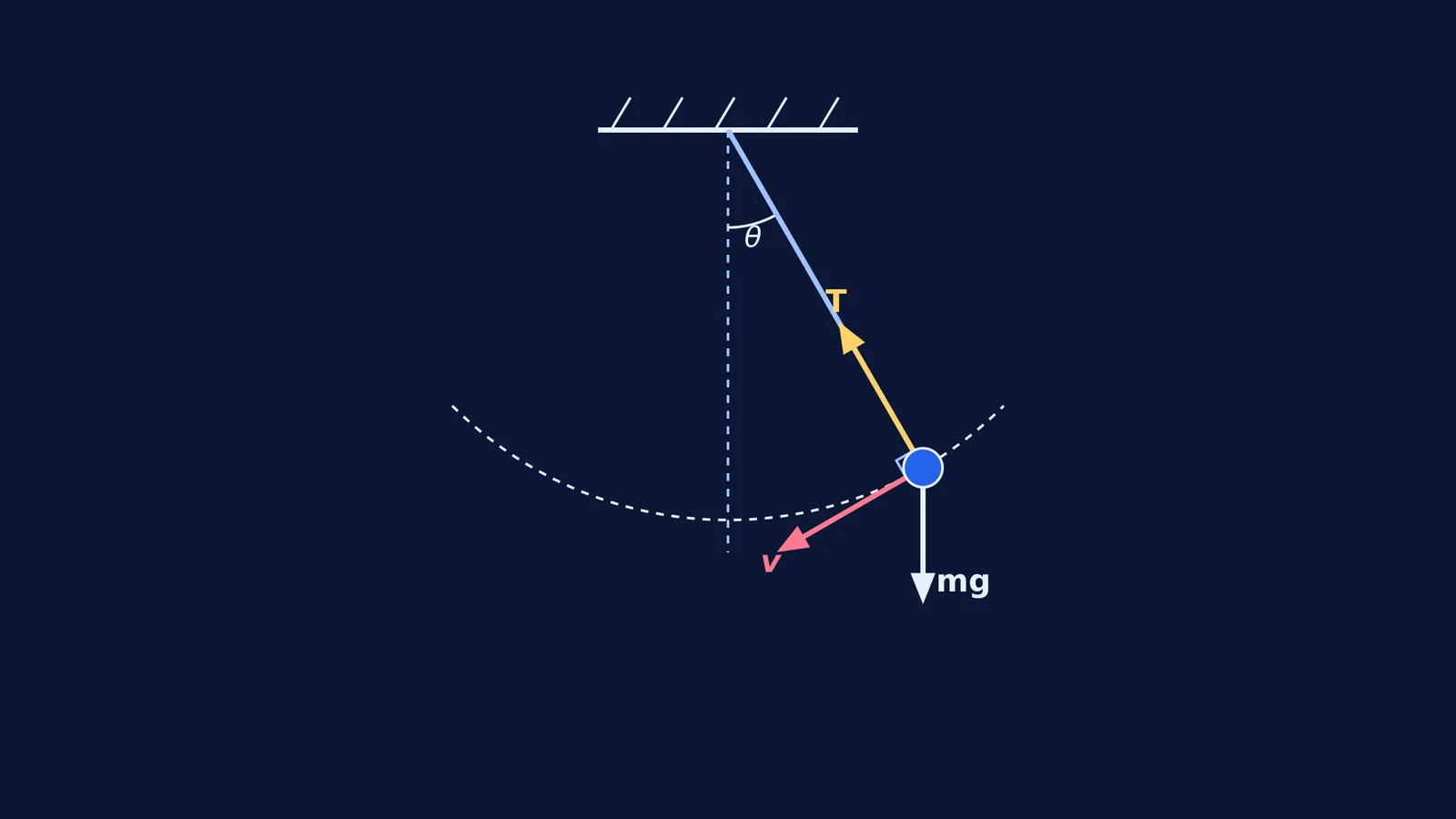
Direction of motion: The bob moves along a circular arc. At any single moment, its velocity (the direction of its instantaneous displacement) is tangent to that arc.
Direction of tension: The string pulls the bob directly toward the fixed pivot point. This force acts radially, straight along the line of the string.
The 90° angle: A radius and a tangent line to a circle are always mathematically perpendicular to each other.
Because the angle between the tension vector and the displacement vector is always exactly 90°, and cos 90° = 0, the equation yields zero work. No matter how heavy the bob is or how fast it swings, tension does no work on it.
If tension does no work, what does it actually do?
Forces that do work transfer energy. When gravity pulls the pendulum bob downward, it adds kinetic energy to the system. As the bob swings back upward against gravity, gravity does negative work, slowing the bob down.
Tension, on the other hand, acts strictly as a centripetal force. Its only job is to change the *direction* of the bob's velocity, forcing it to continuously curve along the circular arc rather than flying off in a straight line. Because tension acts at a right angle to the motion, it does not change the *magnitude* of that velocity (the speed). Since the speed is unaffected by the tension force, the kinetic energy (½mv²) is also unaffected.
This distinction is a common trap in JEE and NEET kinematics problems. When students map the forces on a free-body diagram, they often assume every force present must be put into the energy conservation equation. By separating forces that do work (like gravity) from forces that just steer the object (like tension or a normal force), you avoid adding unnecessary terms to your calculations. If you are struggling to build a clear map of these ideas, the Fermi Concept Library groups topics so you can trace how work, kinetic energy, and circular motion intersect.
How do you find the tension if it does no work?
Because tension does not appear in the work-energy theorem, you cannot find it by setting initial energy equal to final energy. Instead, you must use Newton's second law for circular motion.
The net force acting toward the center of the circle must equal the mass of the bob times its centripetal acceleration (mv²/L). At any angle θ from the vertical, the component of gravity acting away from the pivot is mg cos θ. Therefore, the tension T must support this outward component of gravity while also providing the inward centripetal force to keep the bob on its path:
T − mg cos θ = mv²/L
T = mg cos θ + mv²/L
You still need the work-energy theorem to find the speed (v) at that specific point, but the tension itself is calculated purely from the forces. For more on this derivation, review how to find the simple pendulum string tension at any angle.
A checklist for energy conservation problems
You can apply this exact same logic to other constraints in mechanics. When you set up an energy conservation equation for a new problem, always check the angle of the constraint forces.
Identify the force: What is pushing or pulling the object?
Find the displacement: Which way is the object moving right now?
Check the angle: Is the angle exactly 90°? If so, drop the force from your work equation.
This pattern appears everywhere in physics, simplifying many complex setups:
Normal force on a smooth track: When a cart moves along a smooth curved track, the normal force points directly away from the track surface, perpendicular to the cart's forward motion. It does no work.
Magnetic force on a moving charge: A magnetic field pushes a moving electron perpendicular to its velocity. The field changes the electron's path but does no work.
Tension in a uniform circular orbit: Swinging a stone on a string in a flat horizontal circle takes effort from your hand, but the string's tension itself does no work on the stone.
When solving dynamics problems, taking a moment to eliminate the perpendicular forces simplifies the mathematics significantly. If you are unsure which forces to drop, setting up the problem in the Fermi Problem Library allows the AI tutor to walk you through the free-body diagram before you start writing equations. This ensures you only track the forces that actually transfer energy.
If you are dealing with a more complex pendulum setup where the pivot itself moves or the environment changes, you might also want to read what happens to a charged pendulum in an electric field.


