

On this page
Frictional energy losses account for approximately 20% of the total energy expenditure of the world (Wikipedia). When hauling materials up a slope or braking a car down a hill, separating the work done against this friction from the work done against gravity is a standard milestone in mechanics.
What is the work done against friction on a rough inclined plane?
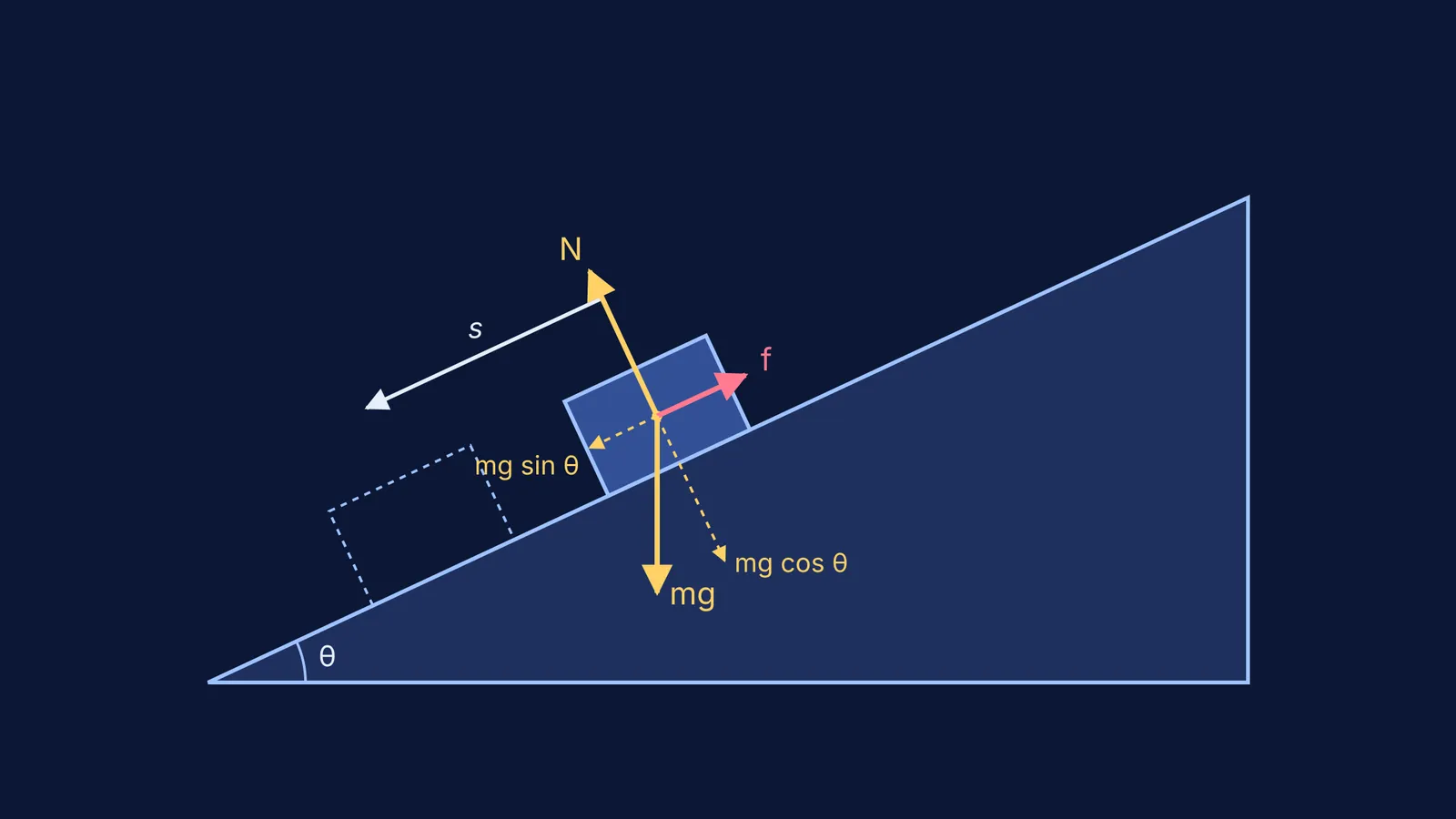
When a block of mass m slides a distance s along a rough inclined plane at an angle θ, it faces a kinetic friction force. Friction always acts in the opposite direction to the slide. Because the normal force N pressing the block into the slope is only a component of gravity (mg cos θ), the friction force f is μmg cos θ, where μ is the coefficient of kinetic friction.
Friction is a non-conservative force because the work done by friction depends entirely on the length of the path taken. The work done against this friction is the mechanical energy dissipated as thermal energy.
Work against friction = μmg cos θ × s
Notice that this is not necessarily the total work required to move the block. The total work also depends on whether you are lifting the mass against gravity.
How does the total work differ when moving up versus sliding down?
A common trap in exams is mixing up the work against friction with the work against gravity. Let us separate them clearly.
Work against gravity: mg sin θ × s. (This is equivalent to mgh, where h is the vertical height gained).
Work against friction: μmg cos θ × s.
If you push the block up the plane at a constant speed, you must supply energy to beat both gravity and friction.
Total work = Work against gravity + Work against friction Total work = (mg sin θ + μmg cos θ)s
If the block is sliding down the plane, gravity is doing positive work, but friction is still removing energy from the system. The work done *against* friction remains the same (μmg cos θ × s). This energy is permanently lost as heat, which makes it an irreversible thermodynamic process.
If setting up these components trips you up, the Fermi Problem Library has worked problems with a step-by-step solver that explains the reasoning rather than printing an answer. You can also review how friction interacts with the normal force for any angle in the Fermi Concept Library.
How do you calculate work against friction in a worked example?
Suppose a 10 kg crate is pushed 5 m up a rough ramp angled at 37°. The coefficient of kinetic friction μ is 0.3. (Use g = 9.8 m/s², sin 37° ≈ 0.60, cos 37° ≈ 0.80).
First, find the work done against friction: Work against friction = μmg cos θ × s = 0.3 × 10 × 9.8 × 0.80 × 5 = 29.4 × 0.80 × 5 = 117.6 Joules.
Next, find the work done against gravity: Work against gravity = mg sin θ × s = 10 × 9.8 × 0.60 × 5 = 294 Joules.
The total work you must do to push it up at a constant speed is the sum of both: 117.6 + 294 = 411.6 Joules.
If you let the crate slide back down those same 5 metres, it will lose another 117.6 J to friction. You can use this remaining net energy to find the time for a block to slide down a rough incline.
A checklist for inclined plane problems
When calculating work on a slope, follow these steps before plugging numbers into a formula:
Identify the displacement: Is the block moving up or down? Friction will point the opposite way.
Resolve gravity: Split mg into the perpendicular component (mg cos θ) and the parallel component (mg sin θ).
Find the normal force: Unless an external force is pressing down on the block, N = mg cos θ.
Calculate friction: Kinetic friction f = μN.
Multiply by distance: Work against friction is the energy lost to heat (f × s). The work done *by* friction is formally written as negative (−f × s), but the work *against* it is a positive amount of energy spent.
Understanding this split prevents sign errors and prepares you to handle more complex systems, such as calculating the minimum force to drag a block on a rough floor.


