

On this page
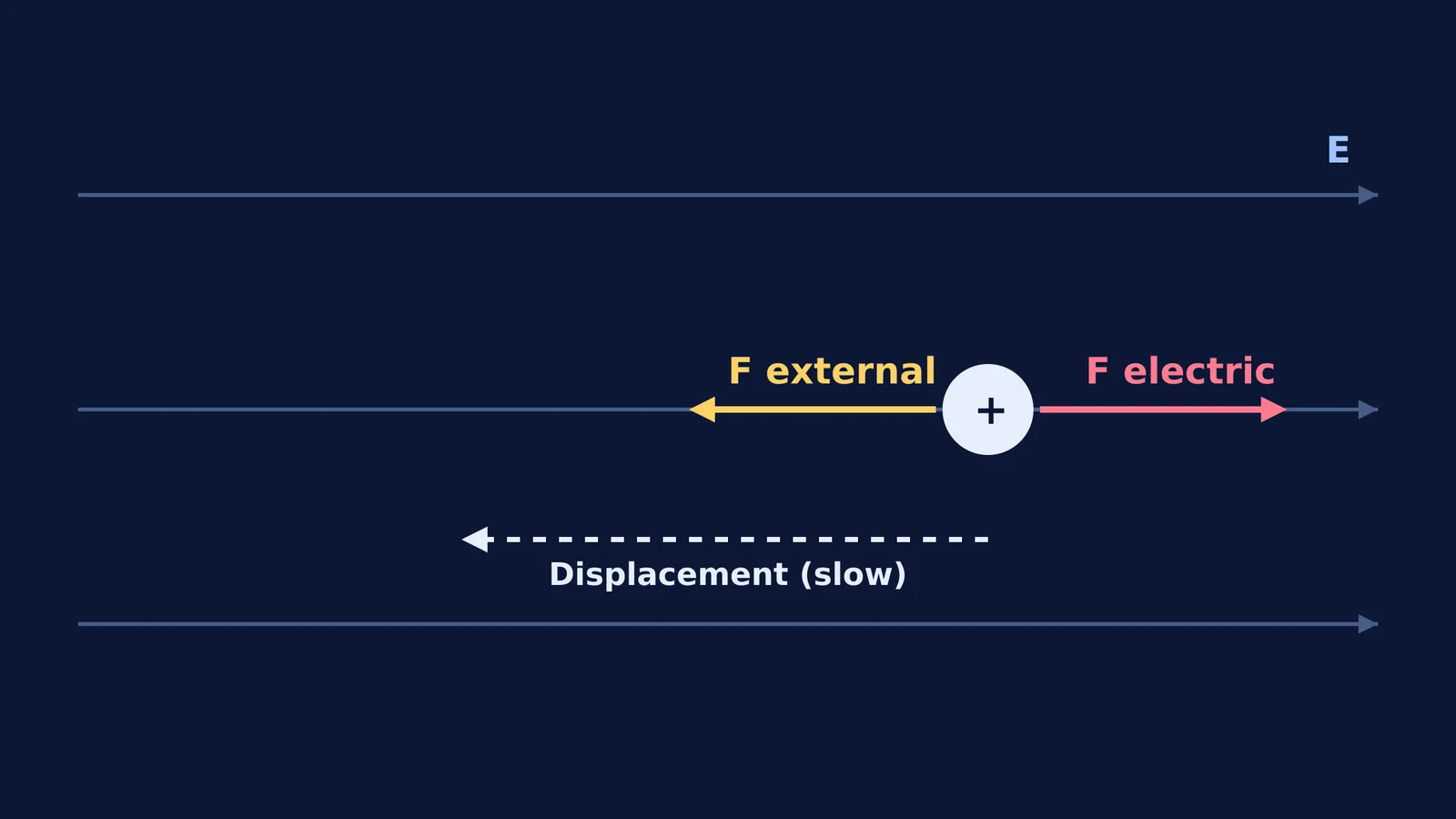
When you move a charge slowly from point A to point B, you are keeping its kinetic energy constant. Because the charge does not speed up or slow down, the change in kinetic energy is zero, meaning the total work done by all forces must add up to zero. To do this, the external force you apply must be equal and opposite to the electric force at every step: F_ext = −F_E (1/Book%3A_University_Physics_II_-_Thermodynamics_Electricity_and_Magnetism_(OpenStax)/07%3A_Electric_Potential/7.02%3A_Electric_Potential_Energy)).
Because work is force multiplied by displacement, the work done by the external agent is exactly the opposite of the work done by the electric field: W_ext = −W_field.
This relationship is a frequent stumbling block in electrostatics problems because textbooks sometimes ask for "the work done" without specifying who is doing it. If an exam question does not name the actor, it usually implies the external agent. Let's break down exactly what happens when each of these forces does the pushing.
When does the electric field do work?
The electric field is a conservative force field. The work it does depends only on the start and end points, and it is defined as the negative of the change in electrical potential energy (ΔU), which means W_field = −ΔU (1/Book%3A_University_Physics_II_-_Thermodynamics_Electricity_and_Magnetism_(OpenStax)/07%3A_Electric_Potential/7.02%3A_Electric_Potential_Energy)).
You can think of the field's work as the natural tendency of the system.
Positive work: If the field moves a positive charge naturally from a high potential to a low potential, the field's force and the charge's displacement are in the same direction. The field does positive work. Because W_field = −ΔU, the system loses potential energy. This lost energy usually turns into kinetic energy as the charge accelerates.
Negative work: If the charge is forced to move against the field's pull (like moving up a potential gradient), the field's force points backward while the charge moves forward. The field does negative work, which means the potential energy of the system increases.
How does the external agent do work?
When you (the external agent) step in to push a charge against the field, you are actively storing energy in the system. Because your force balances the field to keep the charge moving slowly, the work you do goes directly into increasing the potential energy: W_ext = ΔU (1/Book%3A_University_Physics_II_-_Thermodynamics_Electricity_and_Magnetism_(OpenStax)/07%3A_Electric_Potential/7.02%3A_Electric_Potential_Energy)).
Positive work: If you push a positive charge toward another positive charge, your pushing force and the movement are in the exact same direction. You do positive work. All of your effort goes into the system, and the potential energy of the system increases.
Negative work: Imagine slowly lowering a positive charge toward a negative one. The electric field wants to pull it in rapidly, but you have to hold it back to keep it from accelerating. Your restraining force points away from the movement, so the angle between your force and the displacement is 180°. You do negative work, and the system's potential energy decreases.
How to get the signs right in exams?
When you face a question about work and potential in JEE or NEET, using a systematic approach is safer than trying to guess the sign. Here is a reliable framework to avoid sign errors:
Identify the actor: Is the question asking for W_field or W_ext? If it just says "Find the work required to move...", assume it is the external agent.
Find the change in potential: Calculate the change in potential between the two points as ΔV = V_final − V_initial.
Apply the rule: For an external agent, the work is W_ext = q(V_final − V_initial). For the electric field, the work is W_field = −q(V_final − V_initial).
Let's look at a quick example. Suppose you move a +2 C charge from a point where the potential is 10 V to a point where the potential is 50 V. The change in potential is ΔV = 50 V − 10 V = +40 V.
The work done by you (the external agent) is W_ext = (+2 C)(+40 V) = +80 Joules. You did positive work to force the charge up the potential hill.
The work done by the electric field is W_field = −(+2 C)(+40 V) = −80 Joules. The field opposed the motion.
What if the charge is negative? Suppose you move a −2 C charge through the same +40 V potential difference. The work done by the external agent is W_ext = (−2 C)(+40 V) = −80 Joules. The negative charge naturally moves toward higher potential, so you must hold it back. The electric field does +80 Joules of work.
If you still find yourself putting minus signs in the wrong place, the Fermi Concept Library can help. Fermi's AI tutor works out what you already know and builds a plan for the session, writing on a board and checking your understanding as it goes. It will give you a clear next step instead of leaving you to memorise sign conventions.
By keeping the agent and the field separate in your head, you can link the mathematics to the physical reality of where the energy is stored. This turns a confusing sign convention into a logical consequence of energy conservation.


