

On this page
Why does the standard permutation formula fail for EXAMINATION?
When asked to find the number of 4-letter words from a word with repeated letters, a common mistake is plugging numbers directly into ⁿPᵣ or attempting to divide by duplicate factorials in one step. According to the CBSE Senior Secondary Mathematics Curriculum, permutations of n objects where p items are identical require dividing n! by p! only when arranging all n items together.
Choosing a smaller subset—such as 4 letters from 11—breaks that direct approach. The number of arrangements depends on which letters you select:
Four distinct letters arrange in 4! = 24 ways.
Two identical and two distinct letters arrange in 4! / 2! = 12 ways.
Two pairs of identical letters arrange in 4! / (2! × 2!) = 6 ways.
Because the arrangement factor changes with the repetition pattern, you cannot count everything with a single formula. You must first select the letters (combination) and then arrange them (permutation) across mutually exclusive cases. For arranging all letters at once, see arranging letters with repeats using the MISSISSIPPI method.
How do you inventory the letters before counting?
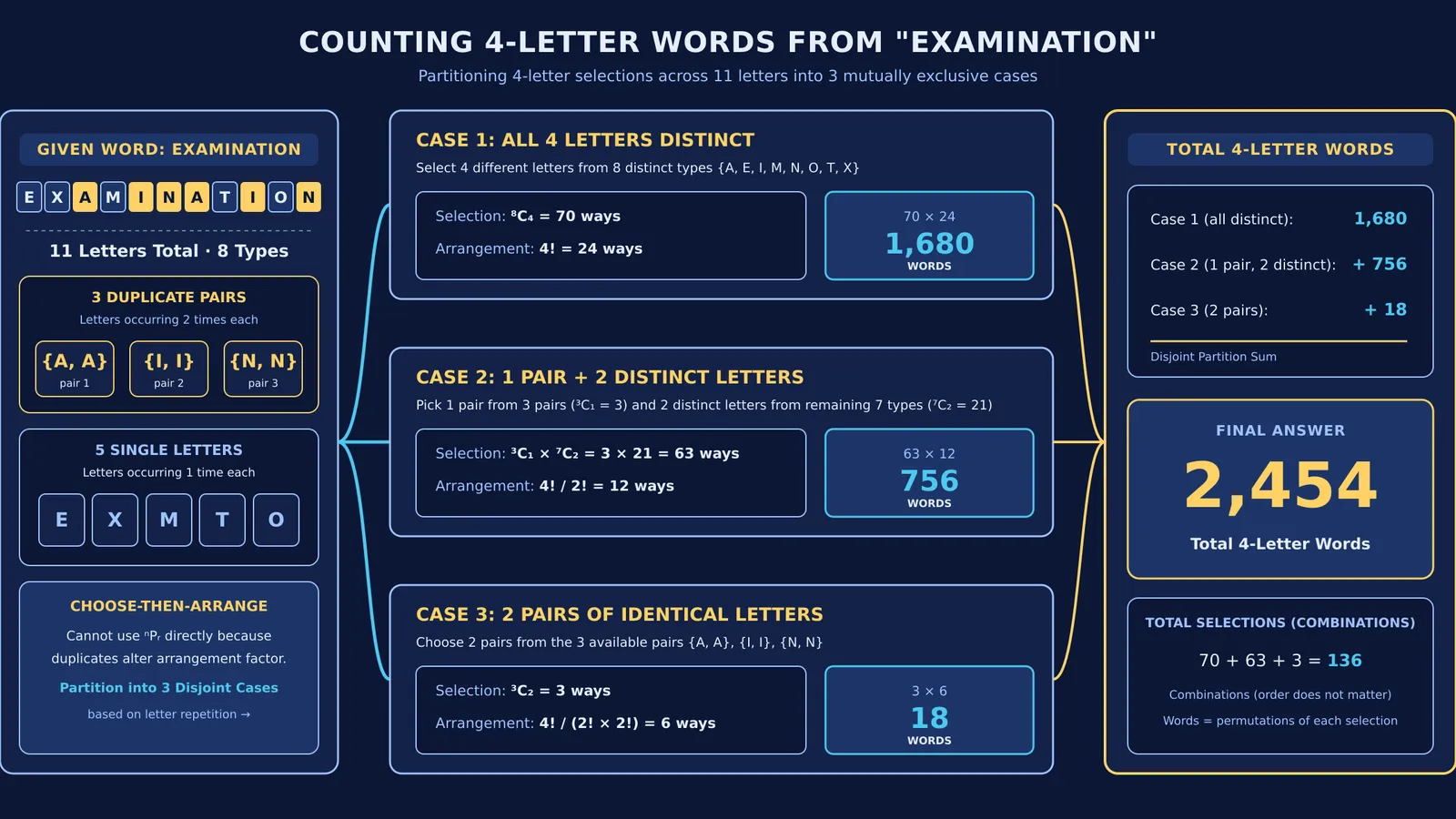
Before setting up cases, inventory the available letters using the multiset principles in the CBSE Senior Secondary Mathematics Curriculum. The word EXAMINATION contains 11 letters in total:
Duplicate pairs: A appears 2 times, I appears 2 times, and N appears 2 times (3 pairs).
Singletons: E, X, M, T, and O appear 1 time each (5 single letters).
This leaves 8 distinct letter types: {A, E, I, M, N, O, T, X}. Because no letter appears 3 or more times, you cannot pick three or four of the same letter (such as AAAA).
Every 4-letter selection falls into one of three disjoint cases:
Case 1: All 4 letters are distinct.
Case 2: 1 pair of identical letters and 2 distinct letters.
Case 3: 2 pairs of identical letters.
How to calculate each case step by step?
Under the counting rules in the CBSE Senior Secondary Mathematics Curriculum, each case requires choosing which letters to use, then ordering them.
Case 1: All four letters are distinct
Choose 4 different letters from the 8 distinct types:
Selection: ⁸C₄ = (8 × 7 × 6 × 5) / (4 × 3 × 2 × 1) = 70 ways.
Arrangement: 4! = 24 ways.
Words formed: 70 × 24 = 1,680 words.
Case 2: One pair and two distinct letters
Choose 1 pair of identical letters and 2 letters that are different from the pair and from each other:
Choosing the pair: Select 1 pair from the 3 available pairs ({A, A}, {I, I}, {N, N}) in ³C₁ = 3 ways.
Choosing the distinct letters: With 1 letter type used for the pair, 7 distinct types remain. Select 2 from these in ⁷C₂ = (7 × 6) / 2 = 21 ways.
Total selections: 3 × 21 = 63 ways.
Arrangement: 4! / 2! = 12 ways.
Words formed: 63 × 12 = 756 words.
Case 3: Two pairs of identical letters
Choose 2 pairs from the 3 available pairs:
Selection: ³C₂ = 3 ways.
Arrangement: 4! / (2! × 2!) = 24 / 4 = 6 ways.
Words formed: 3 × 6 = 18 words.
What is the total number of 4-letter words?
Standard question formats hosted on the NTA JEE Main portal require summing the permutations across each mutually exclusive branch of the partition:
Case 1 (all 4 distinct): 1,680 words.
Case 2 (1 pair, 2 distinct): 756 words.
Case 3 (2 pairs): 18 words.
Summing these gives the total number of arrangements:
Total words = 1,680 + 756 + 18 = 2,454 words.
If a problem asks for combinations (selections) rather than permutations (words), sum the selections: 70 + 63 + 3 = 136 selections.
The Fermi Problem Library has worked problems with a step-by-step solver that explains the reasoning rather than printing an answer, allowing you to verify each branch of your partition.
How do you avoid double-counting on similar combinatorics problems?
In a 2013 study published in *The Journal of Mathematical Behavior* (Lockwood, 2013), researcher Elise Lockwood showed that counting errors in combinatorics usually occur when students apply formulas without coordinating them with an explicit model of the outcome set. Setting up clear partitions based on duplicate counts prevents over-counting.
To solve multiset permutations reliably:
List letter frequencies before writing equations.
In Case 2, pick the pair from the pair pool (³C₁) and the singles from the remaining distinct types (⁷C₂), never from the original 11 letters.
Verify that your cases partition the selection completely by checking letter counts.
Connect your selection rules with structured constraints, as seen in selection problems with combinations and the gap method for arrangements.
When working through multi-case combinatorics, Fermi's AI tutor works out what you already know and notices where you are stuck, deciding whether to explain, ask, or show the next step.


