

On this page
The woodpecker is a living lesson in biomechanics. When a woodpecker hammers into a tree, its head decelerates with forces between 1,200 and 1,400 g-force. To put that into perspective, a human can suffer a concussion at just 60 to 100 g. A single woodpecker may deliver up to 12,000 pecks in a single day, moving its beak at 15 miles per hour to excavate wood.
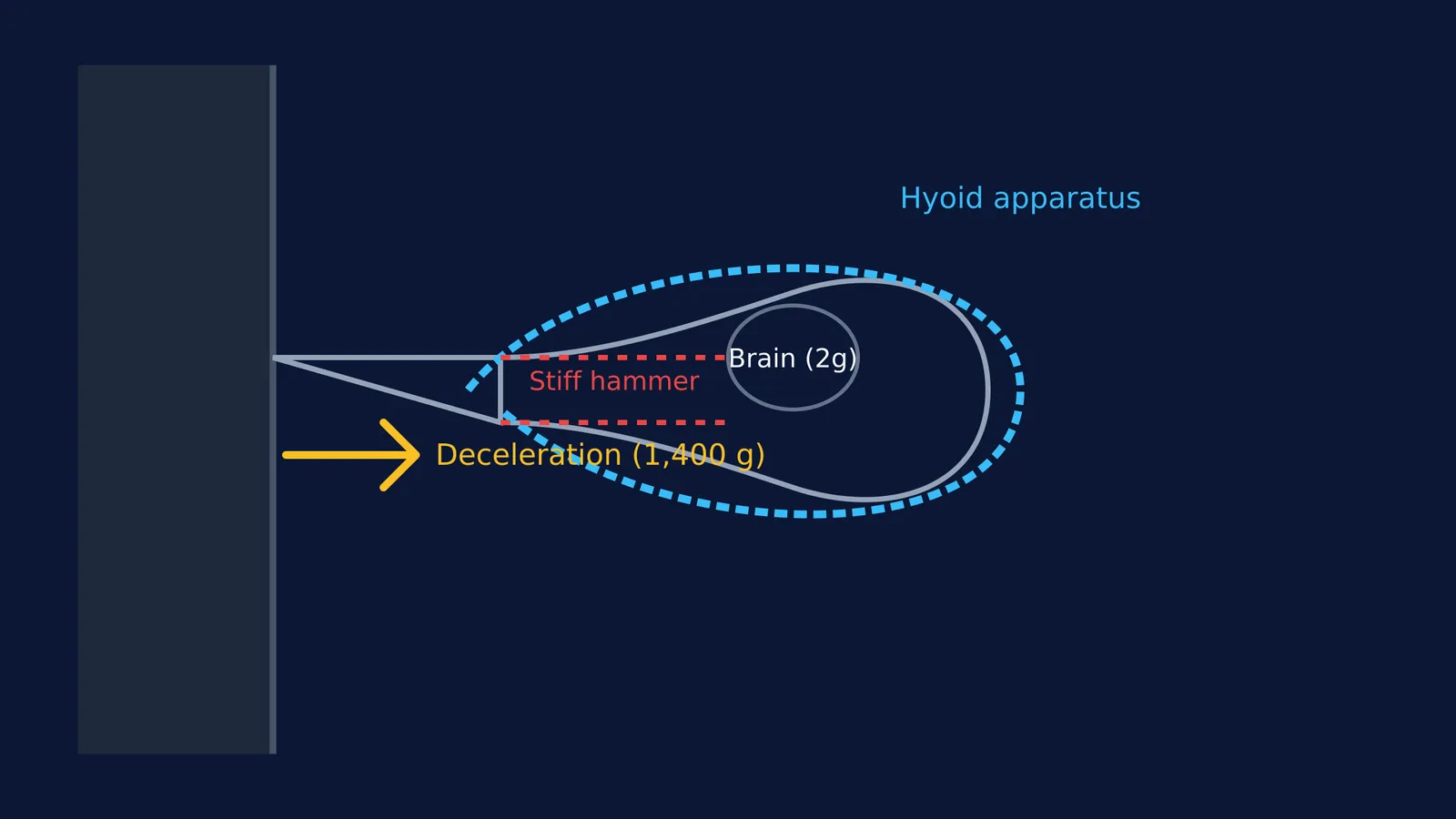
For years, textbooks taught that the woodpecker's skull contained natural shock absorbers to protect the brain. But a 2022 study in *Current Biology* overturned this idea, revealing that the skull functions more like a stiff hammer to maximize drilling efficiency.
Why doesn't a woodpecker get a concussion?
In 2022, biomechanics researcher Sam Van Wassenbergh and his team filmed woodpeckers with high-speed video. They discovered that the beak and the braincase decelerate at the exact same rate upon impact.
If the skull absorbed the impact, it would act like a built-in cushion, which sounds safe but would actually make pecking less efficient. The bird would have to hit the tree much harder to break the wood. Instead, the skull acts as a stiff hammer, transferring the maximum amount of kinetic energy into the tree.
Why doesn't the brain scramble under these forces? The answer lies in scaling laws. A woodpecker's brain weighs only about two grams. Because of its tiny mass and tight fit inside the skull with minimal cerebrospinal fluid, the internal pressure generated during a peck never reaches the threshold required to cause a concussion.
How does the woodpecker's tongue wrap around its skull?
Perhaps the most startling adaptation is the hyoid apparatus, a bony structure that supports the long tongue. In humans, the hyoid is a small horseshoe-shaped bone in the neck. In a woodpecker, the hyoid apparatus is so long that it originates in the right nostril cavity, splits into two "horns" to wrap over the top of the skull, passes behind the head, and rejoins at the lower jaw.
This structure allows the tongue to extend far beyond the beak to extract hidden insects. But during pecking, it serves a critical mechanical purpose. When the muscles around the hyoid contract, they tense the entire loop, cinching the skull together like a safety belt. This stabilizes the head and ensures the impact force is distributed evenly.
Why do woodpeckers need stiff tail feathers and zygodactyl feet?
The adaptations don't stop at the head. A woodpecker's lower body is equally specialized for life on vertical surfaces.
Unlike most perching songbirds that have three toes pointing forward and one backward, woodpeckers have zygodactyl feet. This means two toes face forward and two face backward, providing a vice-like, four-cornered grip on tree bark. Some species can even rotate their outer rear toe to the side, creating an "ectropodactyl" stance that provides extreme lateral stability against gravity.
But the feet alone aren't enough to withstand the recoil of a 1,400 g impact. Woodpeckers rely on their stiff tail feathers, which have rigid, reinforced shafts. When climbing or pecking, they press the tail firmly against the trunk, creating a tripod stance. The tail acts as a structural brace, supporting the bird's weight and allowing it to lean back and hammer with full force.
How can biomechanics improve your biology study habits?
When you prepare for biology exams, it is easy to view animal adaptations as a static list of traits to memorize. But structures like zygodactyl feet and the hyoid apparatus are elegant, connected solutions to the physical problem of hitting wood thousands of times a day without dying.
If you struggle to remember how physiological systems fit together, try stepping back to look at the forces involved. When you map out the biology step-by-step with the Fermi Concept Library, you learn to see the engineering behind the anatomy instead of just reading a textbook. Focusing on how an animal's body matches its habitat turns raw memorization into a logical story.


