

On this page
When a tuning fork is pressed against a sonometer box, it forces the stretched wire to vibrate. The hollow wooden box of the sonometer acts as a resonator, amplifying the sound so you can hear it clearly. If the natural frequency of the wire matches the frequency of the tuning fork, the wire hits resonance and vibrates with maximum amplitude. In a typical laboratory setup, you place a small V-shaped paper rider at the centre of the wire; when resonance occurs, the vigorous vibration throws the paper rider off.
By comparing the resonating lengths of the wire for two different tuning forks, you can quickly find the frequency of an unknown fork or simply verify the laws of transverse vibrations.
What is the formula for the frequency of a sonometer wire?
The NCERT Physics Laboratory Manual defines the fundamental frequency (n) of a stretched string vibrating in a single loop as:
n = 1 / (2L) √(T/m)
In this expression:
L is the length of the vibrating segment of the wire between the two movable wooden bridges.
T is the tension applied to the wire. This is controlled by the mass suspended over the pulley, where T = Mg (M being the hanging mass and g being the acceleration due to gravity).
m is the linear mass density, or the mass per unit length of the wire itself.
When you use the same wire throughout the experiment and keep the hanging mass unchanged, both the tension T and the linear density m are constant. The square root term in the formula becomes a fixed number. The formula then simplifies to the Law of Length: the fundamental frequency of the string is strictly inversely proportional to the resonating length (n ∝ 1/L).
How does the sonometer wire length change for resonance with two forks?
Because the frequency and the resonating length are inversely related under constant tension, multiplying them together always yields the same constant value for a given setup:
n × L = constant
If you have two tuning forks with frequencies n₁ and n₂, and they produce resonance at wire lengths L₁ and L₂ respectively, the relationship holds for both:
n₁ × L₁ = n₂ × L₂
Rearranging this equation gives the direct ratio of the two frequencies:
n₁ / n₂ = L₂ / L₁
This tells us that a higher-frequency tuning fork will resonate with a shorter segment of the wire. Conversely, a lower-frequency tuning fork requires the bridges to be moved further apart to match its slower vibration.
How do you calculate the frequency ratio in a worked example?
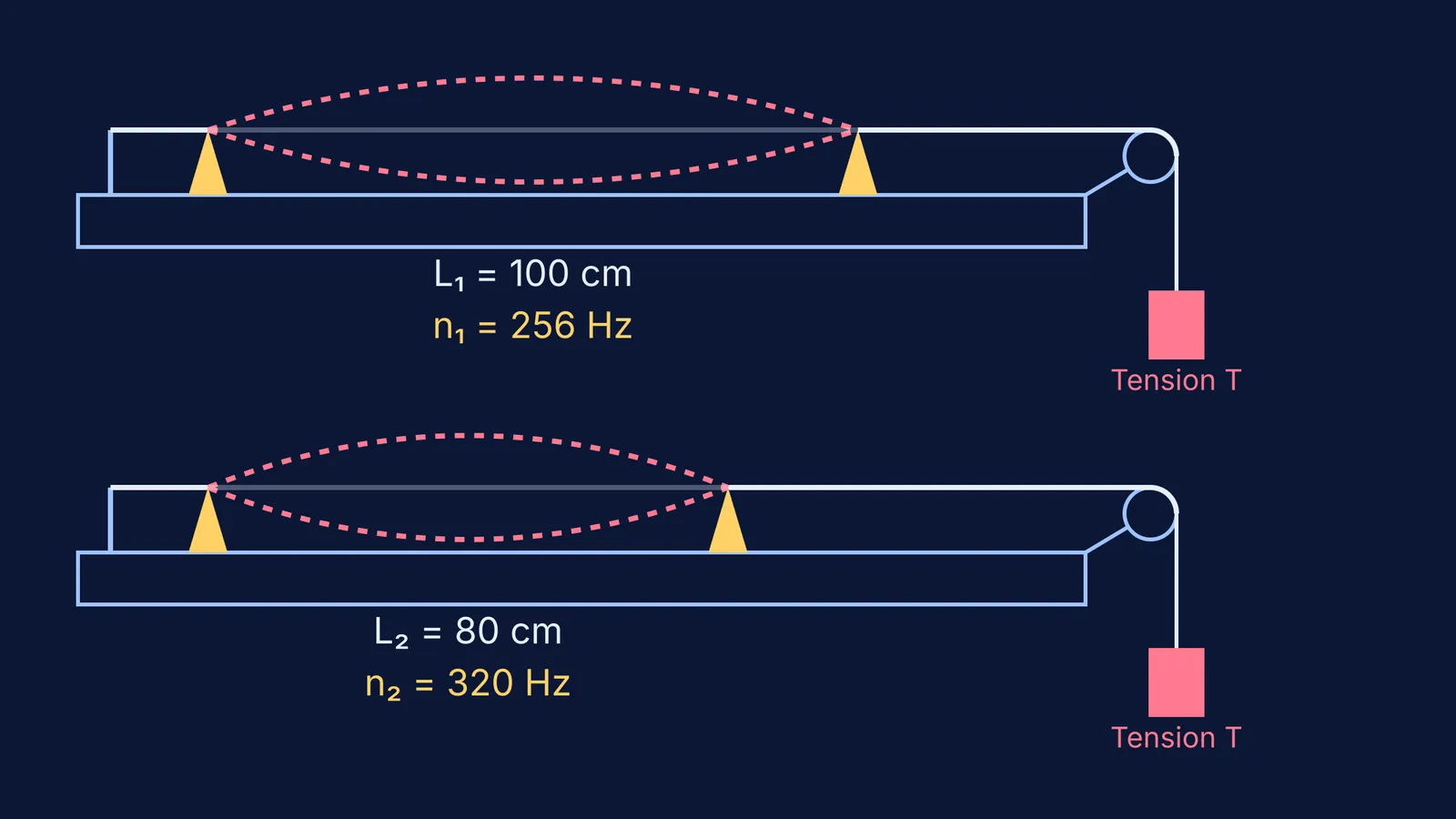
To see how this works in practice, imagine you are performing the sonometer experiment as described in the NCERT Physics Laboratory Manual. You have a known tuning fork with a stamped frequency of 256 Hz. You strike it gently on a rubber pad, press its stem to the sonometer box, and slide the bridges until the paper rider flies off. The measured distance between the bridges is exactly 100 cm.
Next, you pick up a second tuning fork whose frequency is unknown. Keeping the exact same slotted weights on the hanger to maintain a constant tension, you repeat the process. This time, you find that the wire hits resonance and throws off the paper rider when the bridges are 80 cm apart.
Using the Law of Length, you can set up the equality:
n₁ × L₁ = n₂ × L₂ 256 × 100 = n₂ × 80 25600 = 80 × n₂ n₂ = 320 Hz
The unknown tuning fork has a frequency of 320 Hz. This simple inverse relationship makes the sonometer an incredibly reliable and elegant tool for finding unknown frequencies in a school laboratory, entirely avoiding the need for complex electronic frequency counters.
How do transverse waves connect to energy?
The sonometer is a classic experiment because it brings abstract wave properties into the real world, letting you see and hear the physics of strings. If you are preparing for competitive exams like the JEE or NEET, string mechanics frequently appear alongside related concepts such as calculating the Elastic potential energy in a stretched wire, worked through or understanding the difference between Displacement and pressure waves in sound: the 90° phase shift.
When wave equations look too abstract, seeing the logic mapped out step by step clears the confusion. The Fermi Problem Library has worked problems with a step-by-step solver that explains the reasoning rather than printing an answer. By breaking down the laws of transverse vibrations and the mathematics behind them, you learn not just what the frequency formula is, but how the underlying physics connects.


