

On this page
If you watch a field of young sunflowers over a summer day, they will slowly turn their heads to follow the Sun across the sky. After sunset, they swing back the other way, ready to face the dawn.
This daily sweep, known as heliotropism, looks as though the plants are actively watching the sky. But plants do not have muscles. Instead, they move by growing.
Do sunflowers really turn to follow the Sun?
Yes, but only when they are young. A 2016 study published in *Science* proved that this movement is not just a direct reaction to light, but a deeply ingrained habit controlled by the plant's internal 24-hour cycle (10.1126/science.aaf9793).
The researchers found that if young sunflowers are moved indoors and placed under a constant overhead light, they will continue to swing their heads east to west for several days. They do not just react to the Sun; they anticipate it. They know when dawn is coming and position themselves beforehand, driven by a biological circadian clock.
Tracking the Sun allows young sunflowers to increase their biomass and leaf area by about 10% (10.1126/science.aaf9793).
How do sunflowers track the Sun?
Sunflowers turn by altering how fast different sides of their stem grow.
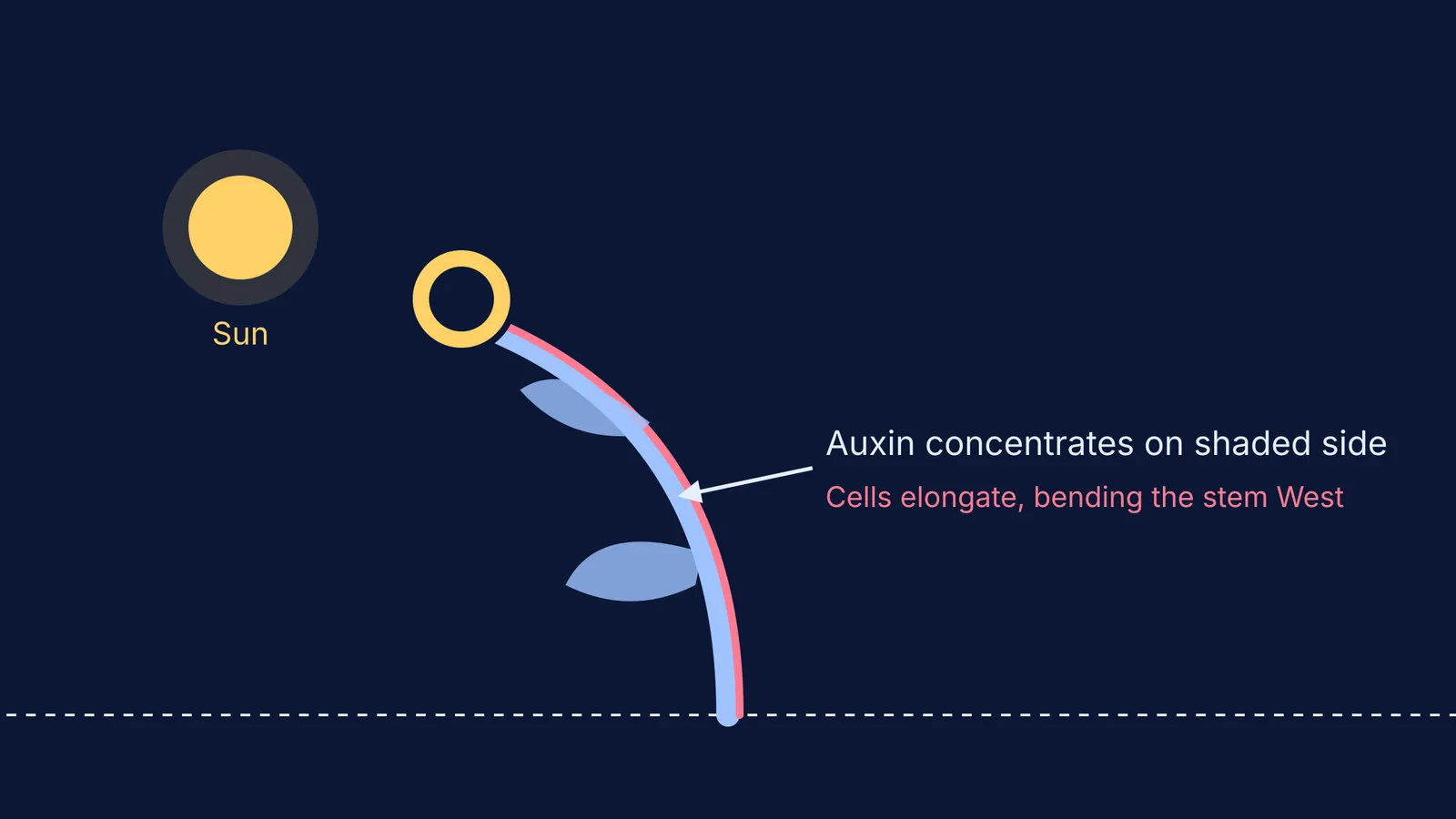
During the day, light sensors detect the Sun's position. This causes a plant growth hormone called auxin to accumulate on the shaded, eastern side of the stem. Auxin makes cells elongate, so the eastern side grows faster and longer than the sunny western side. This uneven growth acts like a bending lever, pushing the flower head towards the west as the afternoon goes on.
If you struggle to picture how uneven growth curves a structure over time, the Fermi Simulation Lab provides interactive simulations for ideas that are easier to see than to read, helping you visualize how changing the rate on one boundary forces a shape to bend.
At night, the plant's internal clock takes over. It reverses the growth pattern, making the western side of the stem grow faster in the dark. This pushes the head back towards the east, timed for the next sunrise.
For a wider look at how plants react to gravity and light, you can read our guide to phototropism, geotropism and other tropic movements in Class 10.
Why do mature sunflowers face east?
As a sunflower matures and its flower opens, its stem stiffens and stops growing. The daily tracking stops, and the plant settles into a permanent eastward-facing direction.
The *Science* study found a clear evolutionary reason for this. By facing east, the mature flowers catch the first rays of morning light and heat up quickly. Warm, east-facing mature flowers attract five times as many pollinating bees as those forced to face west (10.1126/science.aaf9793).
More bees mean better pollination and more seeds. Once the seed-making stage begins, tracking the Sun no longer matters as much as staying warm and attracting insects. To see the maths behind how populations of plants multiply once established, look at our breakdown of arithmetic vs geometric growth in plants.
How to revise plant movements for biology exams
Exam papers often test the difference between tropic movements (like heliotropism) and nastic movements. Use this quick active-recall checklist to keep them straight:
Direction of stimulus: Does the plant move *towards or away from* the stimulus? If yes, it is a tropic movement (e.g. phototropism). If the movement is triggered by a stimulus but its direction is fixed (like a Venus flytrap closing), it is a nastic movement.
Growth vs turgor: Tropic movements in stems and roots are permanent because they rely on unequal cell division and elongation driven by hormones like auxin. Nastic movements, like the drooping of *Mimosa pudica* leaves, are often fast and reversible because they rely on sudden changes in cell water pressure (turgor).
The clock factor: Heliotropism in sunflowers is special because it combines light-driven phototropism with a circadian rhythm, giving the plant "memory" and anticipation of the dawn.


