

On this page
When the summer heat peaks, the standard advice is to wear white. The logic makes intuitive sense: light colors reflect sunlight, while dark colors absorb it.
But heat transfer is a dynamic process. The clothes you wear interact not just with the Sun, but with your body heat and the surrounding air. A 2008 study found that standard white cotton absorbs only about 17% of solar radiation Watanabe et al., 2008. Black fabric, by contrast, absorbs nearly all of it, converting that light into thermal energy. This is a basic rule of heat radiation you might encounter when studying the energy density of an EM wave.
How does albedo keep white clothes cool?
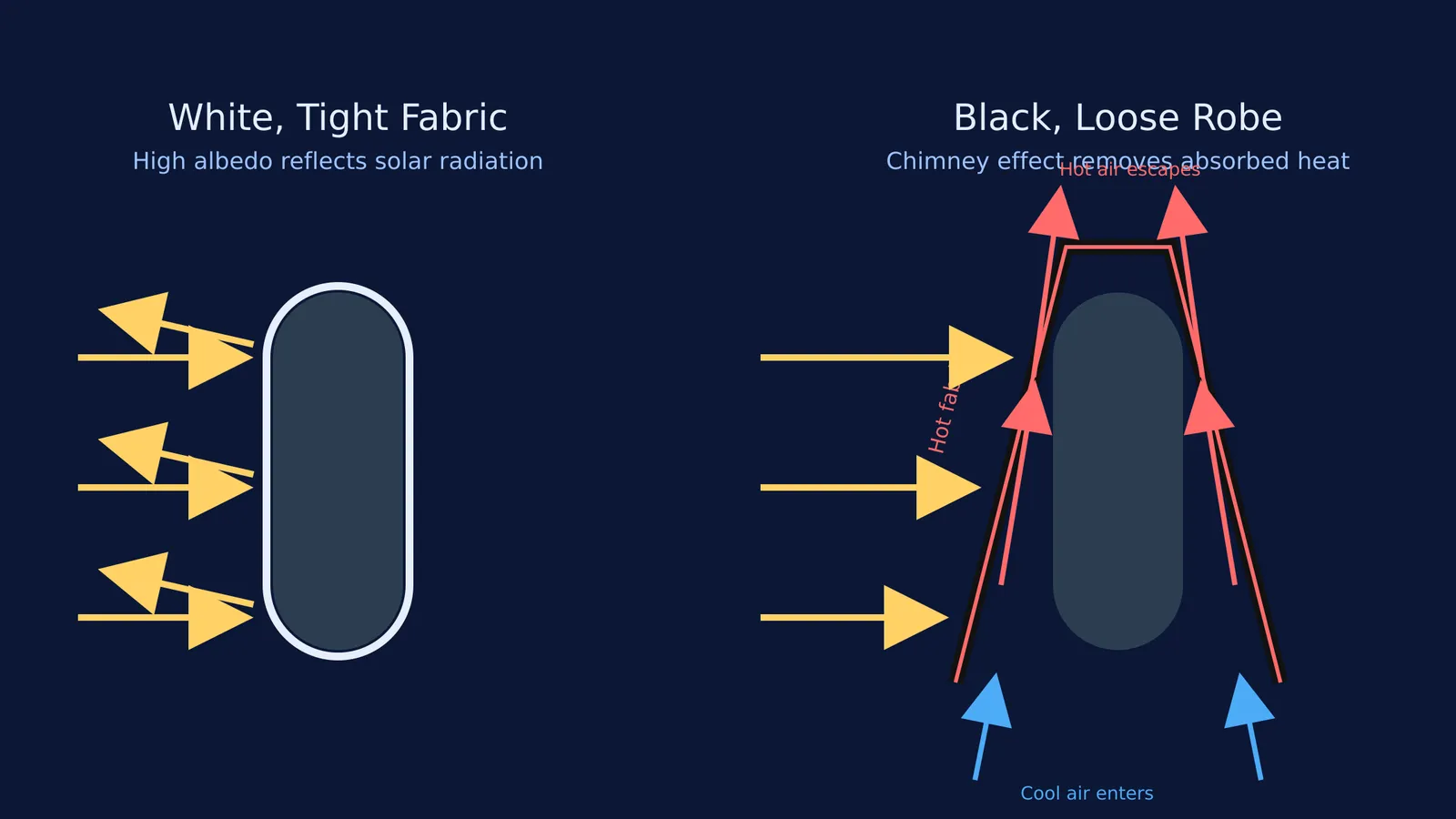
The primary reason white clothes feel cooler is albedo—a measure of how much light a surface reflects. White fabric reflects nearly all wavelengths of visible light. Because it reflects this incoming energy away, the material itself absorbs very little heat and stays cooler to the touch.
When you wear a tight-fitting white t-shirt, it acts as a physical barrier that bounces solar radiation away from your skin. A black t-shirt does the exact opposite. It absorbs the visible light, heats up rapidly, and conducts that heat directly into your body. This difference in absorption is why a black car steering wheel burns your hands in July while a white one remains tolerable. The tighter the fit, the more efficiently that captured thermal energy conducts straight into your skin.
Why do Bedouins wear black in the desert?
If black is always hotter, why do some desert nomads wear heavy black robes? A famous 1980 paper in *Nature* investigated this exact question Shkolnik et al., 1980. Researchers measured the heat gain of volunteers standing in the Negev desert in temperatures from 35 °C to 46 °C.
They found that the black robe absorbed 2.5 times more solar radiation than the white one. Yet, surprisingly, the net heat gain by the wearer's body was exactly the same for both colors. The dark fabric was significantly hotter on the outside, but that excess thermal energy never reached the skin.
The secret lies in convection. The black fabric heats the air in the space between the robe and the skin. Because hot air expands and rises, it escapes through the loose neck opening—a phenomenon known as the chimney effect. As the hot air escapes upward, it draws cooler air in from the bottom of the robe, creating a continuous convective breeze that cools the body. If you are revising thermodynamics and want to see how convection and radiation balance out, the Fermi Simulation Lab lets you interact with models of heat transfer directly.
Does the fit matter more than the color?
The physics of clothing comes down to how well the fabric manages both external solar radiation and internal body heat. Your body is constantly generating heat and emitting it as infrared radiation.
White clothing is excellent at reflecting the Sun, but it also reflects your own body heat back toward your skin. Black clothing absorbs body heat, which can then be carried away by a breeze. Understanding these variables is just as important as knowing the math behind isobaric and isochoric processes when calculating heat in a closed system.
Ultimately, the fit dictates the winner. If your clothes touch your skin, white is significantly cooler because conduction transfers the fabric's heat directly to you. If your clothes are loose and flowing, the color matters much less than the airflow generated beneath the fabric.
How should you dress for a summer study session?
If you are setting up an outdoor study session and want to stay comfortable, the right clothing can keep you focused. Use this framework to decide what to wear:
For tight layers, choose white: If you are wearing a standard t-shirt, a high-albedo white fabric will reflect the most solar energy and keep conduction to a minimum.
For dark colors, go loose: If you prefer wearing black, ensure the garment is loose enough to allow the chimney effect to pull air across your skin.
Pick breathable fabrics: Cotton and linen allow sweat to evaporate quickly, which is your body's primary cooling mechanism regardless of the shirt's color.
Seek shade for dark clothes: If you must wear a dark, tight-fitting uniform, stay out of direct sunlight, as it will rapidly convert light into thermal energy against your skin.
By understanding the physics of reflection and convection, you can outsmart the summer heat and keep your mind on your work.


