

On this page
You spill water on a light blue cotton shirt, and instantly, the wet patch turns navy blue. Your hair looks several shades darker when you step out of the shower. Yet, the physical pigments in your clothes and hair haven't changed. So what is going on?
The answer lies in how a thin layer of water alters the way light enters, bounces, and escapes the material. A 1988 study published in the journal *Applied Optics* by John Lekner and Michael C. Dorf established the physical models for this optical illusion, pinpointing total internal reflection as the primary cause (Lekner & Dorf, 1988).
Why do wet clothes and hair look darker?
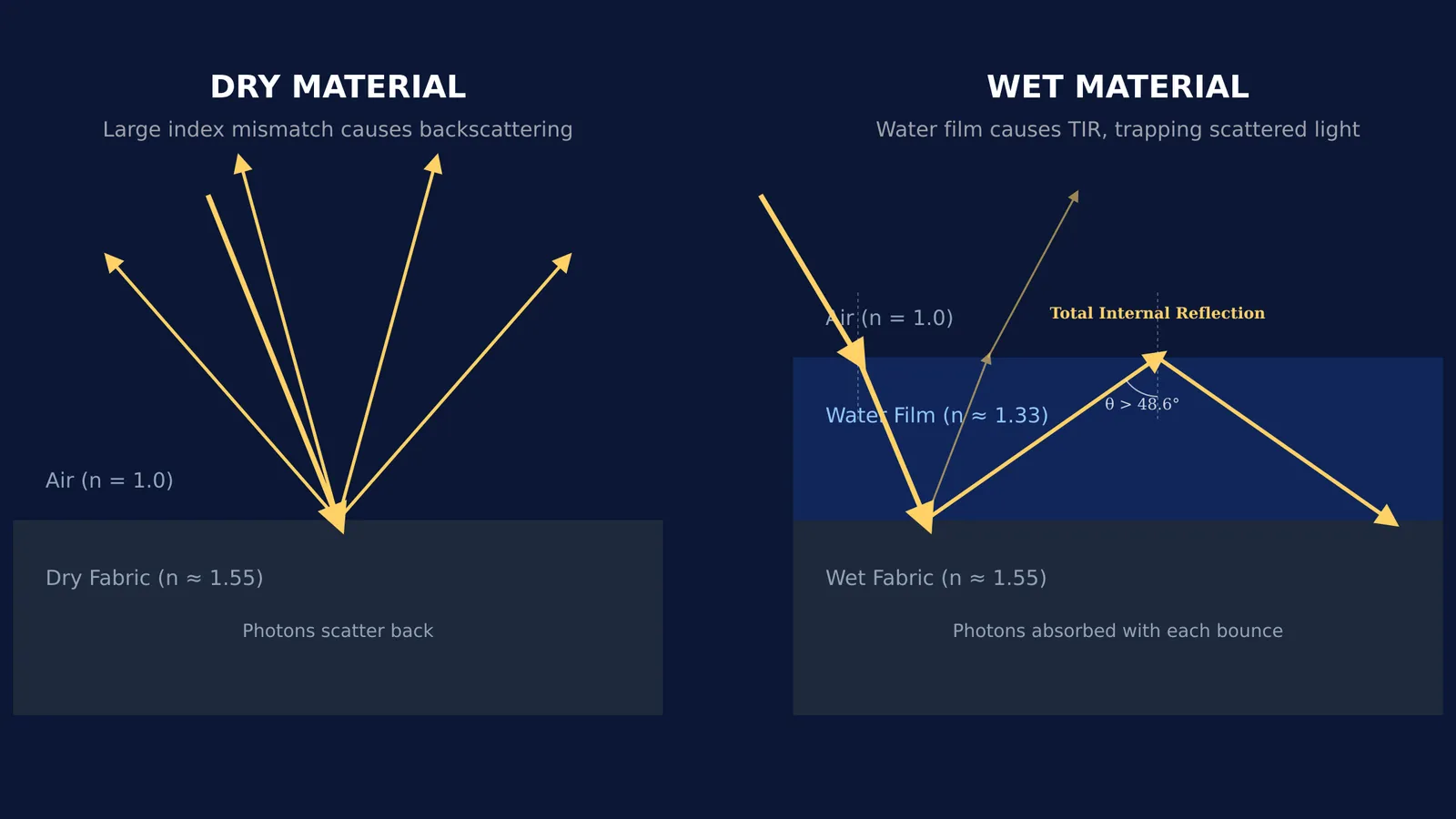
When light hits a dry cotton shirt, it encounters a harsh boundary. The refractive index of air is 1.0, while the refractive index of a dry cotton fiber is roughly 1.55. This large index mismatch causes light to scatter immediately off the rough surface of the fibers. The scattered light bounces straight back to your eyes, which your brain registers as a bright, light colour.
When the shirt is wet, water—which has a refractive index of 1.33—fills the microscopic air gaps between the fibers. The jump in optical density from water (1.33) to cotton (1.55) is much smaller than the jump from air to cotton. A 1986 study by Twomey, Bohren, and Mergenthaler found that this reduced mismatch causes light to scatter forward rather than backward (Twomey et al., 1986). Instead of bouncing off the surface, the light plunges deep into the wet fabric.
How does water trap light inside the fabric?
Once the light penetrates the wet material, it eventually hits a fiber and bounces back toward the surface. But now, it must pass from the water back into the air. This is where the light gets trapped.
When light travels from a denser medium (water) into a less dense medium (air), it bends. If the light ray hits the water-air boundary at an angle wider than the critical angle for water, it cannot escape. Instead, it undergoes total internal reflection, bouncing back down into the fabric just like a mirror reflecting a laser beam. This phenomenon is exactly the same principle used in fiber optic cables to trap and guide light over long distances without losing signal.
If you find these paths hard to trace on a page, the Fermi Simulation Lab has interactive simulations for ideas that are easier to see than to read.
Because of this trap, a single photon might bounce between the wet fibers multiple times before finding an angle steep enough to escape. Every time the light hits a dyed cotton fiber or a strand of hair, the physical pigments in the material absorb a specific fraction of its energy. In a dry shirt, light might only hit the dye once before scattering back to your eyes. In a wet shirt, that same light hits the dye several times. By the time the light finally reaches your eyes, much of its initial energy has been absorbed, leaving the fabric looking significantly darker and more saturated in colour.
Why doesn't a wet mirror look darker?
If water traps light, why doesn't a wet mirror or a wet pane of glass turn dark?
The darkening effect only works on porous, rough, and light-absorbing materials.
Porous: The material needs microscopic gaps for the water to fill, like the weave of a shirt or the overlapping cuticles of human hair.
Rough: The surface must scatter light in random directions so that some rays hit the water-air interface at shallow, trapping angles.
Absorbing: The material must have pigments or dyes that absorb light with each bounce.
A mirror is flat and entirely reflective. When a water film covers it, the light enters, hits the silver backing, and bounces straight back out at the exact same steep angle. It never hits the critical angle, so total internal reflection never occurs.
Try it yourself: The optical trap experiment
You can demonstrate how index matching changes scattering with materials in your own home.
Take two identical pieces of opaque, matte tape (like masking tape or painter's tape).
Stick one to a dry piece of glass and the other to a wet piece of glass.
The tape on the wet glass will appear slightly darker and more transparent from the front.
The water bridges the refractive gap between the tape and the glass, letting light pass through instead of scattering off the adhesive backing. This same physics dictates why wet roads glare at night and why damp soil looks black. It is not a chemical change; it is just light struggling to find its way out of an intricate optical maze created by the simple addition of water.


