

On this page
If you pour dry sand out of a bucket, it collapses into a wide, sloping cone. But add a little water, and you can carve that same sand into vertical towers, arches, and walls. The difference comes down to the surface tension of water and the microscopic bridges it forms between individual grains of sand.
Why can you build with wet sand but not dry sand?
Dry sand is a collection of loose particles with only air between them. Because there is no chemical bond holding them together, the only thing stopping dry sand from flowing like a liquid is friction. When you pour dry sand, it slips and slides until it reaches its angle of repose—the steepest angle at which the grains can lock together without tumbling down.
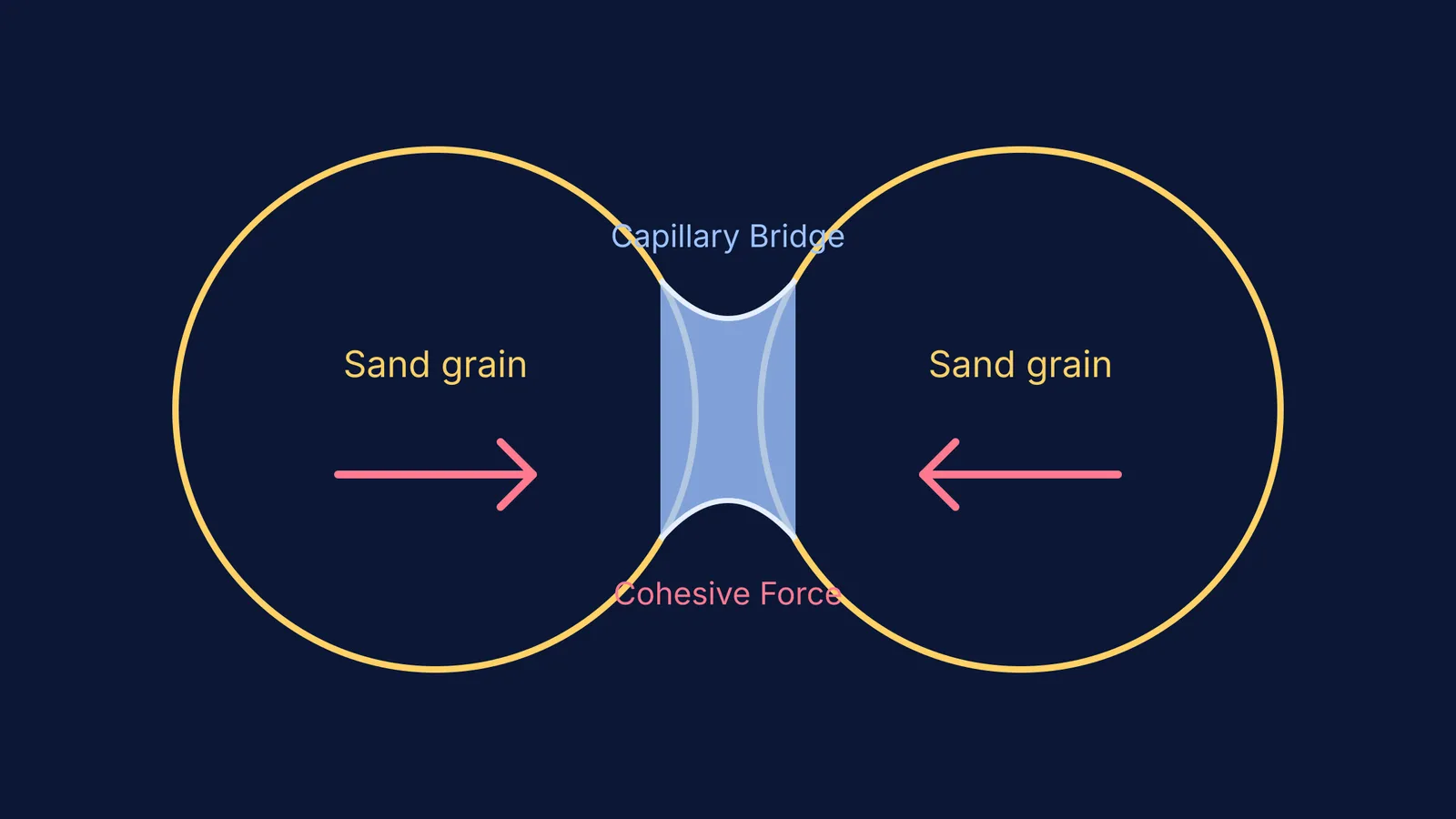
When you add water, everything changes. The water coats the grains and pools at the narrow points where they touch, forming tiny structures called capillary bridges. Because water molecules are strongly attracted to each other (cohesion) and to the surface of the sand (adhesion), the surface tension of these bridges acts like microscopic rubber bands.
This tension creates a suction stress inside the water droplet. The lower pressure inside the bridge pulls the sand grains tightly toward one another, giving the wet sand enough structural integrity to stand vertically.
What is the perfect ratio of water to sand?
You know from experience that if sand is too dry, it crumbles, and if it is too wet, it slumps into a puddle. Finding the exact balance is a measurable physics problem.
In a 2012 study published in *Scientific Reports*, a team of physicists led by Daniel Bonn measured the strength of sand structures built with varying amounts of moisture. They found that the optimum strength is achieved with just 1% water by volume. In a bucket, that is roughly one part water for every 99 parts of sand.
This 1% ratio provides exactly enough water to form a capillary bridge at every contact point between the grains without flooding the empty spaces. The researchers also established a formula for stability, showing that the maximum height of a column grows as the base radius to the power of two-thirds (h ∝ R^(2/3)). Using their 1% mixture, the team calculated that a sandcastle column with a base radius of 20 centimetres could theoretically reach a height of 2.5 metres before the pressure crushed its own base.
Why does too much water ruin the sandcastle?
If capillary bridges make sand firm, why doesn't more water make it firmer?
The strength of wet sand depends entirely on the boundary between air and water. Surface tension only exists at this interface. If you pour in too much water, the air spaces between the sand grains fill up completely. The air is pushed out, the menisci of the capillary bridges vanish, and the surface tension drops to zero.
Without that cohesive force pulling the grains together, the water simply lubricates the sand. The grains slide freely past one another, and the structure collapses into a heavy slurry.
How to visualise forces like surface tension
Capillary bridges and suction stress can be hard to picture because they happen on a microscopic scale. When a physical concept is difficult to see in your head, reading a textbook definition is rarely enough to build true intuition.
In the Fermi Simulation Lab, you can find interactive simulations for the ideas that are easier to see than to read. Instead of guessing how forces interact, you can change the parameters yourself and watch the physics respond in real time, making abstract mechanics feel concrete.
A checklist for a stable sand structure
If you want to test these physics principles yourself, here is a practical plan for building highly stable sand structures:
Use fine sand: Finer grains mean more contact points per cubic centimetre. More contact points mean more capillary bridges, which multiplies the cohesive force holding the structure together.
Find angular sand: Grains that are jagged lock together much better than smooth, round grains. Sand worn down by the ocean is often too round, while rougher sand found further inland holds its shape.
Aim for 1% water: The sand should feel damp but not saturated. If water pools when you squeeze a handful, it is too wet.
Pack it tightly: Compacting the sand forces the grains closer together. This reduces the distance the capillary bridges have to span, making the suction stress much stronger.


