

On this page
A common observation in rural homes and farms is that water drawn freshly from a deep well feels delightfully warm on a freezing winter morning and refreshingly cold on a scorching summer afternoon. This stark contrast often leads people to believe that the ground is actively heating the water during the colder months, acting like a natural furnace. This raises a natural question: does the well water actually heat up in winter, or is something else at play?
The illusion of relative temperature
The first thing to understand is that your skin does not measure absolute temperature; it measures the rate of heat transfer. It is not the water that changes temperature across the seasons, but the ambient air around you.
Consider a typical day in winter. If the morning air is 8 °C, your 37 °C skin is losing heat rapidly to the surrounding environment, making you feel cold. When you touch well water that is sitting at a steady 25 °C, heat flows from the water into your hands. Because the water is significantly warmer than the air you are accustomed to, it feels actively warm.
In contrast, during the peak of summer, the air temperature might climb to 42 °C. That same 25 °C water now draws heat away from your skin, making it feel wonderfully cool. The water itself has barely changed temperature; your baseline for comparison has simply shifted. Your perception of hot and cold is entirely relative to the conditions your body has adapted to over the preceding hours.
What causes the constant ground temperature?
The physical properties of the earth are responsible for keeping groundwater stable. Soil, clay, and rock are poor conductors of heat. They have a remarkably low thermal conductivity and require a vast amount of energy to heat up, which gives the ground high thermal inertia. Furthermore, the water held within the aquifers has a very high specific heat capacity, meaning it resists changes in temperature even when some heat does reach it.
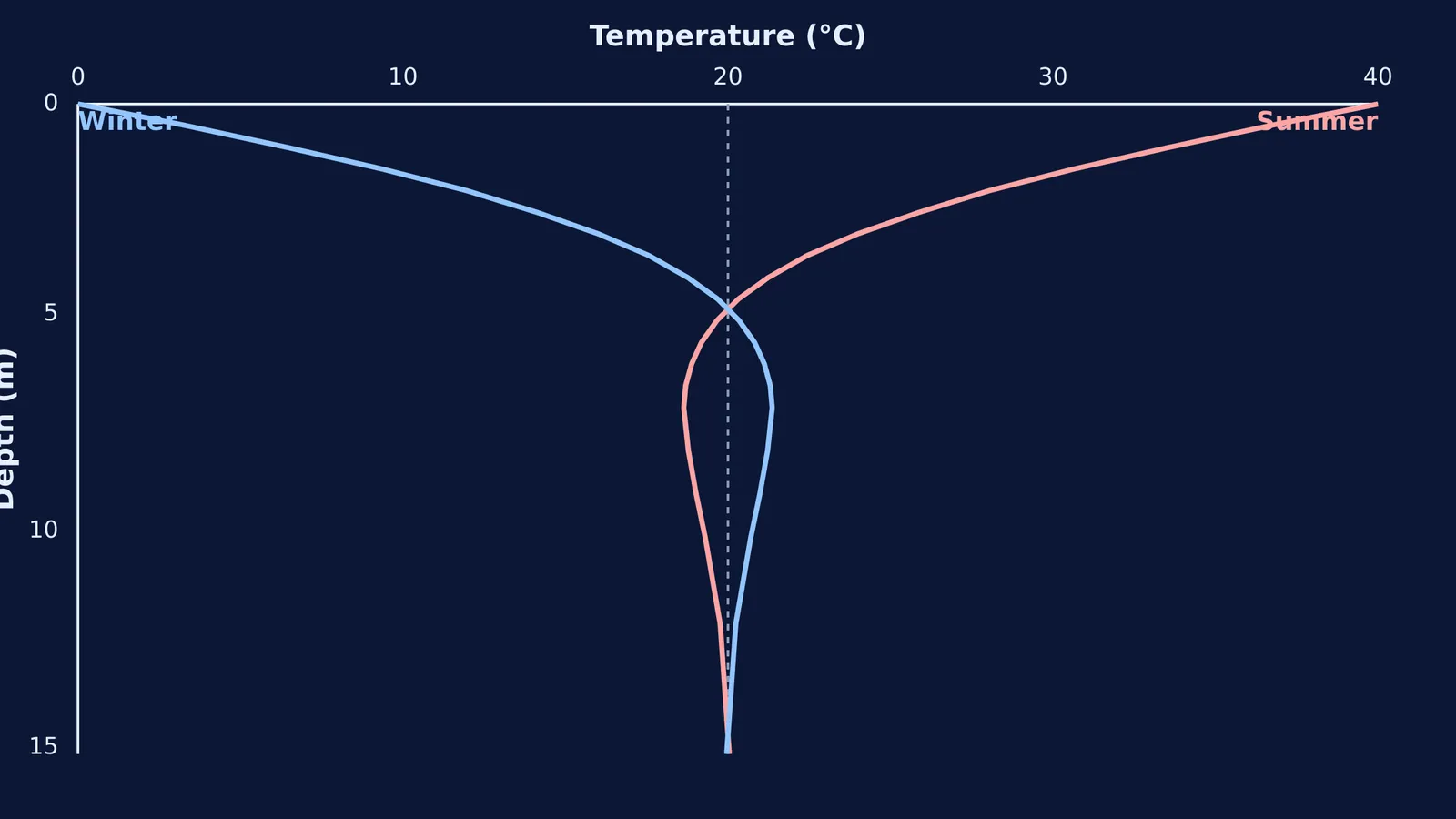
When the sun bakes the surface in June, that heat slowly creeps downward, but the deeper it goes, the weaker the temperature swing becomes. According to the United States Geological Survey (USGS), at depths between 30 and 60 feet (9 to 18 metres), groundwater temperature becomes relatively constant year-round. It stays extremely stable, typically hovering within 2° to 3°F (about 1° to 1.5°C) of the mean annual air temperature of the local region. This explains why a deep well delivers water at the same pleasant temperature regardless of the weather above ground.
How deep do seasonal changes actually reach?
The reduction of the temperature swing with depth follows an exponential decay. Not only does the amplitude shrink as you dig down, but the heat wave also travels very slowly, causing a significant phase lag. The surface temperature takes months to travel just a few metres through the rock and soil. Below 10 to 20 metres, the seasonal wave flattens out entirely, leaving a flat line on the thermometer (Wikipedia).
If you struggle to picture how heat waves damp out over distance, the Fermi Simulation Lab lets you watch thermal conduction in real time, making the exponential decay visible and intuitive.
If you drill even deeper—beyond 200 feet (60 metres)—the temperature stops being constant and starts rising due to the Earth's internal geothermal gradient, increasing by about 25 °C for every kilometre you go down toward the core (Wikipedia). This is why incredibly deep mines and geothermal springs are hot, but typical drinking water wells remain cool and stable.
A framework for heat transfer problems
When tackling heat and temperature problems in physics (or when explaining these everyday phenomena to a student), you can use this simple three-step check to avoid confusion:
Identify the system and the observer: What is the thermal source (in this case, the deep groundwater) and what is the observer (your skin exposed to the cold or hot air)?
Find the fixed values: The deep ground temperature is fixed at the annual average, acting as a massive thermal reservoir that anchors the system.
Determine the heat flow: Which way does the heat flow when the observer interacts with the system? Heat always moves from the warmer body to the colder body, regardless of whether that body "feels" cold to someone else.
This same logic applies whether you are studying the heat in isobaric and isochoric processes or calculating the temperature coefficient of a reaction rate in chemistry. By focusing on the relative flow of energy, rather than just the raw numbers on a thermometer, you can easily explain why the changing seasons fool our senses and make the exact same water feel entirely different.


