

On this page
Why are we slightly taller in the morning?
If you measure your height upon waking and before bed, you will find you are roughly 1 to 2 centimetres taller in the morning. This daily shift is not an optical illusion or muscular relaxation; it is a direct mechanical consequence of gravity compressing the spine. Research in Chronobiology International shows stature follows a daily cycle of daytime compression and nocturnal rehydration.
In the human skeleton, 26 vertebrae form the spine, separated by 23 fibrocartilaginous discs. In Arthritis Research & Therapy, Urban and Roberts note these discs account for 20% to 25% of total spinal height—roughly 15 centimetres in an adult. Throughout the day, body weight squeezes fluid out of these cushions, shortening the spine.
How much height do you lose during the day?
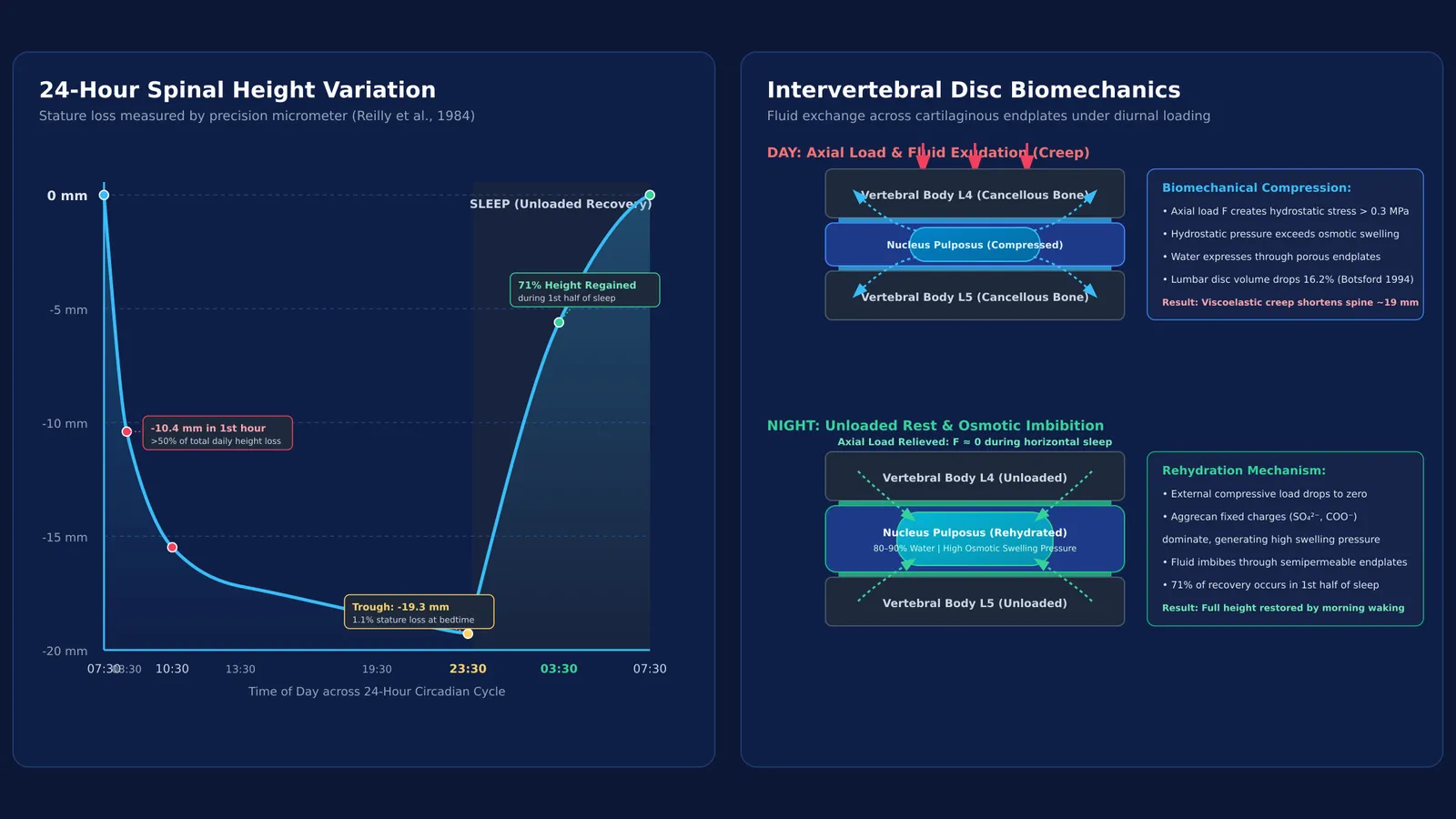
Spinal shrinkage was measured by Reilly, Tyrrell, and Troup in Chronobiology International. Tracking adults with a micrometer accurate to 0.01 millimetres, they recorded a mean diurnal stature loss of 19.3 millimetres—roughly 1.1% of standing height.
This loss is distinctly non-linear:
Over 50% of diurnal loss occurs within the first hour of rising.
Over 80% is lost within the first 3 hours of upright activity.
Shrinkage slows across the afternoon as discs approach mechanical equilibrium.
In Spine, Tyrrell, Reilly, and Troup showed that repetitive lifting accelerates shrinkage over quiet standing. Later 3D MRI trials by Botsford and colleagues in Spine confirmed genuine volume reduction: lower lumbar discs (L3–S1) lost 16.2% of their volume during daily activity due to fluid expulsion rather than outward bulging.
What happens inside spinal cartilage under gravity?
To see why discs lose volume, consider their microscopic architecture. Each disc contains two functional zones:
Annulus fibrosus: Concentric lamellae of type I collagen fibers aligned in alternating diagonal sheets to resist tensile loads.
Nucleus pulposus: A central gel rich in type II collagen and aggrecan proteoglycans.
In Arthritis Research & Therapy, Urban and Roberts show aggrecan's negatively charged sulfate and carboxyl groups create an osmotic swelling pressure that keeps healthy nucleus pulposus 80% to 90% water by weight.
Standing upright creates axial compressive stress, as explored in elasticity and Young's modulus. This stress raises internal hydrostatic pressure above swelling pressure, pushing fluid through cartilaginous endplates into vertebral capillaries—a time-dependent deformation called viscoelastic creep.
How do spinal discs recover overnight?
When you lie horizontal to sleep, axial gravitational loads drop to near zero, relieving external hydrostatic pressure.
The internal osmotic swelling pressure of aggrecan then dominates, drawing fluid back across the semipermeable cartilaginous endplates from vertebral blood vessels. In Chronobiology International, Reilly and colleagues showed nocturnal recovery is front-loaded: 71% of height regained overnight occurs during the first half of sleep. By morning, the discs regain their original fluid volume, restoring 15 to 20 millimetres of stature.
To visualize how hydrostatic and osmotic pressures compete across membranes, the Fermi Simulation Lab provides interactive simulations for the ideas that are easier to see than to read.
How can you calculate your spinal compression?
You can model spinal biomechanics with basic mechanics. For an adolescent weighing 60 kg:
Supported load: Roughly 60% of body mass rests above lumbar level L4–L5. For m = 36 kg, axial force is F = mg ≈ 353 N.
Compressive stress: Over a lumbar disc area of 12 cm² (1.2 × 10⁻³ m²), standing stress is σ = F / A ≈ 0.29 MPa, exceeding 0.8 MPa during movement.
Compressive strain: Across 23 discs totaling 150 mm in uncompressed height, an 18 mm height loss yields an axial strain of ε = 18 / 150 = 0.12 (12%).
Lumbar deformation: Averaging 0.78 mm per disc, heavily loaded lumbar discs compress by 1.0 to 1.6 mm, matching MRI volume loss recorded by Botsford and colleagues in Spine.
Unlike ideal Hookean springs in elastic potential energy problems, spinal cartilage is viscoelastic and poroelastic. When mastering these interconnected topics, the Fermi Concept Library covers every concept in physics, chemistry, biology, mathematics and computing, each with its own lesson and its place in the map.
How should students measure height accurately?
Because diurnal variation shifts stature by up to 2 centimetres daily, inconsistent timing distorts pediatric growth curves and sports fitness assessments. Follow this protocol based on Reilly et al.:
Standardize time: Measure at the same hour, preferably late afternoon when creep has plateaued.
Wait 60 minutes after waking: Over half of daily height loss occurs in the first hour on your feet.
Maintain neutral posture: Stand barefoot with heels, buttocks, and upper back against a wall, eyes in the Frankfurt horizontal plane.
Record on exhalation: Rest a rigid right-angle stadiometer headboard on the crown without pressing on hair.


