

On this page
We often hear that a warm-up is essential before hitting the pitch, court, or track, but it is incredibly easy to skip when you are in a rush. Warming up effectively is one of the most practical strategies you can use to stay healthy and perform at your best. However, warming up is not just an empty ritual or a mental exercise—it creates immediate, measurable physical and chemical changes in your body that directly protect you from injury and improve how you play.
What happens to your muscles when they heat up?
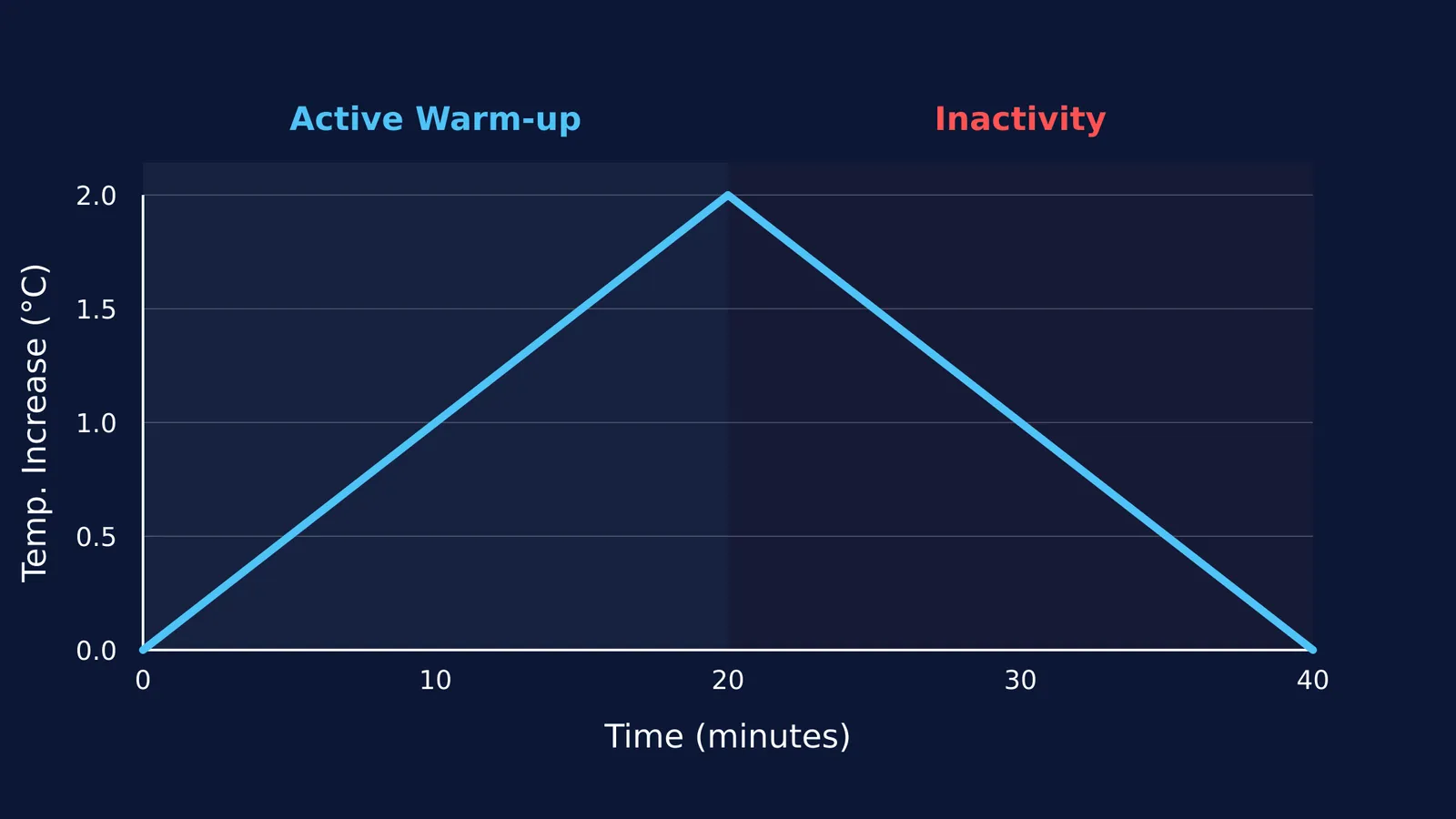
When you start moving, your body begins to generate internal heat. During an active warm-up, your muscle temperature increases by about 0.1°C every minute (Kapnia et al., 2022).
This rising heat physically changes the state of your muscle tissue. Cold muscles are stiffer and have higher internal friction, meaning they resist movement. As they warm up, this viscosity drops, allowing the muscle fibers and connecting tendons to become significantly more elastic. This new elasticity means your muscles can stretch further and absorb much more mechanical force before reaching the point where they tear.
According to a foundational review in *Sports Medicine* on the physiology of warming up, increasing your muscle temperature improves athletic performance (Bishop, 2003). This heat also increases your nerve conduction velocity—the speed at which signals travel from your brain, down your spine, and into your muscle fibers—resulting in faster reaction times and better physical coordination.
How do blood flow and enzymes change?
A warm-up also shifts your cardiovascular and metabolic systems into a higher gear to support sustained effort. At rest, many of the small blood vessels (capillaries) in your resting muscles are closed off. Physical activity triggers vasodilation, opening these pathways and drastically increasing blood flow to the active tissues.
This surge in blood flow is crucial for cellular respiration. As your local tissue temperature rises and your blood becomes slightly more acidic from carbon dioxide production, a biological phenomenon known as the Bohr effect occurs. This effect makes it easier for hemoglobin in your red blood cells to release oxygen right where your active muscles need it most.
At the microscopic level, heat literally accelerates your body's chemistry. The Q10 effect in biology states that enzyme activity increases as temperature rises. By warming up, you accelerate the specific enzymes responsible for breaking down glycogen and producing ATP (your body's primary energy currency). This ensures your muscles have a ready supply of fuel the moment you demand explosive power. If you want to explore the chemistry of enzymes and cellular respiration further, you can visit the Fermi Concept Library for lessons on these essential biological processes.
Does warming up actually prevent injury?
The short answer is yes, provided it is done correctly. A light jog is certainly better than nothing, but modern sports science shows that structured warm-ups yield the best results for injury prevention.
A 2022 meta-analysis published in the *International Journal of Environmental Research and Public Health* examined 15 studies involving young athletes. It found that implementing a structured warm-up program reduces the overall risk of sports injuries by 36% (Ding et al., 2022).
These highly effective programs go well beyond simple static stretching, which is just holding a pose. They include dynamic movements, balance exercises, and neuromuscular control drills that deliberately prepare the body for the specific, unpredictable demands of a competitive sport.
How can you warm up effectively?
To get the physiological benefits without wearing yourself out before the game even begins, follow this simple framework:
Keep it active: Use dynamic movements (like high knees, leg swings, or light cycling) to generate internal heat. Aim for 10 to 20 minutes to achieve a 1°C to 2°C rise in your muscle temperature (Kapnia et al., 2022).
Make it specific: Include movements that mimic exactly what you will do in your sport. If you are playing football, include side-shuffles and controlled accelerations. If you are swimming, focus on shoulder rotations and core activation.
Time it right: Muscle temperature drops at the exact same rate it rises (about 0.1°C per minute) when you stop moving (Kapnia et al., 2022). Try to start your match or intense training session within 5 to 10 minutes of finishing your warm-up so that you do not lose the benefits.
Understanding the underlying physics and biology of your body can give you a real, measurable edge on the field. To see more of these physical principles in action and interact with the science yourself, try running a physics model in the Fermi Simulation Lab.


