

On this page
You are walking in a heavy downpour, shielded by a thin layer of nylon. If you look closely at the canopy of an umbrella, you can see microscopic holes between the woven threads. Because an umbrella is not a solid sheet of plastic, it seems logical that water should pour straight through those gaps. But it does not. The reason your umbrella keeps you dry is an invisible barrier created by surface tension and pressure.
What keeps the rain out?
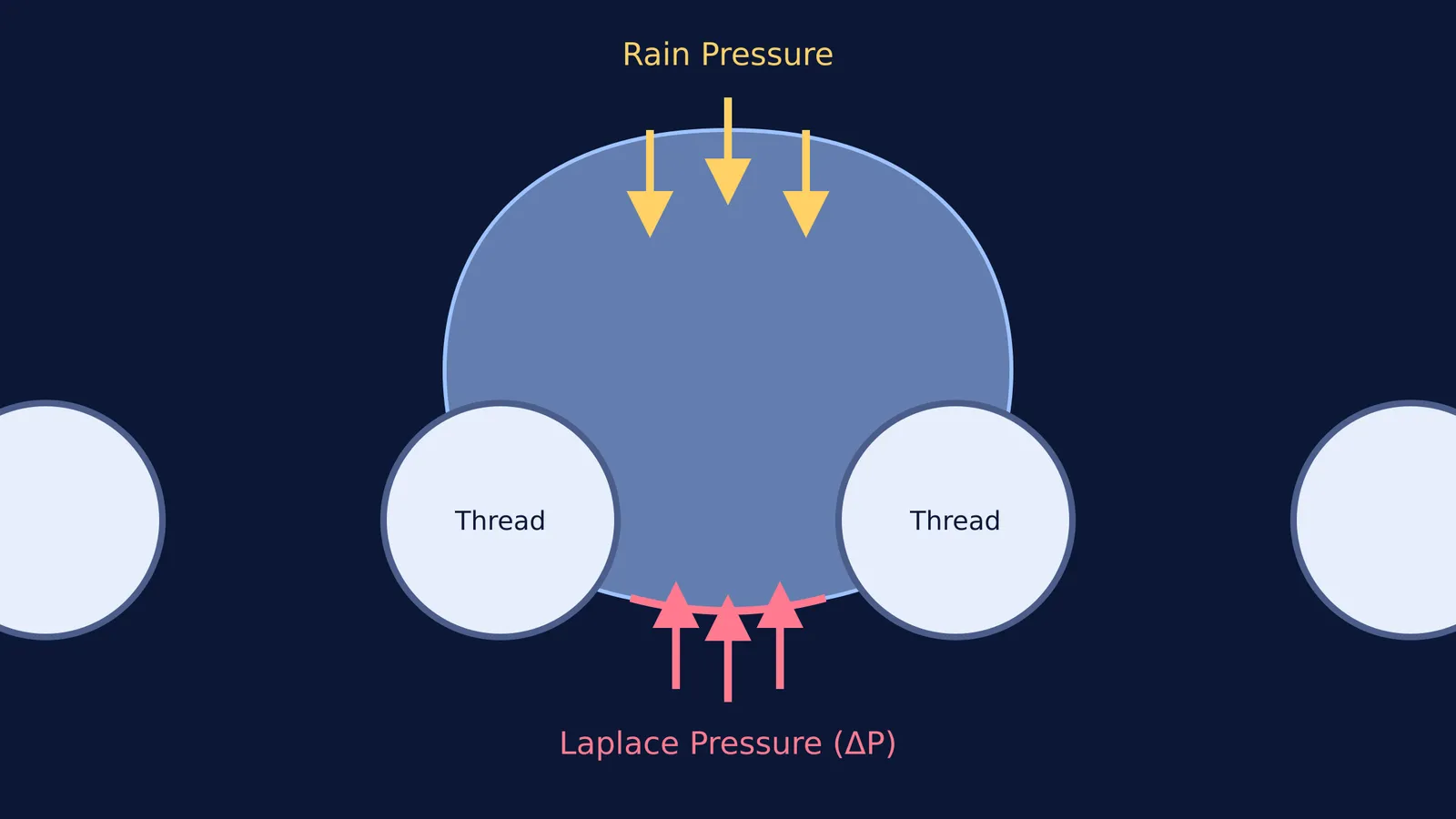
The fundamental mechanism preventing water from leaking through a woven fabric is governed by the Young-Laplace equation (Wikipedia). Water molecules are highly attracted to one another—a property known as cohesion. At the surface of a droplet, this cohesion creates a "skin" called surface tension, which naturally pulls the water into the most compact shape possible.
When a raindrop hits the tiny pore between the threads of your umbrella, it does not immediately squeeze through the opening. Instead, it forms a curved bridge, or meniscus, across the gap. Because the water surface is forced into a sharp curve, a significant pressure difference builds up between the inside and the outside of the droplet. This is known as the Laplace pressure. As long as the Laplace pressure pushing back upward is stronger than the dynamic downward pressure of the rain falling on it, the water remains trapped on the surface. The smaller the hole in the weave, the sharper the required curve, which dramatically increases the Laplace pressure defending against the leak.
Why do umbrellas have a water-repelling coating?
The Laplace pressure barrier only works if the water curves in the right direction. This depends heavily on a property called the contact angle (Wikipedia), which measures how a liquid behaves where it meets a solid boundary. The angle determines whether the liquid will stand up in a bead or flatten out completely.
If a fabric is highly absorbent (like standard cotton), the contact angle is small. Water flattens out, wets the individual threads, and is quickly pulled through the gaps by capillary action. To stop this from happening, umbrella canopies are treated with a Durable Water Repellent (DWR) coating, such as Teflon or silicone. These chemical coatings make the fabric highly hydrophobic (water-fearing), pushing the contact angle well above 90°.
Because the treated fabric aggressively repels the water, the raindrop is forced to bead up into a nearly perfect sphere. This extreme convex curvature maximises the resulting Laplace pressure, creating a formidable and invisible barrier against the rain. If you have ever wondered why droplets roll off some surfaces like tiny marbles while flattening out into puddles on others, the Fermi Simulation Lab provides interactive simulations for the ideas that are easier to see than to read.
Why does an umbrella leak when you touch the inside?
If you are caught in a storm with an older umbrella, you might notice that pressing your finger against the inside of the wet canopy causes a sudden and continuous leak.
This happens because touching the fabric disrupts the delicate physical balance of surface tension. Your finger provides a new, solid path for the water to cling to, effectively breaking the meniscus that was bridging the pore. Once the surface tension bridge snaps, capillary action pulls the water through the gap and onto your hand. For the same reason, Pascal's law in hydraulic machines relies on unbroken, contained fluids to transmit pressure safely without any sudden leaks or breaks in the fluid's continuity.
A practical checklist for your rain gear
To ensure your umbrella (and rain jacket) continues to make use of Laplace pressure to keep you dry, you should follow these essential habits:
Never touch the canopy in a storm. Keep your hands away from the inside of the fabric to avoid breaking the surface tension barrier and creating a path for water to flow.
Let it dry open. When you get indoors, leave the umbrella fully open so the DWR coating can dry evenly without water pooling and degrading the fabric in the folds.
Avoid detergents. If you must clean your umbrella, use plain water. Soap drastically lowers the surface tension of water (an effect first studied by pioneers like Agnes Pockels) and strips away the hydrophobic coating, permanently ruining the contact angle.


