

On this page
In short
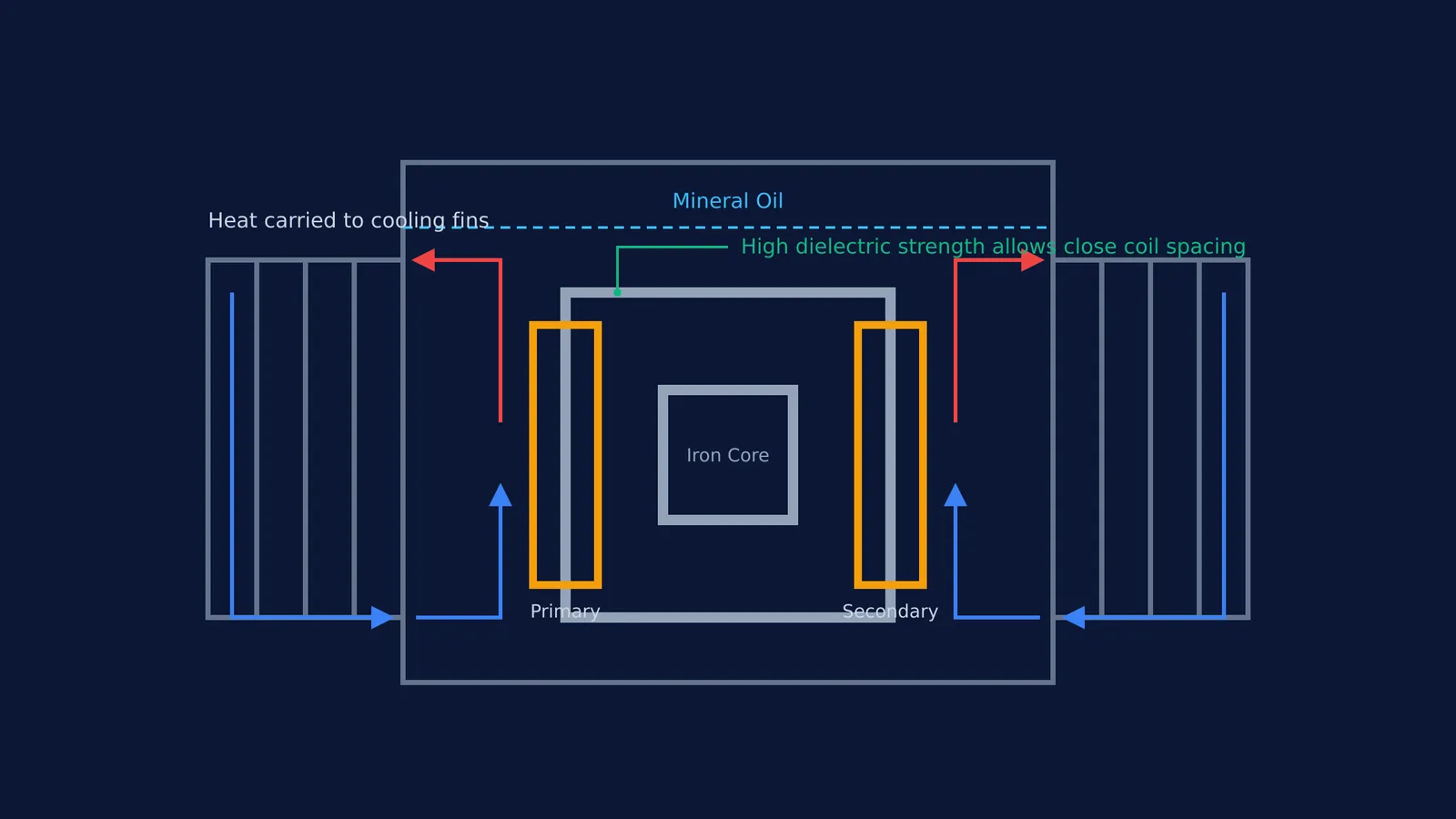
Transformers are filled with mineral oil because it offers a dielectric strength of 10–15 kV/mm, far exceeding air's 3 kV/mm, allowing components to sit closer together without arcing. The oil also conducts heat roughly five times better than air, carrying waste heat away from the windings to the cooling fins.
If you walk past a large electrical substation, you will see massive metal boxes surrounded by ribbed cooling fins. Inside these tanks, electricity is being stepped up to extremely high voltages for long-distance travel, or stepped down for local distribution. With high voltages and large currents come two massive problems: electrical arcing and intense waste heat.
If you left the inside of the transformer filled with just air, the high voltages would spark across the gaps, and the copper windings would quickly melt. To solve this, engineers fill the entire tank with specialized mineral oil. The oil serves two critical purposes: it insulates the live components, and it carries the heat away.
Why is oil a better insulator than air?
When a voltage gets high enough, it can tear electrons away from atoms in the surrounding medium, turning an insulator into a conductor. This is how lightning strikes through the air. The threshold at which this breakdown happens is called the dielectric strength.
The dielectric strength of typical transformer mineral oil is 10–15 kV/mm, compared to just 3 kV/mm for air. Because the oil can withstand roughly four to five times more electrical stress than air before breaking down, engineers can pack the high-voltage coils much closer together. This makes the transformer smaller, cheaper to build, and safer from internal flashovers. The oil also seeps into the porous paper wrapped around the copper wires, displacing tiny air pockets that could otherwise trigger an arc.
Imagine you are designing a small distribution transformer, and there is a voltage difference of 33 kV between two adjacent coils. How far apart must they be to prevent a spark?
In air: Air breaks down at 3 kV/mm. Minimum distance = 33 kV / (3 kV/mm) = 11 mm.
In oil: Transformer oil safely withstands at least 10 kV/mm. Minimum distance = 33 kV / (10 kV/mm) = 3.3 mm.
By using oil, you can place the coils over three times closer together. In a massive power grid transformer, this difference in spacing shrinks the machine from the size of a building down to the size of a truck.
How does the oil cool the transformer?
Transformers are highly efficient, but they still lose some energy as heat due to electrical resistance in the copper windings and magnetic losses in the iron core. This waste heat must go somewhere.
Mineral oil has a thermal conductivity of 0.132 to 0.177 W·m⁻¹·K⁻¹, which is about five to seven times higher than that of air (0.026 W·m⁻¹·K⁻¹). This allows the oil to pull heat away from the hot coils much more effectively.
As the oil against the windings heats up, it expands and becomes less dense, causing it to rise to the top of the tank. It then flows outward into those ribbed radiators (or fins) you see on the outside of the transformer. There, it releases its heat to the outside atmosphere, becomes denser, and sinks back to the bottom of the tank to repeat the cycle. This natural convection loop provides a continuous, self-regulating cooling system without needing mechanical pumps.
Connecting to your physics syllabus
For a JEE or NEET aspirant, a transformer is a perfect intersection of different physics topics. It combines electromagnetic induction (how transformers actually work) with thermodynamics and heat transfer. If you want to practice the mathematics of heat flow, see our guide on Heat conduction: thermal resistance and composite slab problems.
Understanding how convection currents move or how electric fields behave between closely packed coils can be tricky when you only have textbook diagrams. The Fermi Simulation Lab provides interactive simulations for the ideas that are easier to see than to read, helping you build an intuition for the physics. You can also review how changing magnetic and electric fields relate in our notes on Electromagnetic waves: the spectrum, E and B, and board questions.
Next time you see a neighbourhood transformer humming away, you will know that inside the metal casing is a quiet, continuous flow of oil keeping the lights on.


