

On this page
Most people expect toothpaste to foam. When you brush, the paste quickly expands into a mouthful of bubbles. But the foaming action does not come from the brushing alone, and it is not what actually cleans your teeth.
Toothpaste foams because of a chemical called a surfactant.
Why does toothpaste foam when you brush?
A foam is a mixture where a gas is trapped inside a liquid or solid phase. When you brush your teeth, you mix three things: water (from the tap and your saliva), air, and the toothpaste. The physical action of brushing whips air into the liquid mixture.
However, pure water does not form stable bubbles. The water molecules attract each other strongly through hydrogen bonds, and they quickly pull back together, popping any air bubbles that form. To keep the bubbles intact, the surface tension of the water must be lowered.
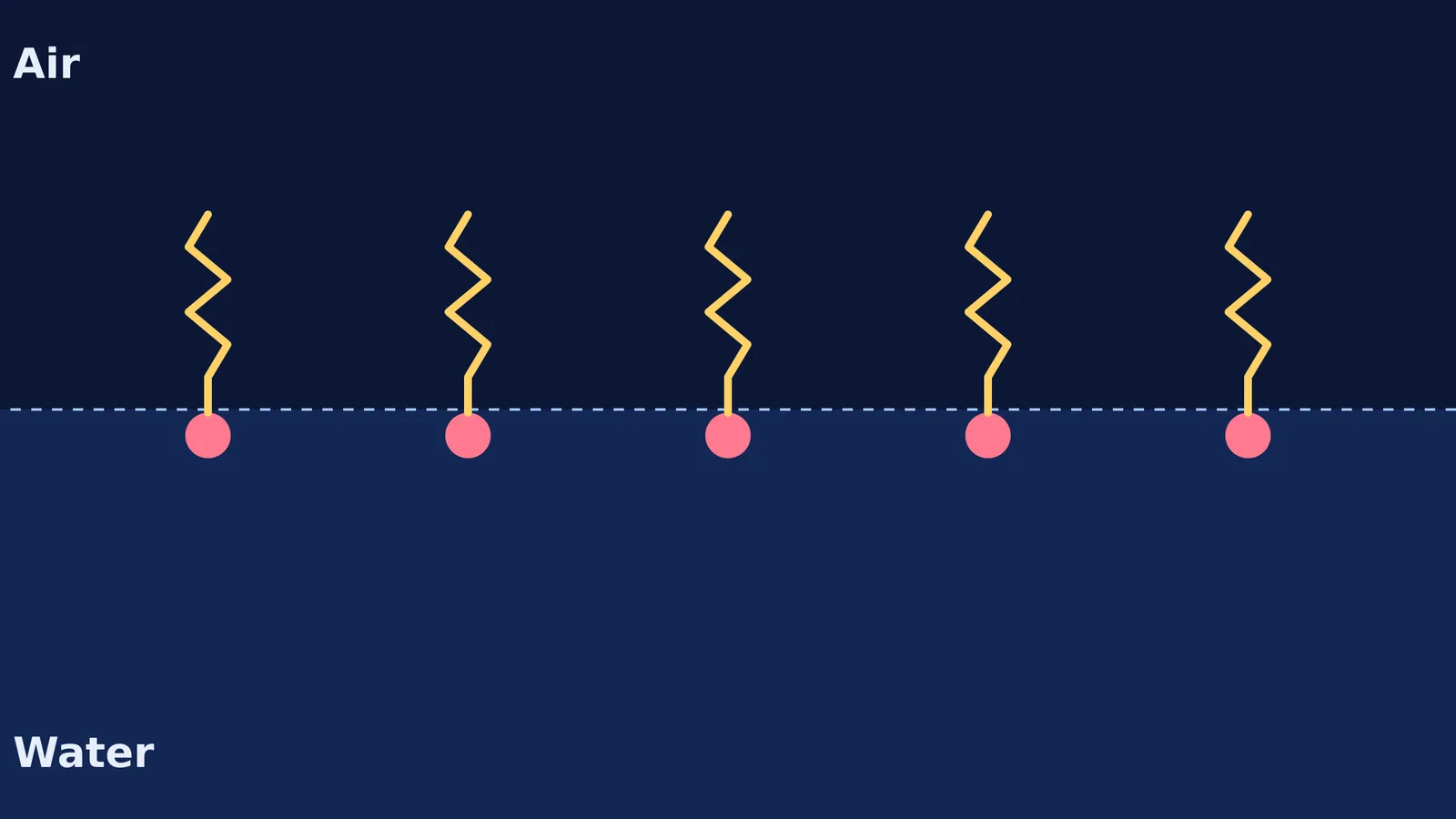
This is why toothpaste contains a surfactant—most commonly sodium lauryl sulfate (SLS). A surfactant is an amphiphilic molecule: it has a water-loving (hydrophilic) head and a water-repelling (hydrophobic) tail. When SLS dissolves in water, its molecules line up at the boundary between the water and the air. The heads stay in the water while the tails point into the air, reducing the surface tension. This allows the liquid to stretch into thin, stable films that trap the air, creating a rich foam.
What happens to surface tension?
Surface tension is the tendency of a liquid surface to shrink into the minimum surface area possible. Because water molecules are polar, they form strong hydrogen bonds with their neighbours. At the surface, there are no water molecules above them, so they pull more tightly to the sides and downwards.
Adding a surfactant disrupts this tight network. The surfactant molecules force themselves between the water molecules at the surface. Because the attractive forces between the surfactant tails and the water molecules are weaker than the forces between the water molecules themselves, the overall surface tension drops.
This physics applies to many everyday phenomena, from insects walking on water to the kitchen trough that measured surface films. If you find surface tension and intermolecular forces hard to picture from a textbook, the Fermi Simulation Lab lets you adjust variables in a liquid and watch how the molecules respond in real time.
Why do manufacturers add foaming agents?
The foam itself does not clean your teeth. The cleaning is done by the physical scrubbing of the toothbrush bristles and the mild abrasives (such as hydrated silica) in the paste, which make up about 8–20% of its weight and physically scrape away dental plaque and food debris.
However, the foam serves two practical purposes:
Distribution: The bubbles help carry the active ingredients, such as fluoride (which helps prevent tooth decay), into the tiny gaps between teeth.
Suspension: The foam traps the dislodged plaque and food particles so they can be easily spat out.
The main reason toothpastes contain foaming agents is user experience. People associate a rich lather with cleanliness. If a toothpaste does not foam, many users feel that it is not working properly, even though the abrasive and the fluoride are still doing their jobs.
Understanding the science behind everyday products helps you realise that chemistry and physics are not just abstract rules to memorise for an exam. Whether you are revising for JEE Main, NEET-UG, or a school test, spotting these principles in your own bathroom makes the concepts easier to hold onto.


