

On this page
When you look at a tiger, its bright orange and black coat seems impossible to miss. It stands out sharply against the green leaves of the jungle, making it one of the most recognizable animals on the planet. But if an orange coat is so visible, how does a tiger ever get close enough to catch its prey? The answer lies in how its prey sees the world, offering a fascinating lesson in evolution and the physics of light.
Why do tigers have orange and black stripes?
Tigers rely on their orange and black stripes for camouflage, a trick that is highly effective against the visual system of their main prey. Dr John Fennell and his team at the University of Bristol published a 2019 study in the *Journal of the Royal Society Interface* testing how the environment and the observer's visual system affect camouflage. Source
Using image processing and deep neural networks, the researchers embedded images of targets into realistic environments, such as temperate forests and semi-arid deserts. They discovered that for simulated red-green colour-blind dichromats—a category that includes most non-human mammals—colour strongly affected detection time. To these animals, an orange coat functions as an optimal colour for concealment, making the tiger look just like the green grass and shade it moves through. The black stripes help break up the outline of the tiger's body, completing the illusion.
How do deer see colour?
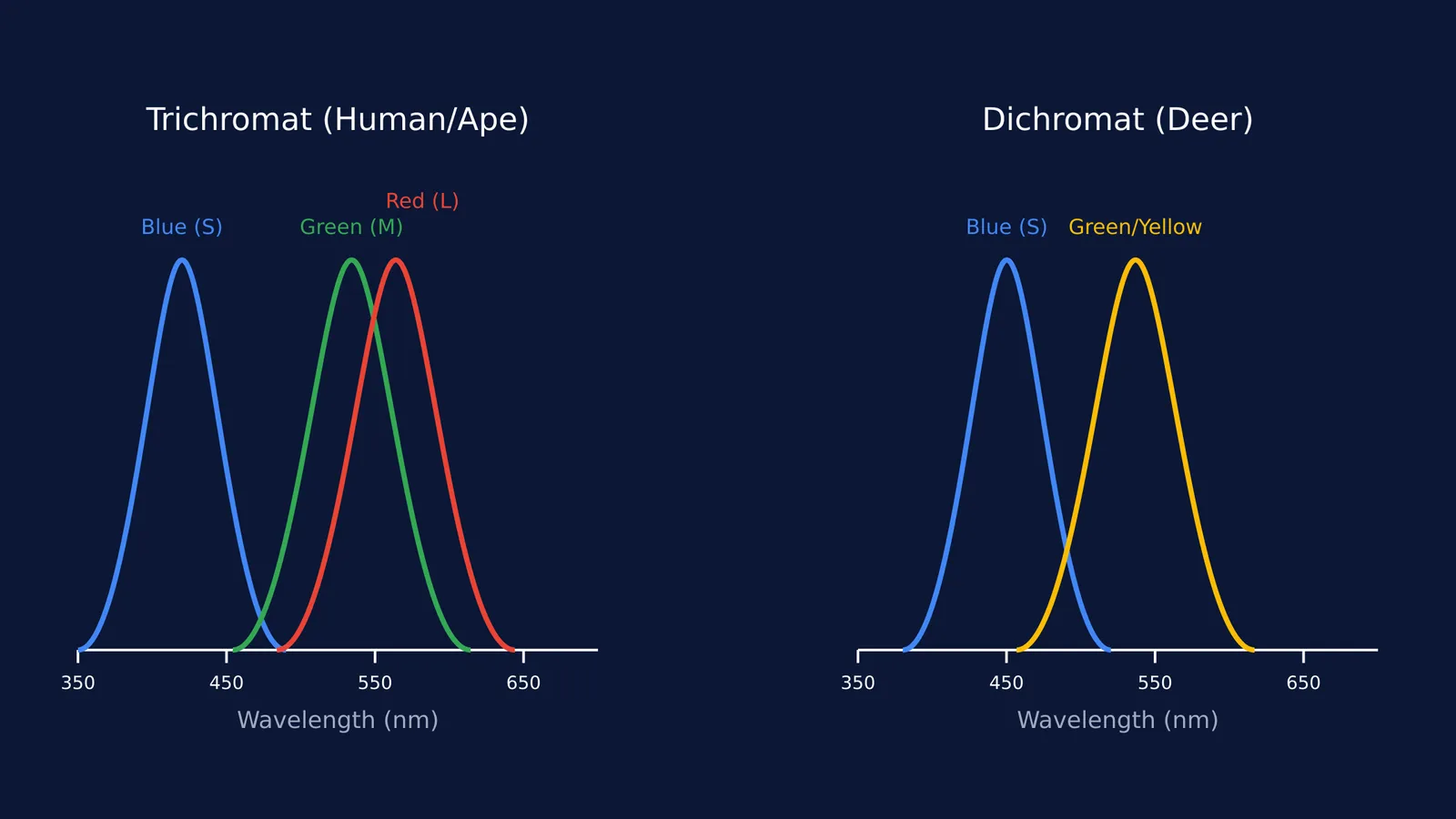
Most mammals, including deer and wild boars, are dichromats. This means they have only two types of colour-sensing cone cells in their eyes, leaving them unable to distinguish between red or orange and green. When a deer looks at an orange tiger, its eyes process the light in a way that makes the predator appear a mottled green.
Humans and some apes are trichromats. We possess a third type of cone cell that allows us to easily distinguish red and orange wavelengths from green ones. In the Fennell study, trichromatic observers were found to be far more effective at breaking camouflage. Source
Trichromatic vision in primates is thought to have evolved to help them spot ripe red or orange fruit against green leaves in the forest canopy. Because we share this evolutionary history, our eyes are exceptionally good at spotting the tiger. We see the predator clearly because our ancestors needed to see the fruit. But a deer’s ancestors were busy scanning wide fields of view for movement, relying more on their sensitive hearing and smell. Their dichromatic vision is well suited for detecting motion in low light, which is a far more critical survival tool for them than seeing the full colour spectrum.
Why not just evolve green fur?
If green is the perfect camouflage in a forest, why did tigers not simply evolve green fur? The answer comes down to physical constraints in mammalian biochemistry. Mammalian hair gets its colour from melanin pigments, which only produce colours ranging from black and brown to red, orange and yellow. Mammals lack the biochemical pathway to produce a true green pigment. While reptiles and amphibians can easily create green skin, mammals simply do not have the genetic tools to do so.
Because orange fur already looks green to a dichromatic deer, there was no evolutionary pressure for the tiger to develop complex new biochemistry to turn its fur literally green. The orange coat was an evolutionary shortcut that worked well enough to keep the tiger hidden from the animals it hunts.
To see how light interacts with materials and the eye, you can explore the Fermi Simulation Lab, which has interactive simulations for the ideas that are easier to see than to read.
How does this help you study science?
Understanding tiger colouration is an excellent example of how physics and biology overlap in the real world. It is not enough to simply know about animal habitats; you must also understand the physics of light and the biology of cone cells.
If you are studying for exams or tackling advanced biology concepts, this cross-disciplinary approach is vital. Questions often ask you to connect a physiological trait to an ecological outcome. Instead of memorising that tigers are orange for camouflage, understand the mechanism: the predator's pigmentation, the prey's photoreceptors, and the evolutionary pressure that ties them together. By breaking down a concept into its biological and physical components, you build a deeper understanding that is much harder to forget.
When you prepare for biology exams, keep this checklist in mind for answering questions about evolutionary adaptations:
Identify the physical constraint: What are the biochemical limits of the animal? (e.g., mammals cannot produce green pigment in their fur).
Look at the interaction: How does the trait interact with other species? (e.g., the predator's coat against the prey's vision).
Find the survival advantage: Why does this specific trait help the animal survive, hunt or reproduce?
To explore more about how animals adapt to their environments, read our guide on stabilising, directional and disruptive selection or see how physiology dictates survival in our breakdown of ammonotelic, ureotelic and uricotelic animals.
Next time you look at a brightly coloured animal, ask yourself who the colour is really meant for.


