

On this page
If you pick up a large block of thermocol, it feels like lifting almost nothing. How can a solid object take up so much space but have so little mass?
The answer lies in the chemistry of its structure and the physical laws of buoyancy.
What is thermocol made of?
Thermocol is the common name for expanded polystyrene (EPS). Polystyrene itself is an addition polymer made by joining thousands of styrene molecules into long chains. In an addition polymerisation reaction, the double bonds between carbon atoms in the styrene monomers break and link to adjacent molecules, forming a continuous backbone of carbon atoms without losing any atoms as by-products.
In its solid form, polystyrene is a hard, clear plastic (like the material used for CD cases or plastic cutlery). Solid polystyrene has a density of roughly 1050 kg/m³, which means it is slightly denser than water and would sink (Wikipedia).
So how does it become the feather-light white foam we know?
Why is thermocol so light?
To turn solid plastic into thermocol, manufacturers use a blowing agent, often pentane gas. When tiny polystyrene beads are heated with steam, the gas expands, puffing the beads up.
These expanded beads fuse together to form a closed-cell structure. The resulting material is approximately 98% trapped air and only 2% plastic by volume (Engineered Foam Products).
Because air has very little mass, the overall density of the material drops drastically. Standard EPS typically has a density ranging from 18 to 200 kg/m³ (Engineered Foam Products). When a material is mostly air trapped in tiny pockets, it becomes exceptionally light.
How does trapped air provide thermal insulation?
Because EPS is 98% air (Engineered Foam Products), it is not only light but also an excellent thermal insulator. In physics, gases like air are poor conductors of heat because their molecules are spread far apart compared to those in solids or liquids.
Furthermore, when this air is trapped inside millions of tiny, closed cells, it cannot circulate freely. This trapped structure effectively prevents heat transfer by convection currents. As a result, thermocol blocks the flow of heat, keeping hot things hot and cold things cold. This makes the material perfect for manufacturing disposable coffee cups, ice coolers, and building insulation.
Why does thermocol float?
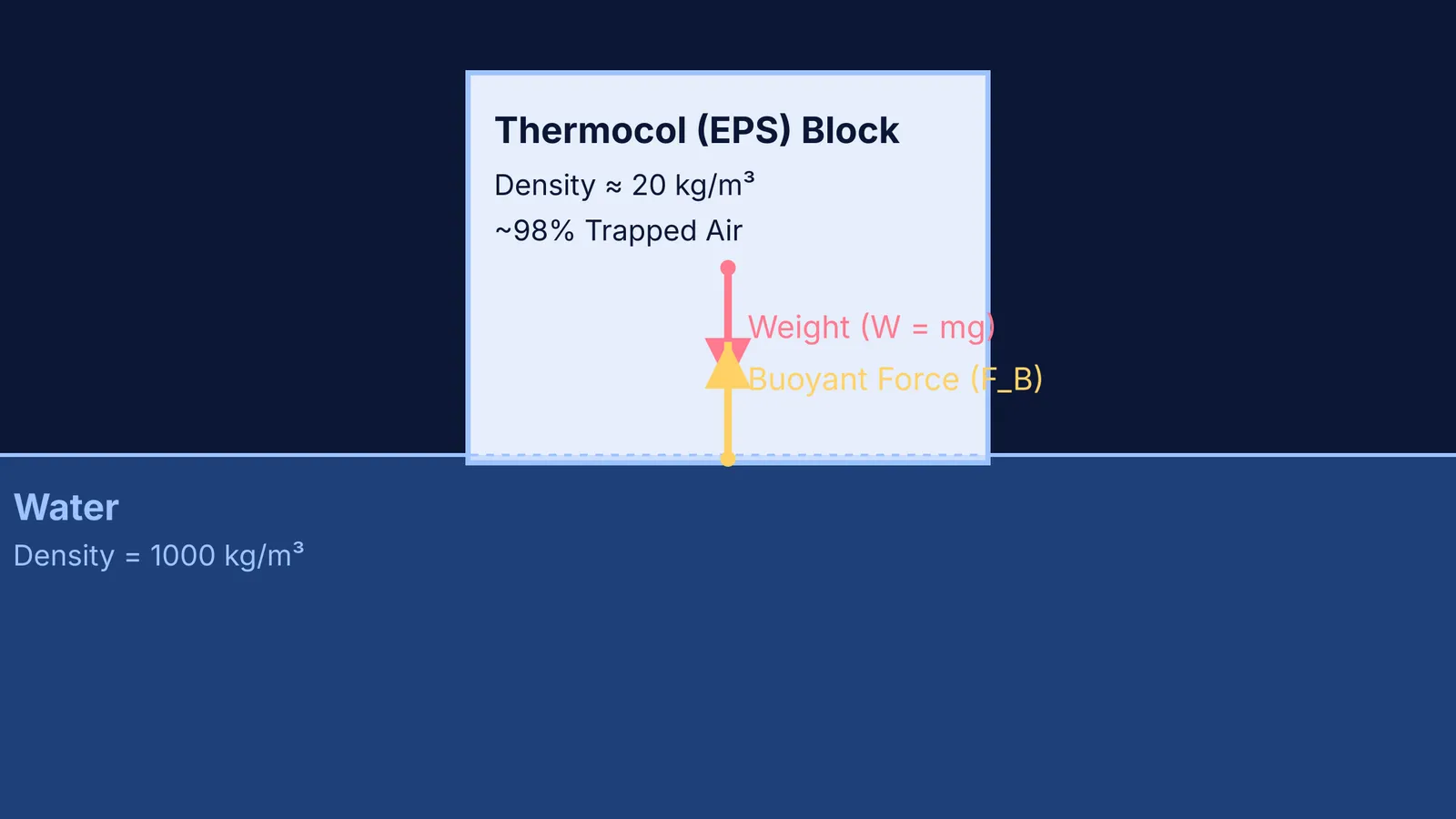
The reason thermocol floats so easily comes down to Archimedes' principle. This principle states that any object placed in a fluid experiences an upward buoyant force equal to the weight of the fluid it displaces. When an object is placed in water, gravity pulls it downward, while the displaced water pushes it upward. The object will sink until the upward buoyant force exactly matches its downward weight.
Pure water has a density of exactly 1000 kg/m³ (USGS). If you submerge a block of thermocol, it pushes water out of the way. Because thermocol's density is so low (e.g., 20 kg/m³, a typical value within the range provided by Engineered Foam Products), the water it displaces is about 50 times heavier than the block itself. This creates a massive upward force compared to the block's tiny downward weight.
The block will float, sitting very high in the water, with only a small fraction of its volume submerged to balance its weight. Understanding how buoyancy works in Class 9 gravitation can help you solve exam problems on floating objects, but visualizing it makes the concept stick. You can use the Fermi Simulation Lab to experiment with different block densities and see exactly how they settle in water.
How much weight can thermocol support?
If you want to build a raft, how much thermocol do you need? You can calculate this by comparing densities.
Find the volume: Let's say you have a block of EPS that is exactly 1 m³.
Find its mass: If its density is 20 kg/m³ (a typical value within the range provided by Engineered Foam Products), the block has a mass of 20 kg.
Find the displaced water's mass: If fully submerged, it displaces 1 m³ of water. Since water's density is 1000 kg/m³ (USGS), the displaced water has a mass of 1000 kg.
Calculate the supporting capacity: The upward buoyant force can support 1000 kg total. Since the block itself takes up 20 kg, it can support an extra 980 kg before going completely under.
Because of its closed-cell structure, the air inside thermocol is trapped securely. It doesn't soak up water like a sponge, ensuring it stays buoyant for a very long time even when submerged.


