

On this page
On a scorching May afternoon in India, outdoor temple flagstones grow too hot to cross barefoot without canvas runners. Yet stepping inside the shaded pillared hall (mandapa) onto polished granite or marble delivers an immediate, soothing chill to your bare soles.
This contrast is not merely psychological or a simple consequence of shade. The coolness stems from two physical mechanisms: the sensory physics of contact heat transfer and the building physics of massive stone. As physicist Stefano Oss (2022) demonstrated in the *European Journal of Physics*, cutaneous thermoreceptors do not measure an object's internal temperature. Instead, our nerve endings register the instantaneous temperature of the contact interface and the rate at which heat drains from our skin.
How does thermal effusivity explain what bare feet feel?
When two objects at different temperatures touch, heat flows from the warmer body to the cooler one. The speed and extent of this transfer are governed not by thermal conductivity alone, but by thermal effusivity.
Thermal effusivity, denoted by e, measures a material's ability to exchange thermal energy with its surroundings. It is defined as:
e = √(k · ρ · c)
Here, k represents thermal conductivity in W/(m·K), ρ is density in kg/m³, and c is specific heat capacity in J/(kg·K).
Human skin has an effusivity of roughly 1,000 to 1,300 J/(m²·K·s^(1/2)) according to Stefano Oss (2022). Dense stone like granite or marble has an effusivity between 2,200 and 2,700 J/(m²·K·s^(1/2)), owing to its high density (about 2,600 to 2,700 kg/m³) and moderate conductivity (2.2 to 3.2 W/(m·K)). By comparison, dry wood has an effusivity of only 300 to 600 J/(m²·K·s^(1/2)).
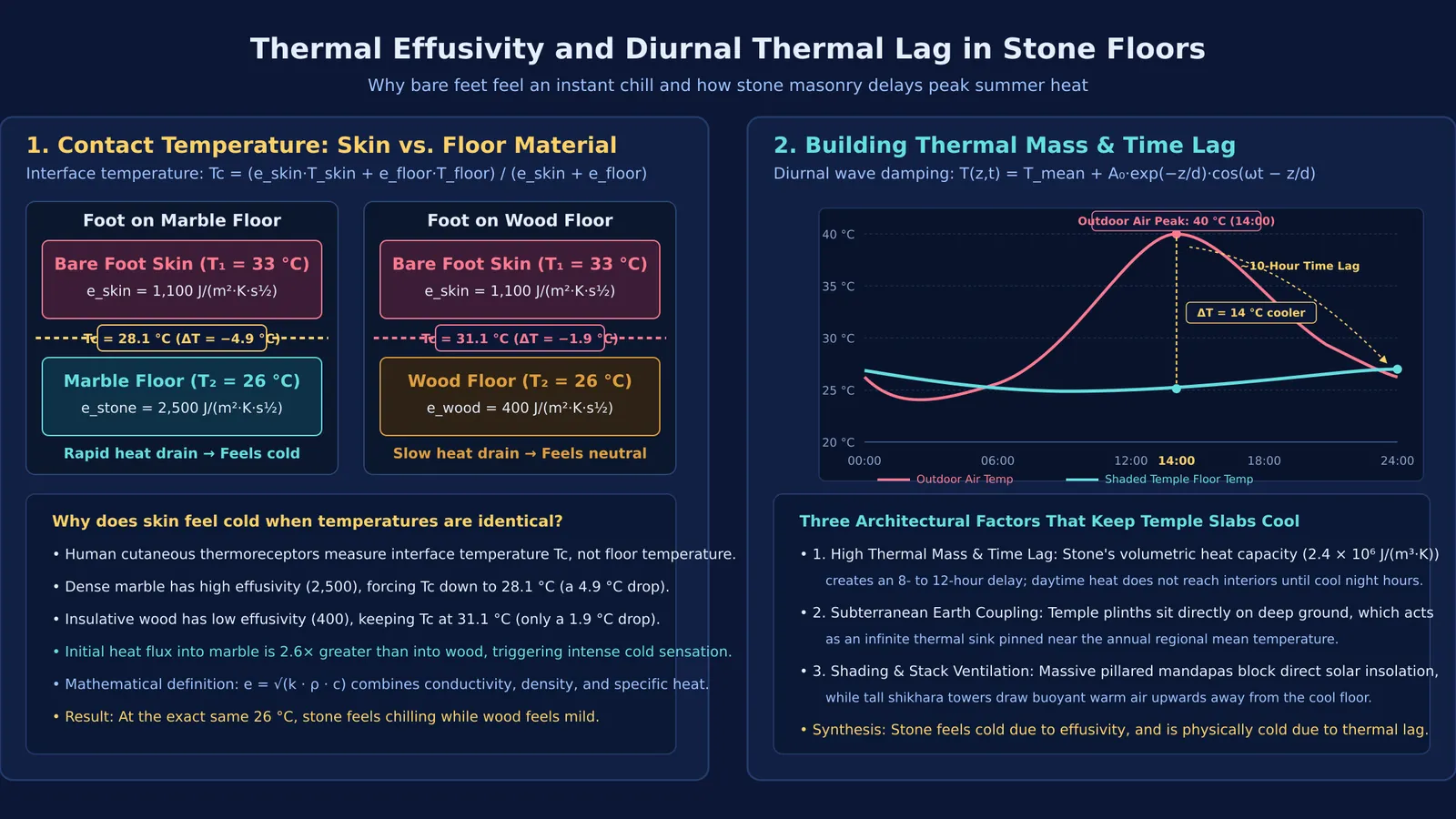
In research on bare-foot thermal comfort published in *Materials Research*, Carmeane Effting and colleagues (2007) showed that when skin touches a floor, the interface contact temperature T_c instantly reaches:
T_c = (e_skin · T_skin + e_floor · T_floor) / (e_skin + e_floor)
Consider a worked numerical example:
Suppose your bare foot has a skin temperature of 33 °C, and you step on a floor at 26 °C.
On a marble floor with e_floor = 2,500 and e_skin = 1,100 J/(m²·K·s^(1/2)):
T_c = (1,100 × 33 + 2,500 × 26) / (1,100 + 2,500) = (36,300 + 65,000) / 3,600 ≈ 28.1 °C. Your skin temperature drops by 4.9 °C almost immediately.
On a wooden floor at the exact same 26 °C, with e_wood = 400 J/(m²·K·s^(1/2)):
T_c = (1,100 × 33 + 400 × 26) / (1,100 + 400) = (36,300 + 10,400) / 1,500 ≈ 31.1 °C. Your skin temperature drops by only 1.9 °C.
Because the contact temperature on marble drops by an extra 3.0 °C and the initial heat flux is more than twice as large, your cold-sensitive cutaneous receptors fire intensely. The stone feels cold, even when a thermometer proves both wood and stone are at the exact same temperature.
Why is the stone floor actually colder than the afternoon air?
Thermal effusivity explains why stone feels colder than wood at the same temperature. But in traditional temples, the floor is also physically cooler than the surrounding afternoon air, often by 6 °C to 10 °C. Three architectural and environmental factors produce this baseline cooling:
High thermal mass and time lag: Dense stone has a high volumetric heat capacity of roughly 2.4 × 10^6 J/(m³·K). According to technical guidelines from India's Bureau of Energy Efficiency (BEE), high-mass envelopes create an 8- to 12-hour time lag and dampen daily temperature swings. Heat absorbed on exterior stone during peak afternoon sun takes half a day to penetrate thick masonry, so the coolness absorbed from the night air persists through mid-afternoon.
Earth coupling: Unlike modern framed structures with insulated raised slabs, traditional temple plinths (adhisthana) sit directly on deep earth foundations. As documented by S. P. Parmar and D. P. Mishra (2024) in *Frontiers of Architectural Research*, earth-coupled stone masonry acts as a massive thermal reservoir, continuously conducting absorbed heat downwards into the cooler ground.
Shading and stack-effect ventilation: Colonnaded halls and deep roof overhangs shield temple floors from direct solar radiation. High sanctum towers (shikhara) create a chimney effect: warm air rises and exhausts through upper openings, drawing cooler air across the shaded floor. Regular ritual washing of the stone adds evaporative cooling, consuming 2.26 × 10^6 J of latent heat per kilogram of evaporating water.
How can students connect temple floors to physics exams?
This everyday phenomenon directly connects to the Class 11 physics unit on Thermal Properties of Matter:
Fourier's law of heat conduction: Rate of heat flow H = dQ/dt = k · A · (T1 - T2) / L.
Specific heat capacity and calorimetry: Q = m · c · ΔT.
Newton's law of cooling and thermal diffusion across materials with differing conductivity.
To see these principles at home, you can run a simple three-step test:
Place a stone tile and a wooden block together on a table away from direct sunlight for a few hours until both reach thermal equilibrium.
Touch both surfaces with your palms; notice the instant sensation of cold on the stone despite identical temperatures.
Place an identical ice cube on each surface. The ice cube on the stone melts significantly faster because stone conducts thermal energy into the ice far more rapidly.
When concepts like transient heat conduction and boundary conditions feel difficult to grasp from static textbook diagrams, interactive exploration makes them intuitive. The Fermi Simulation Lab offers interactive simulations for ideas easier to see than read, helping you experiment with heat flow and material properties. For practising numericals on heat transfer and thermal equilibrium, the Fermi Problem Library has worked problems with a step-by-step solver that explains the reasoning rather than printing an answer.


