

On this page
When you pour hot water over dry tea leaves, they usually sit on the surface for a few minutes. Then, one by one, they begin to drift downward. This everyday kitchen ritual is a perfect demonstration of buoyancy, density and fluid dynamics in action.
The leaves change their position because their overall density changes as they steep. Understanding why this happens gives us a concrete way to see Archimedes' principle at work.
Why do tea leaves float initially?
Dry tea leaves are highly porous. During the curing and drying process, the water inside the plant cells evaporates. This leaves behind tiny, hollow pockets called vacuoles that are filled with air.
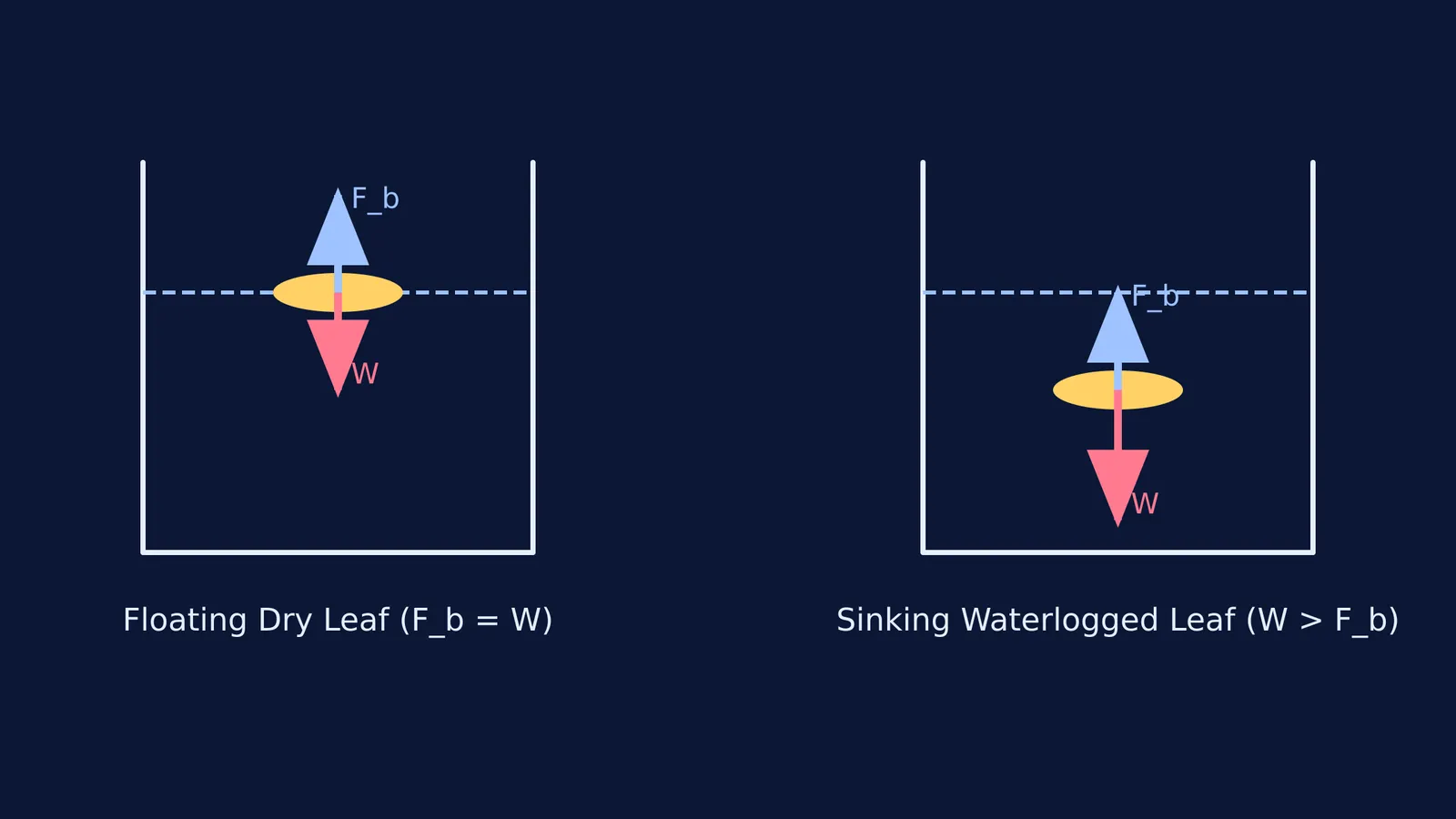
Because air is significantly less dense than water, the trapped air reduces the leaf's overall bulk density, making it lighter than water (1.0 g/cm³). According to Archimedes' principle, the upward buoyant force on an object equals the weight of the fluid it displaces. Since the dry, air-filled leaf weighs less than the volume of water it displaces, it experiences a net upward force and floats.
Additionally, surface tension plays a supporting role. The water's surface acts like a thin, elastic film that can hold up the light, often hydrophobic (water-repellent) surface of the dry leaves. For ideas that are easier to see than to read—like watching how buoyant forces balance out with density—you can run interactive simulations in the Fermi Simulation Lab.
How does waterlogging make the leaves sink?
As the leaves steep in hot water, two things happen to alter their mass and volume:
Displacement of air: Hot water gradually penetrates the porous cellular structure of the leaf, forcing the trapped air out. You can often see this as tiny bubbles escaping from the leaves and rising to the surface.
Increase in density: As water replaces the empty air pockets, the leaf becomes waterlogged.
While the leaf does lose a small amount of mass as flavour compounds (like tannins and caffeine) dissolve into the liquid, the weight of the water it absorbs is much greater. The main structural component of the leaf is cellulose, which has a density of approximately 1.5 g/cm³ (Wikipedia). Once the air is fully displaced, the combined density of the cellulose and the absorbed water exceeds the density of the surrounding liquid. The downward force of gravity now beats the upward buoyant force, and the leaf sinks.
This transition from floating to sinking is a great example of how matter in our surroundings changes physical properties through absorption and states.
Worked example: checking the net force on a sinking leaf
To see why the waterlogged leaf accelerates downward, we can estimate the net force acting on it.
Imagine a fully waterlogged tea leaf with a volume of 0.1 cm³ (1 × 10⁻⁷ m³).
Find the mass: If its density is dominated by cellulose at 1.5 g/cm³, its mass is 0.1 cm³ × 1.5 g/cm³ = 0.15 g (1.5 × 10⁻⁴ kg).
Find the weight (W): Using g = 9.8 m/s², the downward weight is 1.5 × 10⁻⁴ kg × 9.8 m/s² = 1.47 × 10⁻³ N.
Find the buoyant force (F_b): The leaf displaces 0.1 cm³ of water (density 1.0 g/cm³, or 1000 kg/m³). The displaced water's mass is 0.1 g (1.0 × 10⁻⁴ kg). The upward buoyant force is 1.0 × 10⁻⁴ kg × 9.8 m/s² = 9.8 × 10⁻⁴ N.
Net force: The downward weight (1.47 × 10⁻³ N) is greater than the upward buoyant force (9.8 × 10⁻⁴ N), resulting in a net downward force of 4.9 × 10⁻⁴ N. The leaf sinks.
Why do tea leaves gather in the centre when stirred?
If you stir your tea, you might expect the leaves to be flung to the outer edges of the cup by centrifugal force. Instead, they gather in a neat pile at the centre of the bottom. This counterintuitive behaviour is known as the "tea leaf paradox", a fluid mechanics puzzle famously explained by Albert Einstein in 1926 (Wikipedia).
When you stir the liquid, friction against the bottom and sides of the cup slows the water down. The faster-moving water near the top is pushed outward, creating slightly higher pressure at the rim. Because the slower-moving water at the bottom cannot push back against this pressure gradient, it is forced inward toward the centre. This creates a secondary flow that sweeps the heavy, waterlogged leaves into a pile at the middle of the cup.
Whether you are revising fluid mechanics and pressure for an exam or just making breakfast, the humble cup of tea is full of physics. Next time you brew a cup, watch the leaves carefully—you are watching Archimedes' principle in real time.


