

On this page
Why does tap water feel boiling hot the moment you turn on the tap?
If you turn on a tap on a scorching summer afternoon, the initial burst of water often feels hot enough to scald. Yet after running the tap briefly, the stream noticeably cools down.
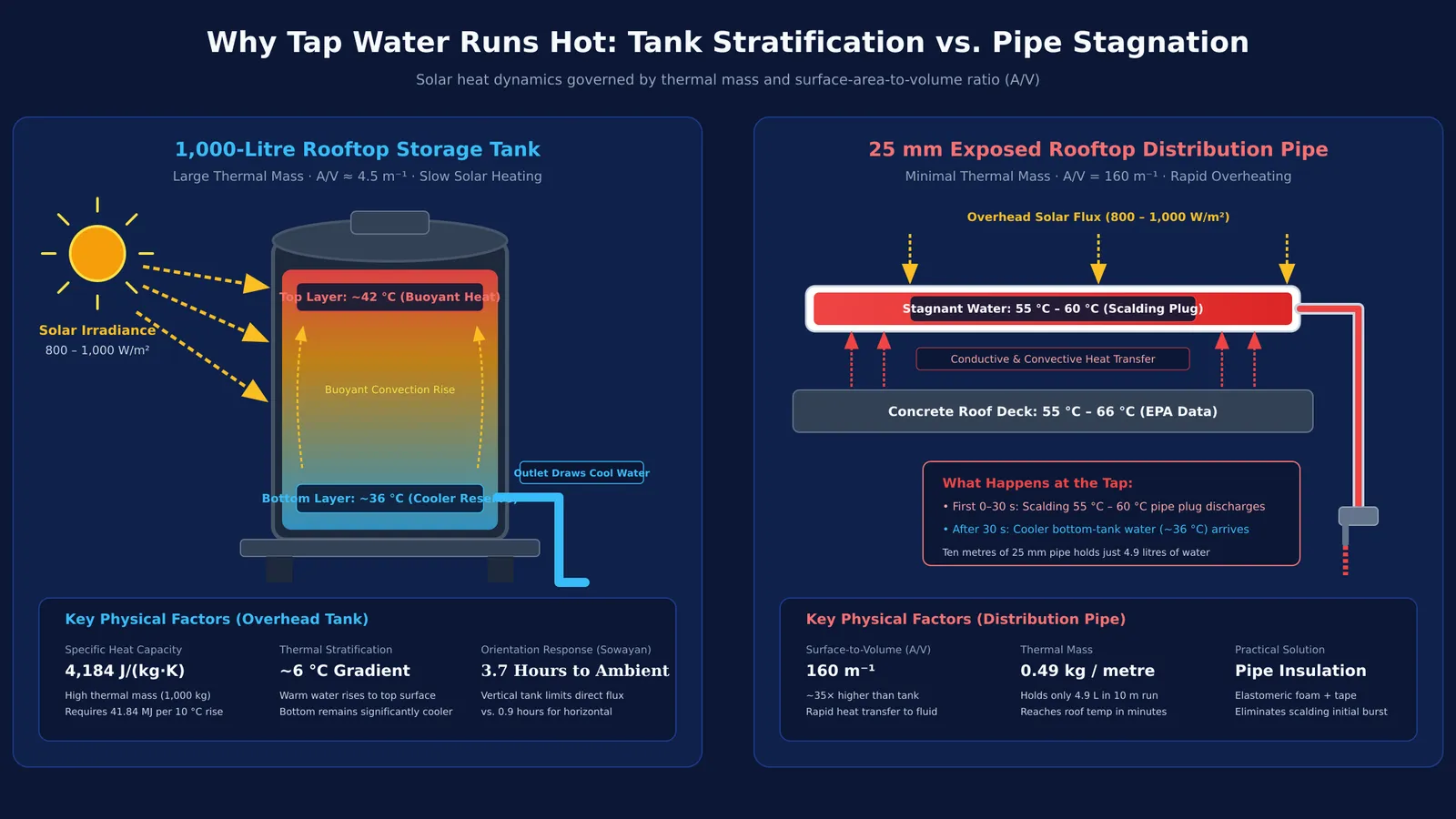
This temperature spike happens in exposed rooftop plumbing rather than the overhead tank. Most buildings route uninsulated polyvinyl chloride (PVC) or chlorinated polyvinyl chloride (CPVC) pipes horizontally across open concrete rooftops before dropping into living spaces. Data from the U.S. Environmental Protection Agency shows that conventional dark roofs reach peak surface temperatures between 55 °C and 66 °C under direct summer sun. Stagnant water sitting inside these exposed pipes absorbs this heat rapidly.
Heating rate depends on the surface-area-to-volume ratio (A/V). For a cylindrical pipe of radius r, A/V = 2/r. A standard 25-millimetre distribution pipe (r = 0.0125 m) has an A/V ratio of 160 reciprocal metres (m⁻¹), holding just 4.9 litres of water across a ten-metre run. With minimal thermal mass exposed to a large surface area, stagnant pipe water reaches thermal equilibrium with the roof within minutes. Analyzing how heat crosses material boundaries connects directly to heat conduction and thermal resistance in building plumbing.
Why are most rooftop water tanks black if dark colors absorb heat?
Because dark surfaces absorb more radiation, installing a black tank on a sunlit roof seems counterproductive. A white tank reflects considerably more visible sunlight.
The dominance of black tanks across India comes down to polymer durability and hygiene. Under Bureau of Indian Standards specification IS 12701:1996, outdoor rotational moulded polyethylene water storage tanks require 2% to 3% carbon black (2.5 ± 0.5% by mass). Tropical sunlight contains intense ultraviolet radiation that breaks polymer chains, making unprotected plastic brittle and prone to cracking. Carbon black serves as a permanent ultraviolet absorber, converting damaging UV photons into harmless heat. Complete opacity also stops light penetration, preventing algae and bacteria from contaminating stored drinking water.
This biological protection creates a thermal trade-off. Carbon black gives polyethylene an absorptivity (α) between 0.90 and 0.95, absorbing over 90% of incident radiation across visible and infrared wavelengths. In contrast, white polyethylene reflects most visible rays with an absorptivity near 0.25. As covered in lessons on conduction, convection, and radiation for Class 7, radiant heat transfers through electromagnetic waves without needing a medium, dumping thermal power directly into the tank wall.
How much energy does it take to heat a 1,000-litre water tank?
While pipe water warms in minutes, a full overhead storage tank takes hours to heat up because of the high heat capacity of bulk water.
Data from the NIST Chemistry WebBook confirms that liquid water has a specific heat capacity (cp) of 4,184 joules per kilogram-kelvin (4.184 kJ/(kg·K)) at 25 °C. Heating a 1,000-litre tank (mass m = 1,000 kg) by 10 °C requires:
Q = m · cp · ΔT = 1,000 kg × 4,184 J/(kg·K) × 10 K = 41.84 megajoules.
That energy equals 11.6 kilowatt-hours (kWh). Clear summer skies provide peak solar irradiance between 800 and 1,000 watts per square metre (W/m²). An unshaded tank exposes a projected area of about 2.2 square metres, receiving roughly 2 kilowatts of radiant heat around noon. Over six hours of high sun, this absorbed flux warms 1,000 litres of water from 32 °C to over 42 °C. Students exploring calorimetry and heat transfer calculate these exact thermal balances.
Orientation also governs warming rates. In the Arabian Journal for Science and Engineering, Ahmed S. Sowayan showed that a 1,000-litre vertical rooftop tank takes 3.7 hours to reach ambient temperature, compared to 0.9 hours for a horizontal tank. The vertical shape exposes less projected area to high-angle sun and promotes buoyant thermal stratification.
To visualize how irradiance, absorption, and buoyancy interact throughout the day, students can explore interactive models in the Fermi Simulation Lab, which provides interactive simulations for ideas that are easier to see than to read.
How can you keep your household tap water cool in summer?
You can keep tap water cooler by mitigating rapid pipe heating and slowing storage tank heat accumulation:
Insulate exposed rooftop pipes: Wrap pipes in closed-cell elastomeric foam sleeves or polyethylene insulation finished with reflective tape. By creating a thermal barrier against direct sunlight and hot concrete, insulation keeps stagnant water plugs from rapidly overheating.
Build an elevated shade canopy: Construct an open-sided roof structure over the tank. Shading blocks direct solar rays while leaving open sides for cross-ventilation, allowing natural air circulation to cool the tank exterior.
Install a reflective thermal jacket: Multi-layer slip-on covers pair a reflective aluminized shell with an insulating foam core, blocking incoming radiation while preserving the algae-inhibiting dark interior.
Refill the tank in early morning: Pump municipal or well water during the coolest pre-dawn hours, when supply water is at its lowest temperature. Filling before sunrise gives the bulk liquid greater thermal resistance against afternoon heat.
For students solving thermal physics numericals, the Fermi Problem Library offers worked problems with a step-by-step solver that explains the reasoning rather than printing an answer.


