

On this page
Why does a switch sometimes spark when you turn it off?
When you flip a switch to the "off" position, you are mechanically pulling two metal contacts apart to break the circuit. If the circuit was actively carrying a current, that flow of electricity cannot simply vanish in an instant. As the copper or brass contacts begin to separate, the current attempts to keep flowing, jumping across the microscopic air gap before the switch has fully opened.
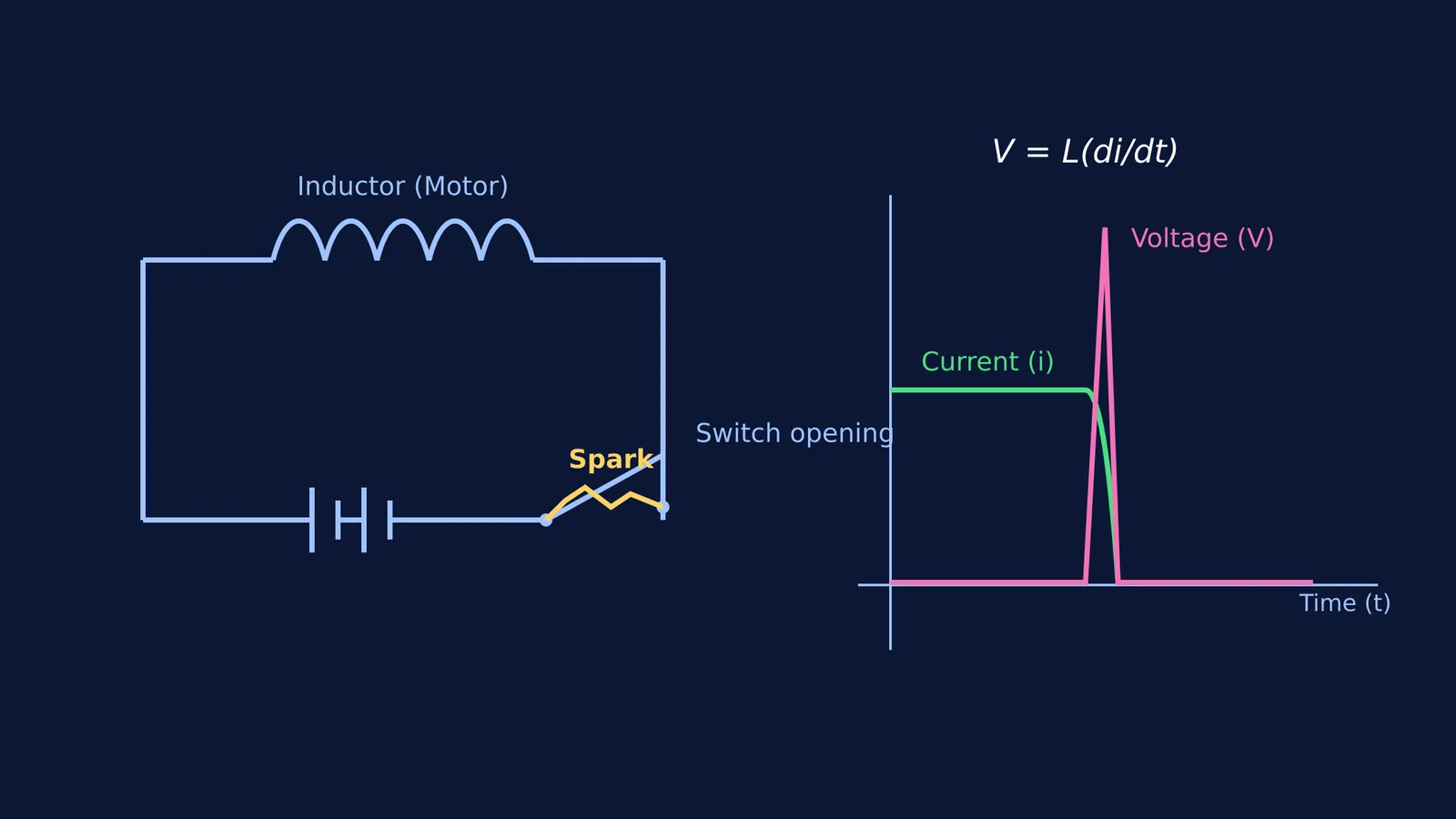
This happens because the circuit opposes any sudden change in current. The brief flash of light you see is an electric arc—a miniature lightning bolt—carrying the last of the electrical energy across the growing gap until the distance becomes too great for the arc to sustain itself.
Why does breaking the circuit cause a voltage spike?
To understand why the current forces its way across empty space, you have to look at the physics of self-induction. Every electrical circuit possesses some amount of inductance, which acts like electrical inertia. According to Faraday's law of induction, a changing magnetic field induces a voltage in a conductor.
You can see this relationship clearly in the standard equation for an inductor: V = L × (di/dt)
Here, `L` is the inductance of the circuit, and `di/dt` is the rate of change of the current over time.
When you open a switch, the current drops to zero in a fraction of a millisecond. Because the time interval (`dt`) is incredibly small, the rate of change (`di/dt`) becomes an enormous value. This phenomenon, often called inductive kickback, generates a sudden voltage spike. Even if you are just turning off a standard 240 V household circuit in India, this kickback can momentarily generate hundreds or even thousands of volts across the separating switch contacts.
If you struggle to picture how these induced fields behave in space, the Fermi Simulation Lab lets you interact with changing currents and watch the resulting voltage spikes in real time. We also have a detailed guide covering Faraday's law for a changing B: the circulating E inside a solenoid for a deeper mathematical look at the topic.
How does the air turn into a conductor?
Under normal conditions, air is an excellent insulator. However, if the voltage across an air gap climbs high enough, the intense electric field literally rips electrons away from the nitrogen and oxygen molecules in the air.
Dry air breaks down and conducts electricity when the electric field reaches approximately 3 million volts per metre (Wikipedia).
Because the switch contacts are only a fraction of a millimetre apart in the exact millisecond they first separate, the required voltage to bridge that specific gap is surprisingly low. For instance, a gap of just 0.1 mm only requires 300 V to reach the breakdown threshold of 3 million volts per metre.
The inductive kickback easily exceeds this 300 V requirement. When the threshold is crossed, the air ionizes and turns into a plasma. Plasma is highly conductive, allowing the current to bridge the gap and creating the bright, hot flash you see as a spark.
Why do some appliances spark more than others?
You might notice that turning off a simple incandescent bulb or an electric heater rarely produces a spark, but turning off a vacuum cleaner or an older ceiling fan almost always does. The difference comes down to the type of electrical load connected to the switch.
Resistive loads, like heaters, have very little inductance. When you switch them off, the current drops smoothly, and the induced voltage kickback is far too small to break down the air and cause a spark.
Inductive loads, however, are driven by electric motors, which are essentially large coils of copper wire wrapped around iron cores. A typical household motor holds a significant amount of magnetic energy while it is running. When you cut the power, all the energy stored in those magnetic fields has to go somewhere. The motor's large inductance fights the sudden change in current, generating a massive kickback voltage that forces a spark to carry the energy across the switch until the magnetic field collapses completely.
If you are preparing for exams like the JEE or NEET and get confused about what happens the moment a circuit is opened or closed, our breakdown of Inductors at t = 0 and t = ∞: quick rules for switch problems gives you the quick, practical rules for solving circuit problems.
How can you tell if a sparking switch is safe?
While a small spark is a completely normal demonstration of physics when turning off inductive loads, it should not happen with every device in your house. Use this simple checklist to tell the difference between normal inductive kickback and a potential electrical hazard:
Check the appliance type. Sparks are perfectly normal for devices with large motors, such as vacuums, power drills, blenders, and water pumps. They are not normal for modern LED lights, phone chargers, or televisions.
Look at the spark's colour. A brief, bright blue or white flash contained inside the switch casing is typical of an arc plasma. A yellow or orange spark that lingers suggests burning dust or plastic.
Listen for crackling. A single sharp "pop" is the sound of the arc breaking the air. Continuous crackling or a buzzing sound indicates a loose internal connection that is arcing continuously, which is a severe fire risk.
Smell for ozone. A tiny spark produces a trace amount of ozone, which has a sharp, metallic smell. However, if you smell burning plastic or fishy odours, the switch itself is overheating and must be replaced immediately by an electrician.
By understanding the underlying physics of the voltage spike, you can recognise that the brief flash in the dark is usually just your household appliances strictly obeying the laws of electromagnetism.


