

On this page
When you put pure sugar in a hot pan, it does not just melt into a liquid; it transforms. The clear crystals turn pale yellow, then a rich amber, and finally a deep, dark brown. This process, known as caramelisation, is one of the most complex non-enzymatic browning reactions in chemistry. It is completely distinct from the Maillard reaction, which requires the presence of amino acids in addition to reducing sugars. Caramelisation, by contrast, needs only sugar and heat to proceed. It is a fundamental process in both cooking and industrial food science.
At what temperature does sugar caramelise?
Caramelisation is a pyrolytic process (thermal decomposition) that relies on high temperatures. Different sugars have different starting points. Fructose begins to caramelise at just 105 °C, which is why fructose-rich foods brown so quickly in the oven. However, ordinary table sugar, or sucrose, requires significantly more heat. Sucrose begins to caramelise at 170 °C.
At this temperature, the energy from the heat overcomes the chemical bonds holding the sugar crystals together, and the solid structure breaks down.
What happens during the chemical process of caramelisation?
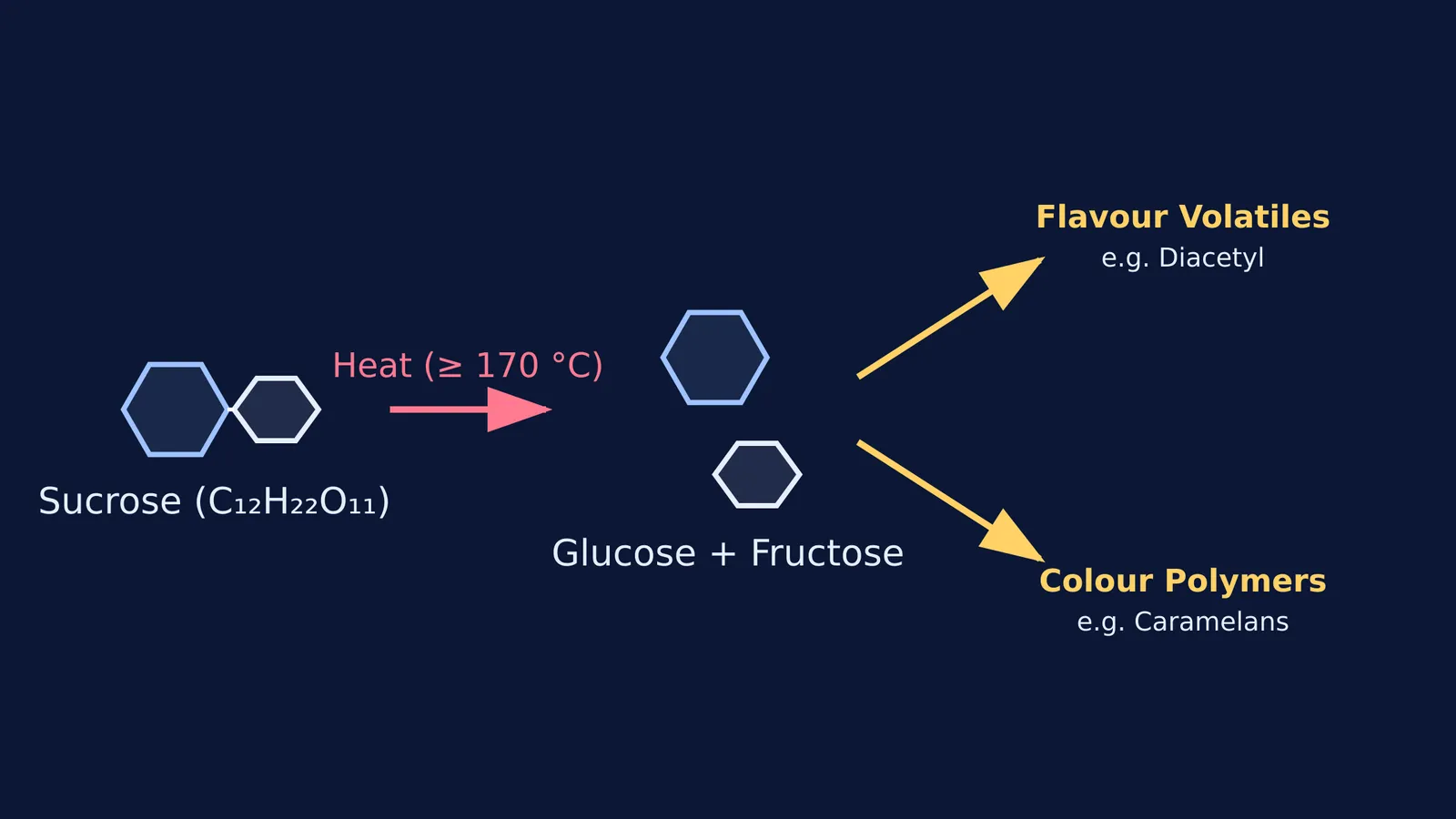
The reaction happens in a series of overlapping stages rather than a single step. As the temperature crosses the 170 °C threshold, the sucrose undergoes a process called sugar inversion. Heat breaks the disaccharide's glycosidic bond, splitting it into its two constituent monosaccharides: glucose and fructose.
Once the ring structures of sugars break open, the molecules undergo dehydration (losing water) and condensation. The sugar molecules begin to fragment into highly reactive pieces that collide and recombine in unpredictable ways. This cascade of reactions continues as long as sufficient heat is applied, constantly shifting the balance of compounds in the mixture.
If you find it difficult to picture these molecular rearrangements, the Fermi Simulation Lab provides interactive simulations for the ideas that are easier to see than to read.
What compounds are formed during caramelisation?
The fragmentation and condensation stages of caramelisation produce hundreds of chemical products. These products generally fall into two categories: small volatile molecules that create aromas, and massive polymers that create colour.
Flavour and aroma volatiles
As the sugar fragments, it releases small, highly volatile compounds that easily escape into the air. These include:
Diacetyl: This compound is released as the process occurs and is known for its intense butter-like taste.
Colour polymers
While the small fragments evaporate, other pieces link together in a continuous process called polymerisation. They form complex, heavily cross-linked molecules that give caramel its signature colour. There are three main groups of brown pigments produced during this phase, each characterised by its chemical formula:
Caramelans (C₂₄H₃₆O₁₈): These form early in the process as sucrose molecules begin to condense. They are relatively small polymers and give the mixture a light brown colour.
Caramelens (C₃₆H₅₀O₂₅): As heating continues and more water is lost, larger polymers form, turning the mixture a deeper, darker brown.
Caramelins (C₁₂₅H₁₈₈O₈₀): These are massive, highly cross-linked polymers that appear in the final stages of the reaction. They create a very dark, thick and nearly insoluble substance.
If the heat is not removed in time, the complex polymers will break down completely, releasing the last of their oxygen and hydrogen as water vapour. This final stage leaves behind pure, bitter carbon, destroying the appealing flavours entirely.
Instead of just handing you the answer to complex reaction mechanisms, Fermi's AI tutor teaches — it holds a line of reasoning across a whole session, notices where a student is stuck, and decides whether to explain, ask, or show.
A checklist for analysing thermal reactions in chemistry: When evaluating a browning reaction in a chemistry exam or laboratory, it is important to systematically identify the reactants and the conditions. Use this framework to guide your analysis:
Identify the reactants: Is it pure sugar, or are proteins and amino acids present? (If amino acids are present, you are observing a Maillard reaction, not caramelisation).
Check the threshold temperature: Ensure the heat applied meets the specific sugar's activation point (e.g. 170 °C for sucrose, 105 °C for fructose).
Trace the initial breakdown: Map the inversion of the disaccharide into its monosaccharides before proceeding to the fragmentation steps.
Categorise the products: Group the resulting molecules by size, separating the small aroma volatiles from the large colour polymers to better understand the reaction's output.


