

On this page
Open a jar of granulated sugar stored in a cupboard for a decade, and it remains as safe to eat as when milled. Unlike bread, milk, or fresh fruit, dry white sugar does not sour, rot, or grow mold.
Food safety authorities recognise this stability. The U.S. FoodSafety.gov FoodKeeper App notes white sugar has an indefinite pantry shelf life. In India, Regulation 5(10)(d) of the Food Safety and Standards (Labelling and Display) Regulations, 2020 explicitly exempts solid sugars from expiry date requirements. Under the Codex Standard for Sugars CXS 212-1999, commercial white sugar must have a polarization of at least 99.7 °Z (indicating 99.7% pure sucrose) with a maximum loss on drying of only 0.1%. Sucrose is a non-reducing disaccharide linked by an α-1,β-2-glycosidic bond—a structure explored in our guide on reducing and non-reducing sugars—making it chemically resistant to oxidation. But its true preservative power lies in physics.
Why does sugar never go bad in the jar?
Food spoils when microbes feed on nutrients, divide, and release metabolic by-products. Like all cellular life, microbes require biologically available water for membrane fluidity, nutrient transport, and enzymatic catalysis.
Without free water, cellular machinery stalls. Pure sucrose contains abundant carbohydrates, but dry granules instantly starve any microbial cell of water. Sugar does not merely lack moisture; it actively extracts water from any cell that touches it.
What is water activity, and why does microbial life stop at 0.605?
Food scientists measure water availability using water activity (a_w). As defined in the U.S. Food and Drug Administration's FDA Inspection Technical Guide on Water Activity in Foods, water activity is the ratio of water vapour pressure in a food (p) to that of pure water (p₀) at the same temperature: a_w = p / p₀.
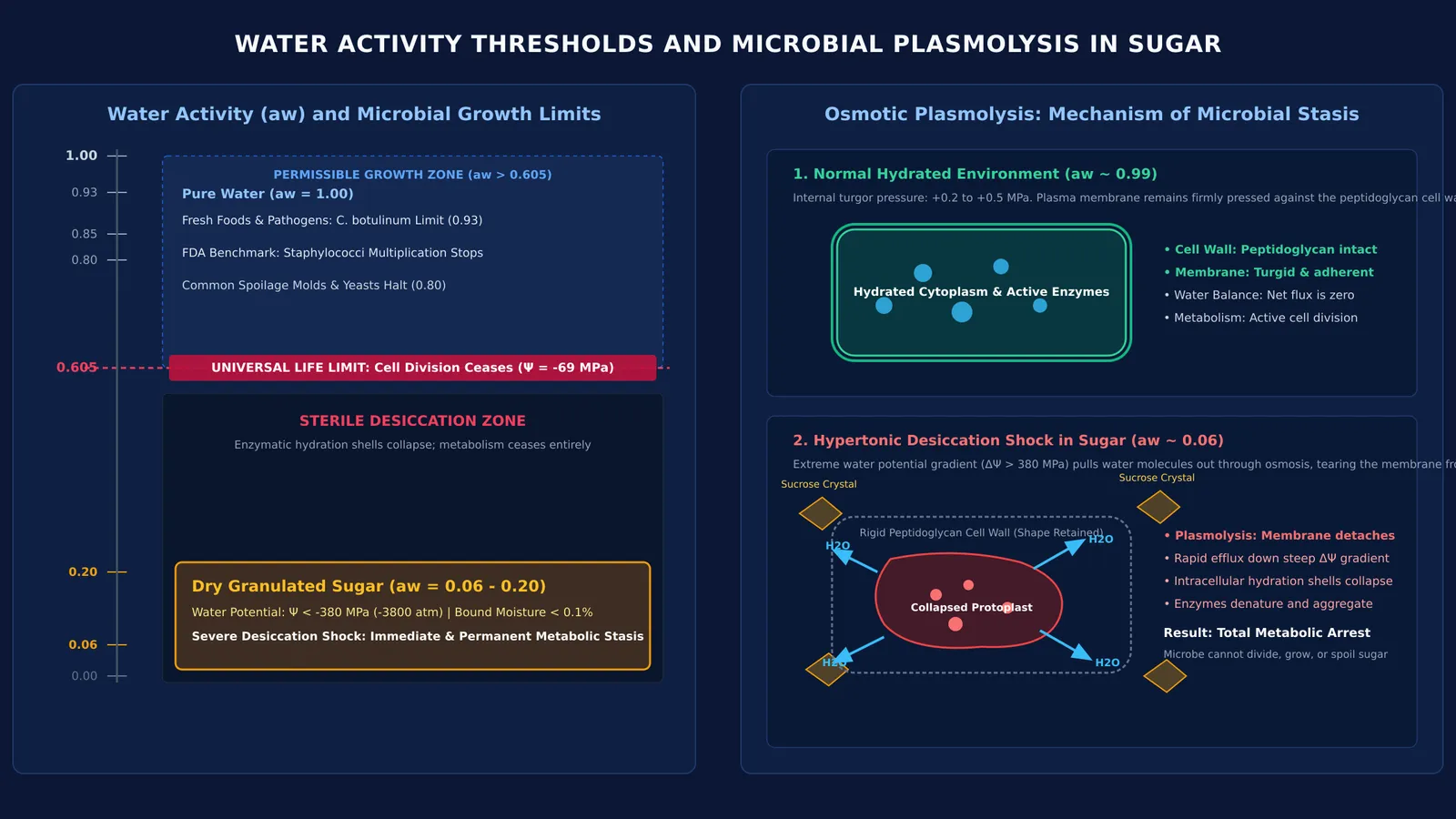
Pure water has an a_w of 1.00, while fresh meats and fruits sit above 0.95. The FDA guide notes that pathogens like Clostridium botulinum require an a_w of roughly 0.93, while controlling a_w to 0.85 or less serves as a key benchmark to stop vegetative pathogen multiplication. In Applied Microbiology, J. I. Pitt and J. H. B. Christian showed that xerophilic molds stop dividing below 0.605 a_w. Andrew Stevenson and colleagues confirmed in Environmental Microbiology that 0.605 is a universal thermodynamic threshold for cell division across terrestrial life.
Commercial granulated sugar has a typical a_w between 0.06 and 0.20, creating an uninhabitable biological desert.
How does osmosis trigger lethal plasmolysis in microbes?
When a microbe settles on dry sugar, it encounters a catastrophic chemical potential gradient driven by osmosis.
As analyzed by Andrew Stevenson and colleagues in Environmental Microbiology, water activity couples to water potential (Ψ) by Ψ = (RT / V_w) × ln(a_w). At the microbial division limit of 0.605 a_w, water potential is −69 MPa (−690 atmospheres). In dry granulated sugar with an a_w near 0.06, water potential plunges below −380 MPa (−3800 atmospheres). Because a bacterial cell maintains internal turgor between 0.2 and 0.5 MPa (2 to 5 atmospheres) and an a_w near 0.99, water rushes out of its cytoplasm.
This rapid water loss triggers plasmolysis: the cell membrane tears from the cell wall, hydration shells around enzymes collapse, and the microbe dies or enters complete metabolic arrest. Our profile of Wilhelm Pfeffer and osmotic pressure details early osmotic measurements, while our guide on finding molar mass from osmotic pressure covers the calculations.
The Fermi Simulation Lab provides interactive simulations for ideas that are easier to see than to read, allowing students to observe cellular plasmolysis in real time.
When can sugar actually spoil or grow mold?
Pure sugar is hygroscopic, binding ambient water vapour through polar hydroxyl groups.
As documented by M. Mathlouthi and B. Rogé in Food Chemistry00534-4), sucrose exhibits a sharp sorption isotherm. When room relative humidity exceeds 65% to 75%, surface crystals absorb moisture. Temperature fluctuations dissolve a microscopic sugar film, creating capillary bridges that recrystallise into hard lumps—a mechanical process called caking that leaves sugar sterile.
True spoilage occurs only if external liquid water enters the jar. A wet spoon or steam condensation creates a diluted syrup pool. If surface water activity rises into the 0.65 to 0.80 range, airborne osmophilic yeasts or xerophilic molds can germinate, fermenting the syrup into alcohol and organic acids. Sugar never spoils from age; it spoils only if diluted.
How can you tell if pantry sugar has been compromised?
If you find an old jar of sugar, use this four-step check:
Test hardness: Solid blocks reflect humidity cycles. If dry and white, crush it with a spoon; it is completely safe.
Inspect for pooling: Weeping syrup or dark spots mean liquid water entered. If mold mycelium or wet syrup is visible, discard the jar.
Check aroma: Pure sucrose is odorless. A sour or fermented smell indicates yeast or bacterial growth in damp pockets.
Protect against humidity: Store sugar in an airtight container with a rubber seal, away from steam.
To explore how solute concentrations govern colligative properties, the Fermi Concept Library covers every concept in physics, chemistry, biology, mathematics and computing, each with its own lesson and its place in the map. For step-by-step practice calculating osmotic pressure and solution equilibria, the Fermi Problem Library provides worked problems with a step-by-step solver that explains the reasoning rather than printing an answer.


