

On this page
If you have ever seen an insect helplessly trapped in a spider web, you might wonder how the spider itself walks freely across the same sticky threads. A spider's web is a feat of biological engineering, capable of stopping a flying insect in mid-air while allowing the architect to move easily across it. The answer to this puzzle is not just one simple trick, but a layered system of structural, physical, and chemical adaptations that work together perfectly.
Which threads are sticky?
The first way spiders avoid getting trapped is by building a web where not every thread is sticky. An orb-weaving spider produces different types of silk from different specialized glands, each engineered for a specific purpose. The outer frame and the radial "spokes" that run from the centre to the edge are made of dry, non-sticky dragline silk. Spiders generally use these dry lines as safe, structural pathways to travel rapidly across the web without risk.
The sticky threads, on the other hand, are only found in the circular capture spiral. These lines are coated with an aqueous glue that sits in microscopic droplets along the thread, remaining highly viscous and ready to snare a passing insect. But because the spider must sometimes build, repair, and traverse these lines to reach its prey, what happens when it inevitably has to step on these sticky threads?
How do spiders avoid the glue?
For decades, scientists debated the exact physical mechanism, with early theories suggesting spiders simply secreted an oily substance or possessed a specialized claw. A 2012 study published in *Naturwissenschaften* by researchers at the Smithsonian Tropical Research Institute and Universidad de Costa Rica identified three precise ways orb-weaving spiders navigate the glue.
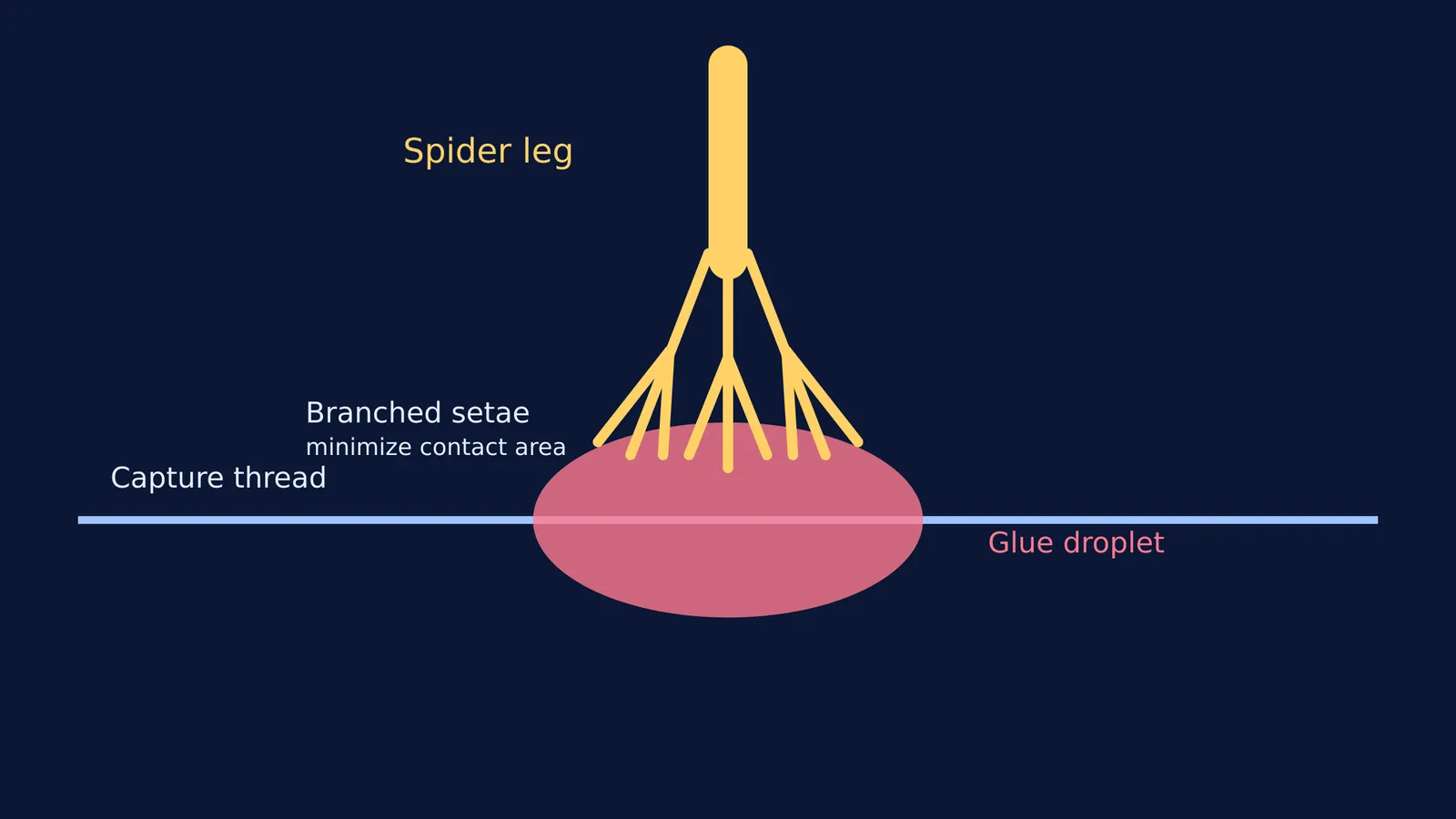
Branched leg hairs: The tips of a spider's legs are covered in dense, branching hairs called setae. When a spider touches a glue droplet, these branched hairs act like a microscopic bed of nails, significantly reducing the total surface area that comes into direct contact with the adhesive.
Chemical non-stick coating: A separate 2012 study published in the *Journal of Zoological Systematics and Evolutionary Research* confirmed that spider legs have an organic, anti-adhesive chemical coating. When researchers washed the spiders' legs with an organic solvent to remove this protective coating, they found the legs adhered strongly to the sticky threads.
Clever leg movements: High-speed video analysis shows that spiders engage and withdraw their legs using a highly specific peel-off mechanism. Instead of pulling directly upwards against the adhesive droplet, they carefully roll their legs away. This gentle, angled withdrawal minimizes the mechanical force required to break the temporary bond.
How to navigate sticky subjects without getting trapped?
Just as a spider navigates a complex web by building a dry structural framework and carefully avoiding the sticky traps, students can approach dense, complicated subjects without getting bogged down. If you jump straight into the hardest numericals without first establishing a strong conceptual foundation, you are effectively stepping directly into the glue.
Instead, build your dry framework first. Map out the core principles before you attempt to memorize all the exceptions. If you are struggling with a difficult concept, you can approach learning a chapter you've never understood, step by step to ensure your foundational understanding is solid. When you do need to engage with the difficult, "sticky" parts of a syllabus, you need the right technique rather than just brute force. Fermi Simulation Lab provides interactive simulations for the ideas that are easier to see than to read, helping you build that necessary intuition.
When working through difficult, multi-step problems, Fermi's AI tutor acts like a non-stick coating for your study session: rather than answering a question and letting you stay stuck on the next one, it holds a line of reasoning across a whole session and decides whether to explain, ask, or show. If you find that you consistently struggle with similar questions despite understanding the theory, remembering why making mistakes helps you learn, and how to use them ensures you know exactly which sticky areas to avoid in the future.


