

On this page
Why does orbital velocity make tiny space debris so dangerous?
Everyday intuition fails in orbit. On Earth, air resistance slows down loose particles, and a 1-millimetre fleck of paint drifting in a breeze seems harmless. In low Earth orbit (LEO), however, objects travel through vacuum at speeds governed by gravitational equilibrium: v = √(GM/r). According to the NASA Orbital Debris Program Office FAQ, spacecraft and orbital debris in LEO travel at speeds between 7 km/s and 8 km/s, or approximately 28,000 km/h, matching centripetal acceleration to Earth's gravity.
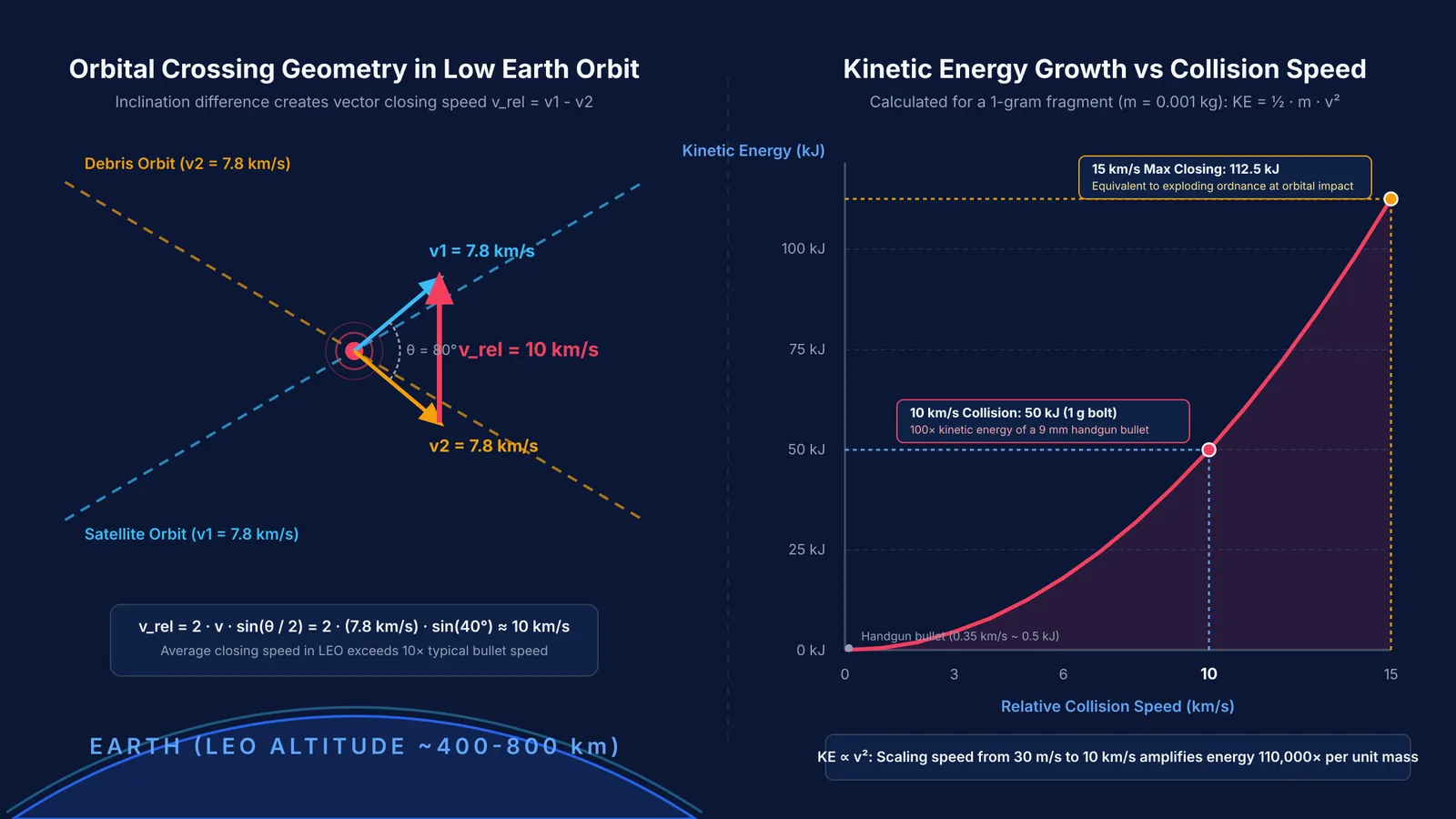
The danger compounds because satellites and debris occupy distinct orbital planes with different inclinations. When two crossing orbits intersect, closing speed depends on the vector difference of their velocities. As documented by the NASA Orbital Debris Program Office, average relative collision speed in LEO is approximately 10 km/s (22,370 mph), with head-on encounters reaching 15 km/s. To explore how altitude determines circular speed, see our guide to gravitation and satellite orbital mechanics.
The physical consequence follows from the kinetic energy relation: KE = ½mv². Because velocity is squared, raising speed from highway conditions of roughly 30 m/s to an orbital impact speed of 10,000 m/s increases velocity by 333 times, magnifying kinetic energy per unit mass by more than 110,000 times.
How much kinetic energy does a 1-gram fragment carry?
To see why small fragments threaten spacecraft hulls, consider a worked calculation for an aluminium fragment weighing 1 gram (m = 0.001 kg) colliding at an average relative speed of v = 10 km/s (10,000 m/s):
Convert mass to standard SI units: m = 1.0 × 10⁻³ kg.
Square the relative velocity: v² = (1.0 × 10⁴ m/s)² = 1.0 × 10⁸ m²/s².
Calculate kinetic energy: KE = ½mv² = 0.5 × (1.0 × 10⁻³ kg) × (1.0 × 10⁸ m²/s²) = 50,000 Joules (50 kJ).
According to data published by the European Space Agency, hypervelocity collisions at these velocities deliver massive destructive power, noting that a 1-centimetre fragment packs the kinetic energy of an exploding hand grenade.
As noted in the NASA Orbital Debris Program Office FAQ, orbital collision velocities exceed ten times the speed of a bullet. By comparison, a 9 mm handgun bullet delivers roughly 500 Joules of kinetic energy; a 1-gram orbital fragment at 10 km/s delivers 100 times that amount. Even a 1-millimetre paint fleck (mass roughly 0.0014 grams) carries approximately 70 Joules—comparable to a 5-kilogram bowling ball dropped from a height of 1.4 metres.
For physics students preparing for JEE, understanding how kinetic energy and linear momentum diverge at extreme speeds is essential; see our breakdown of kinetic energy and momentum relations. When practicing mechanics numericals, the Fermi Problem Library offers worked problems with a step-by-step solver that explains the reasoning rather than printing an answer.
Why can't satellite operators track and dodge millimeter debris?
The volume of orbital debris creates an acute tracking challenge. According to the European Space Agency Space Debris Office, statistical models estimate that Earth orbit contains more than 130 million fragments between 1 mm and 1 cm, about 1 million objects between 1 cm and 10 cm, and roughly 36,500 objects larger than 10 cm. Space surveillance networks regularly catalogue roughly 35,290 larger objects down to about 10 cm in LEO, enabling flight controllers to plan collision avoidance manoeuvres.
In India, space situational awareness is managed through the ISRO System for Safe & Sustainable Space Operations Management (IS4OM), which analyses close approach alerts to safeguard national satellites. However, collision avoidance manoeuvres only work for objects radar can detect. A 2-millimetre paint fleck or 5-millimetre metal shaving 800 km above Earth reflects far too little radar signal to be catalogued from the ground.
Consequently, as the NASA Orbital Debris Program Office FAQ warns, millimeter-sized debris represents the single highest mission-ending penetration risk to robotic spacecraft in low Earth orbit because impacts occur without warning. Calculating collision probabilities between crossing orbits relies on the principles of closest approach of moving bodies. In a landmark 1978 paper in the *Journal of Geophysical Research*, scientists Donald J. Kessler and Burton G. Cour-Palais demonstrated that cascading collisions among untracked debris could eventually form a dense, hazardous debris belt. To build an intuitive grasp of how orbital inclination and relative velocities create close approach risks, the Fermi Simulation Lab allows you to explore interactive simulations for ideas that are easier to see than to read.
How do Whipple shields protect spacecraft against hypervelocity impacts?
Because millimeter debris cannot be dodged with thruster burns, spacecraft rely on passive armor known as Whipple shields. At relative collision velocities between 7 km/s and 15 km/s, as documented by the NASA Orbital Debris Program Office FAQ, impact pressures vastly exceed the tensile strength of solid metals. On impact, the intense shock wave causes the incoming projectile and the outer shield wall to shatter, melt, and disperse into an expanding cloud of fine spray.
A single solid metal plate would be pierced through by such a concentrated blast. Invented by astronomer Fred Whipple in 1947, a Whipple shield uses spaced armor to disperse destructive energy across a wider footprint:
Outer bumper: A thin sacrificial sheet of aluminium shatters and melts the incoming projectile on impact.
Standoff distance: An open space allows the vaporized debris cloud to expand laterally as it travels forward.
Inner pressure hull: The spacecraft wall absorbs a diffuse spray distributed across hundreds of square centimetres rather than a concentrated puncture.
According to the NASA Orbital Debris Program Office FAQ, shielding on the International Space Station is engineered to withstand impacts from debris up to 1 centimetre in diameter. However, fragments between 1 cm and 10 cm remain too large for shielding to stop and too small for ground radars to track—leaving this size bracket the most hazardous operational gap in orbital safety.


