

On this page
Leaving a bowl of moong or chana soaked overnight is a familiar routine in many Indian kitchens. By morning, the seeds have swelled, and within a day or two, tiny white tails appear. But what exactly happens inside that bowl?
The answer comes down to water acting as an activation switch. A dry seed is alive but dormant, holding all the genetic instructions and food reserves it needs to become a plant. It waits for the right conditions—primarily water, oxygen, and warmth—to start growing.
What is imbibition?
The first step in sprouting is imbibition, the physical process where a dry seed rapidly absorbs water through its seed coat. Botanists divide this water absorption process into three distinct phases. Phase I is rapid imbibition, where dry seeds take up water until their cells are fully hydrated. Phase II is a plateau phase where water uptake slows down, but the seed experiences strong metabolic reactivation. Phase III is the completion of germination, marked by a final increase in water uptake as cells elongate. During Phase I, a chickpea can absorb a massive amount of water, roughly doubling its weight after 10 to 12 hours of soaking.
This water enters through a tiny pore called the micropyle. As the water rushes in, it hydrates the seed's cells and softens the tough outer coat.
Why do soaked moong and chana start sprouting?
Once the seed is fully hydrated, it shifts from physical swelling to biological action. Water reactivates dormant enzymes that the plant needs to digest its own food reserves.
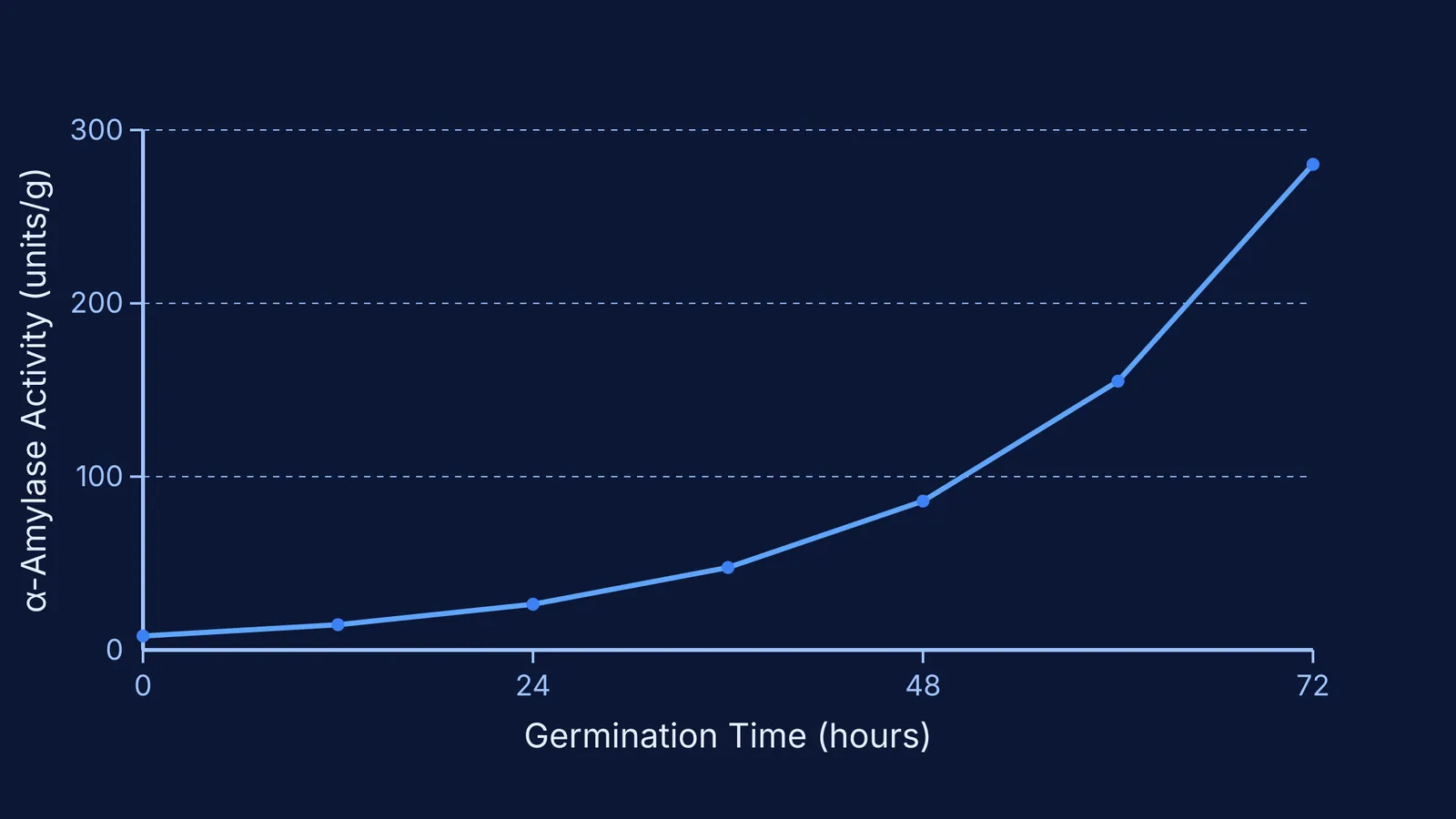
The seed's starchy interior is too complex for the baby plant (embryo) to use directly. To solve this, the seed uses hydrolytic enzymes. In mung beans, the activity of α-amylase—an enzyme that cuts starch into simple sugars—increases exponentially from 8.1 to 280.2 units per gram over the first 72 hours of germination. This sugar provides the immediate energy the embryo needs to push out its primary root, or radicle.
At the same time, other enzymes go to work:
Proteases break down stored proteins into free amino acids, making the protein much easier for our bodies to digest.
Phytase breaks down phytic acid (phytate), an anti-nutrient that binds minerals like iron and zinc. Studies show that phytate content can diminish by approximately 60% after 12 to 72 hours of soaking and germination, unlocking these essential minerals.
Other metabolic pathways produce beneficial compounds, such as gamma-aminobutyric acid (GABA), which can increase by two to five times during the initial sprouting phase.
This enzymatic breakdown is what makes sprouts so nutritious. For instance, the in vitro protein digestibility of chickpeas improves significantly as germination progresses over a 120-hour period. The enzymes driving this change, such as amylase and protease, belong to the six enzyme classes that govern biological reactions.
How does the embryo grow?
With simple sugars and amino acids now available, the seed begins cellular respiration to generate energy. This process uses respiration as an amphibolic pathway to build new plant tissue.
The radicle is the first part to emerge, seeking water in the soil. Moong beans generally sprout faster than chana because they have a thinner seed coat and activate their enzymes more rapidly.
Visualising biology with Fermi
It can be hard to picture the microscopic processes inside a seed, from water diffusion to enzymatic breakdown. If you want to see how these dynamic systems behave, the Fermi Simulation Lab lets you run interactive models of biological and physical processes, helping you understand the mechanism rather than just memorising the steps.
A practical timeline for sprouting at home
If you are sprouting seeds at home or for a school biology project, here is the timeline of what is happening inside the bowl, based on botanical studies of seed germination:
0–12 hours (Imbibition): The seed coat absorbs water rapidly. The seed swells and doubles in weight.
12–24 hours (Hydration complete): You drain the water. Oxygen can now reach the embryo, and enzymes wake up.
24–48 hours (Early germination): Keep the seeds moist and aerated in a cloth. The radicle emerges.
72–120 hours (Peak nutrition): Amylase and protease activity peak, making the sprouts highly digestible and rich in free amino acids, as seen in the 120-hour germination studies.


