

On this page
In a family, one sibling might have curly hair, brown eyes, and be unusually tall, while another has straight hair, hazel eyes, and is shorter. Unless they are identical twins, brothers and sisters are genetically distinct, despite coming from the exact same parents. The reason lies in how their parents' bodies produce reproductive cells through a highly specialised cellular division called meiosis. This microscopic mechanism is the fundamental engine of human variation.
What is meiosis?
Meiosis is a type of cell division that reduces the number of chromosomes by half to produce sperm and egg cells, yielding four haploid daughter cells that each carry a single set of 23 chromosomes (NHGRI). Human body cells are diploid, meaning they contain 46 chromosomes in 23 pairs—one set from the mother and one from the father. This reduction ensures that when an egg and sperm unite during fertilisation, the resulting embryo has the correct diploid number of 46 chromosomes. But meiosis does not just halve the genetic material; it actively shuffles it.
How does independent assortment shuffle chromosomes?
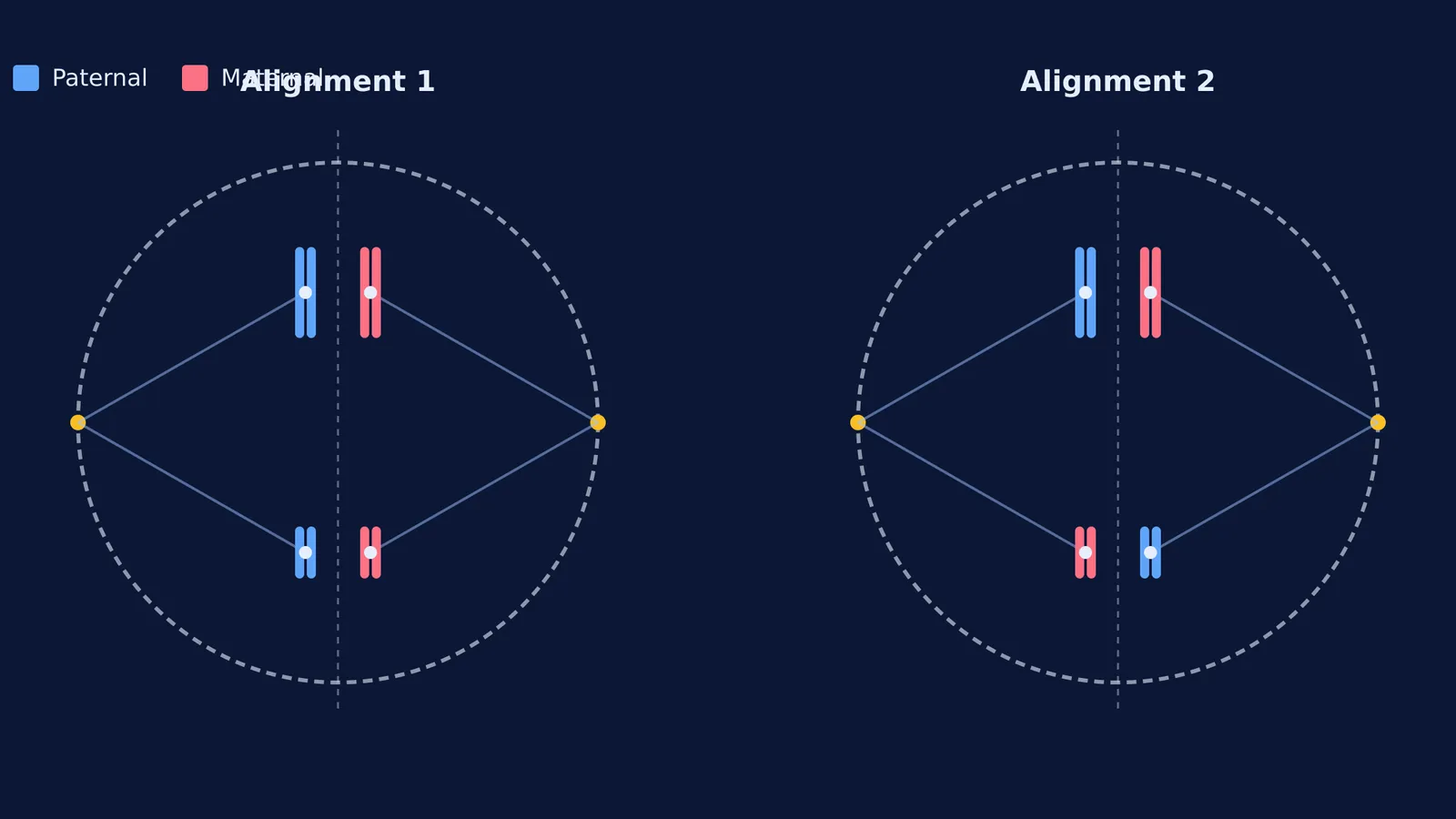
During the first round of meiosis (Metaphase I), the 23 homologous pairs of chromosomes line up along the centre of the cell. How they orient themselves is completely random. For any given pair, the paternal chromosome might face the left side of the cell, while the maternal one faces the right, or vice versa. The orientation of one pair does not affect any other pair.
Because each of the 23 pairs can line up in two different ways, the number of possible chromosome combinations in a human gamete is 2²³, which equals exactly 8,388,608 (Biology Online).
This means that a single person can produce over 8.3 million genetically unique sperm or eggs just through the random sorting of whole chromosomes. When a sperm and egg fuse, the combinations multiply (8.3 million × 8.3 million), meaning one couple could theoretically produce over 70 trillion unique offspring without counting any further mixing.
What is crossing over?
The 70 trillion figure assumes that chromosomes are passed down intact. In reality, they are not. Before the pairs line up to separate, they undergo a process called crossing over.
Crossing over is the exchange of DNA between paired homologous chromosomes during meiosis, creating new combinations of alleles (NHGRI). The non-sister chromatids intertwine, break, and swap segments of genetic material. This breaks the linkage between genes that sit on the same chromosome, creating entirely new, recombinant chromosomes that neither parent originally possessed. For example, if the gene for hair type and the gene for eye colour were originally linked on the same piece of DNA, crossing over can separate them. With crossing over, the number of possible genetic combinations becomes virtually infinite, ensuring that every single child is genetically unique.
A practical plan for learning meiosis
If you are preparing for biology exams or studying inheritance patterns like test crosses and back crosses, rote memorisation is a brittle strategy. Build a structural understanding instead.
Track the DNA, not just the names. Draw a cell with just two pairs of chromosomes (2n = 4). Follow them through every stage, explicitly counting the chromosomes and the chromatids.
Focus on Prophase I. This is the longest and most complex phase, where crossing over happens. Remember the sequence: Leptotene, Zygotene (pairing), Pachytene (crossing over), Diplotene, and Diakinesis.
Run the simulation. Instead of reading flat diagrams, use the Fermi Simulation Lab to watch homologous chromosomes pair up and exchange segments. Seeing the 3D geometry of the tetrads makes the concept stick.
Relate it to the organism. Understand how these cellular events map to the life cycle, whether you are looking at chromosome types by centromere position in an animal or studying pollen formation in plants.
When you can connect the microscopic movement of chromosomes during meiosis to the visible traits of siblings in a family, genetics stops being a static list of vocabulary terms and becomes a clear, logical mechanism. Understanding this process not only helps you ace your biology exams, but it also gives you a deeper appreciation for the immense diversity of life and why no two people are exactly the same.


