

On this page
If you watch a high-speed replay of an elite badminton smash, something counter-intuitive happens the moment the racket hits the shuttlecock. Often struck sideways at speeds exceeding 100 m/s (360 km/h), as documented by Caroline Cohen and colleagues (2015), the shuttlecock does not wobble. Within milliseconds, it snaps cork-forward, while its conical skirt brakes violently before plunging inside the baseline.
Top tournaments never use plastic shuttles. Natural plumage provides the stiffness, chirality, and aerodynamic drag needed to make the fastest racket sport playable on a 13.4-metre court governed by BWF statutes.
Why does the shuttlecock flip in under 20 milliseconds?
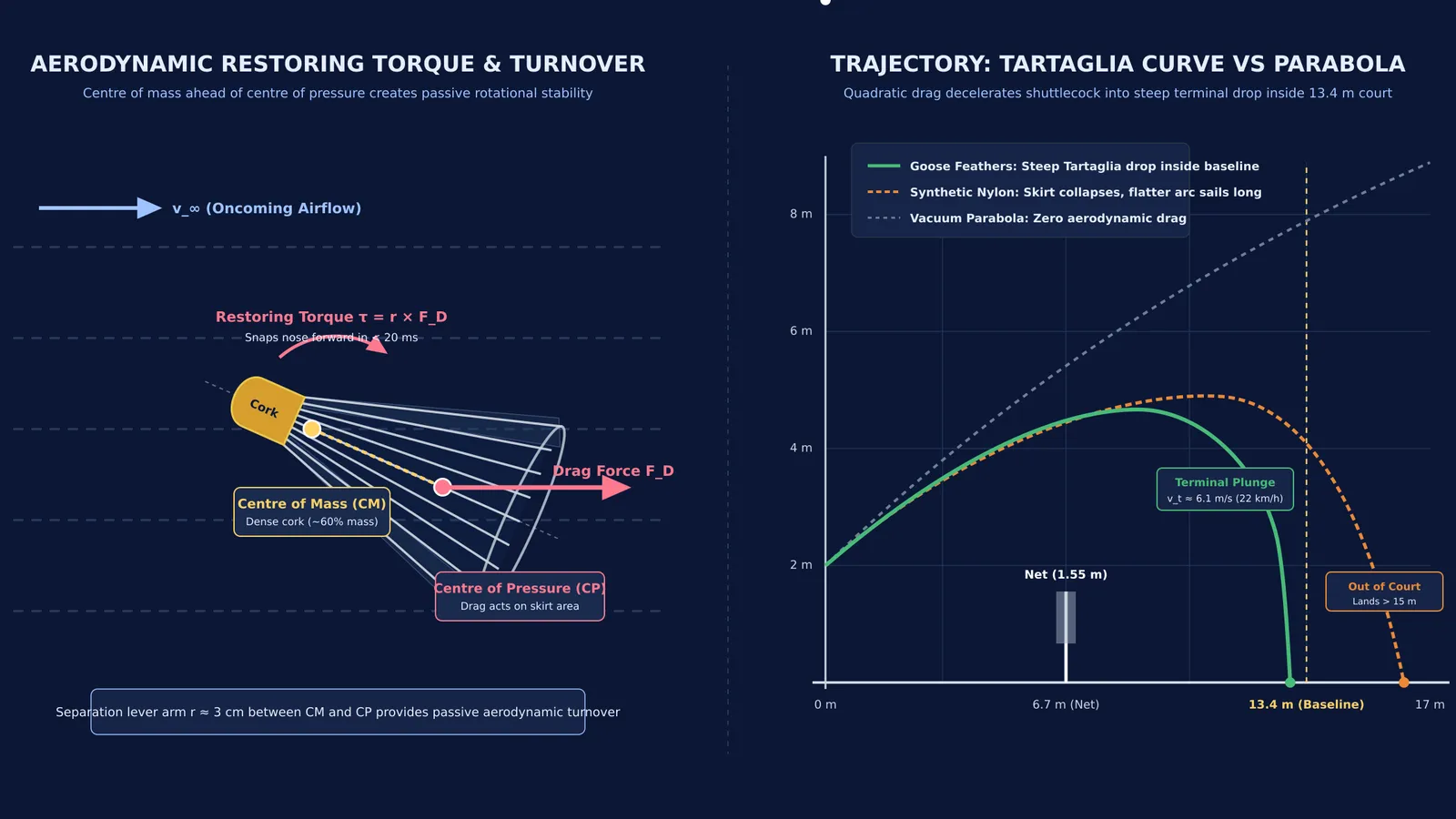
When struck off-centre, a shuttlecock leaves the racket flying sideways or backwards. High-speed video analysis published in the *New Journal of Physics* by Caroline Cohen and colleagues (2015) demonstrated that a feather shuttlecock completes a full 180-degree flip in less than 20 milliseconds.
This rapid turnover stems from two separated centres:
Centre of Mass (CM): Under the Badminton World Federation Statutes, a tournament shuttlecock weighs 4.74 to 5.50 grams with a 25 to 28 mm diameter cork. Because the cork contains roughly 60% of the mass, the CM sits barely 3 cm from the nose tip.
Centre of Pressure (CP): The flared skirt creates drag acting at the centre of pressure, roughly 3 cm behind the CM.
When tilted relative to airflow, drag pushes the skirt and generates a restoring torque around the CM. Understanding how centre of mass determines rotational balance clarifies why forward-weighted mass yields passive aerodynamic stability.
Why do 16 goose feathers outperform nylon skirts?
Under BWF Laws of Badminton, every tournament shuttlecock contains 16 feathers forming a skirt 58 to 68 mm in diameter. Goose flight quills are stiff keratin beams with rectangular cross-sections that resist buckling under heavy smash impacts.
Computational fluid dynamics in the *Journal of Fluids and Structures* by Aekaansh Verma, Ajinkya Desai, and Sanjay Mittal (2013) revealed that quill gaps entrain oncoming air into the hollow cone. This builds an internal pressure differential, generating roughly double the drag of a solid cone and three times that of a smooth sphere.
Synthetic nylon skirts collapse under high aerodynamic pressure, shrinking their frontal area and losing drag when braking is needed most.
What makes the Tartaglia trajectory different from a parabola?
Introductory mechanics models projectile flight as a symmetric parabola, as shown when deriving the standard equation of trajectory for a projectile. In badminton, quadratic drag dominates gravity. Wind tunnel measurements by Alison Cooke (1999) and Firoz Alam and colleagues (2010) establish a high drag coefficient between 0.55 and 0.65.
Because drag scales with velocity squared, kinetic energy bleeds rapidly. Cohen and colleagues (2015) showed that the trajectory follows a *Tartaglia curve*: flat initially, followed by a steep, near-vertical descent governed by aerodynamic length L = 2m / (ρ · S · C_D).
With L between 4 and 6.5 metres, smashes decelerate to near terminal velocity within roughly 7 metres, keeping powerful hits inside the court.
The Fermi Simulation Lab lets you interactively modify drag coefficients and launch angles to watch how the Tartaglia trajectory evolves compared to ideal motion.
How does aerodynamic drag shape deceleration and terminal velocity?
Consider a shuttlecock hit horizontally at 50 m/s (180 km/h). Using BWF standard specifications and aerodynamic data from Cooke (1999), let mass m = 0.005 kg, air density ρ = 1.2 kg/m³, skirt diameter d = 68 mm (area S ≈ 0.00363 m²), and drag coefficient C_D ≈ 0.60.
The instantaneous drag force is: F_drag = 0.5 · ρ · S · C_D · v² = 0.5 · 1.2 · 0.00363 · 0.60 · (50)² ≈ 3.27 N
With gravitational weight W = m · g ≈ 0.049 N, drag exceeds gravity by 67 times, producing deceleration of a = F_drag / m ≈ 654 m/s² (approx 67 g).
As shown by Cohen and colleagues (2015), vertical terminal velocity is: v_t = √(2 · m · g / (ρ · S · C_D)) ≈ √(9.8 · 3.83) ≈ 6.1 m/s (approx 22 km/h)
The shuttlecock slows from 180 km/h to walking speed before landing. In exam problems, solving this requires integrating variable acceleration as a function of velocity.
The Fermi Problem Library provides worked problems with a step-by-step solver that explains the reasoning rather than printing an answer.
How do goose feathers and nylon compare in play?
Wind tunnel testing by Alam and colleagues (2010) highlights why court feel differs:
Quill stiffness: Goose quills resist smash buckling; flexible nylon skirts deform under aerodynamic pressure.
Turnover time: Feather shuttles complete their flip in under 20 ms; nylon skirts lag at 60 ms or more.
Trajectory: Feather shuttles produce a steep Tartaglia drop inside the baseline; nylon shuttles follow a flatter arc that risks sailing long.
Durability versus control: Nylon suits gym practice, but goose feathers deliver the flight precision, sound, and tactical control demanded in competitive play.


