

On this page
If you mix a spoonful of table salt into a glass of water, it vanishes. If you do the same with a spoonful of beach sand, it sinks to the bottom and stays there. The water is identical, but the two solids are fundamentally different in how they hold themselves together.
The answer to this classic chemistry puzzle lies in the difference between an ionic lattice and a giant covalent network.
Why does salt dissolve in water?
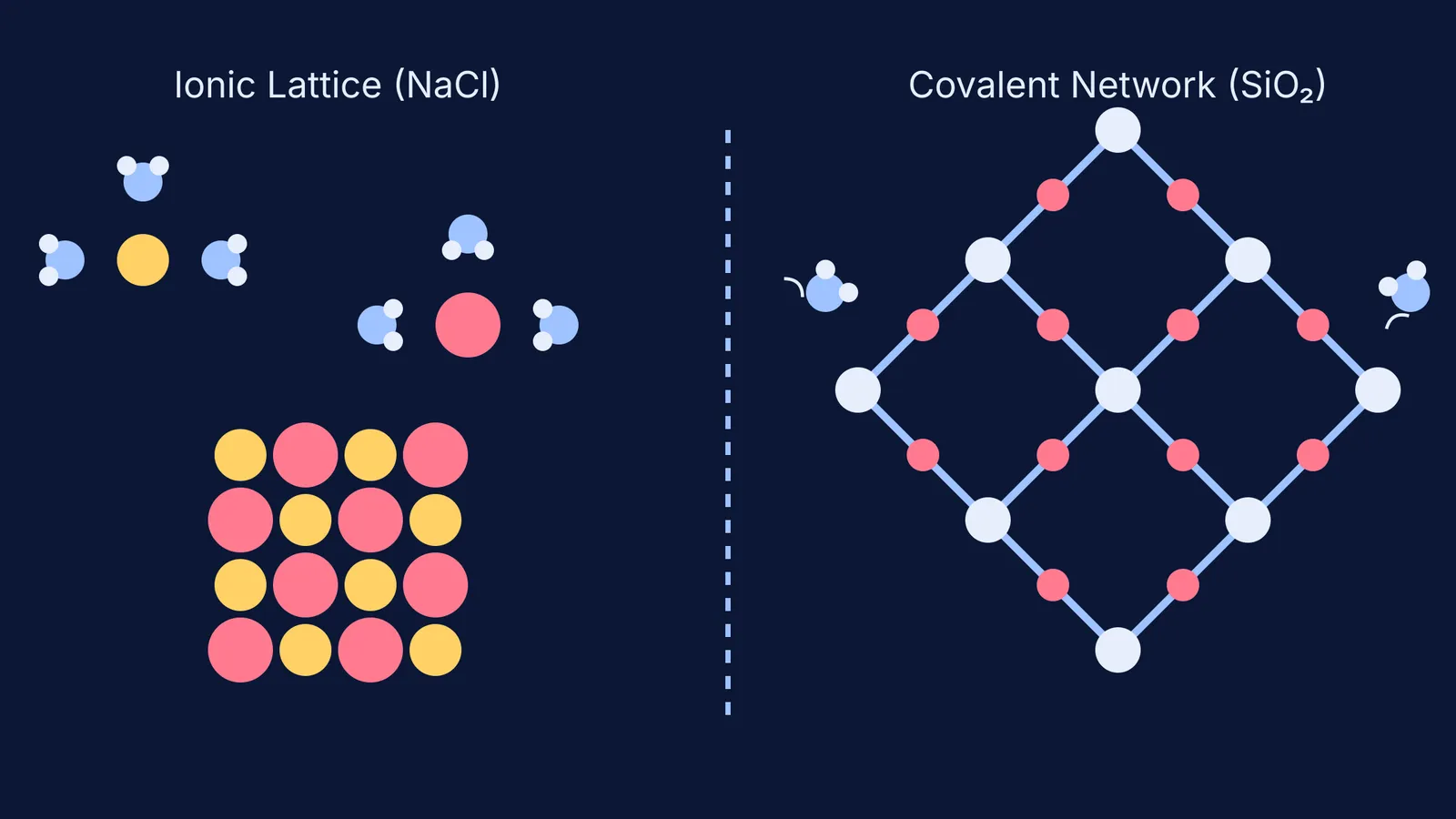
Table salt, or sodium chloride, is held together by ionic bonds. A grain of salt is a repeating three-dimensional grid—specifically a face-centered cubic lattice—of positively charged sodium ions and negatively charged chloride ions.
Water molecules are polar, meaning they act like tiny magnets. The oxygen end of a water molecule has a slight negative charge, while the two hydrogen ends have a slight positive charge. When you drop salt into water, these polar molecules crowd around the outer edges of the salt crystal.
The negative oxygen ends are attracted to the positive sodium ions, while the positive hydrogen ends pull at the negative chloride ions. This collective pulling force is strong enough to break the ionic bonds holding the crystal together. The water molecules form a "hydration shell" around each separated ion, physically carrying them off into the liquid phase. This complete separation is why the solid salt seems to vanish.
At 25 °C, the solubility of sodium chloride in water is approximately 360 grams per litre.
This reliance on partial charges explains why predicting solubility often requires examining molecular polarity, much like calculating the Percentage ionic character from dipole moment: a worked example.
Why does sand not dissolve in water?
Sand is primarily composed of silicon dioxide (silica), which has a completely different structural foundation. It is a giant covalent network, sometimes called a macromolecular structure.
In most forms of silica, each silicon atom is covalently bonded to four oxygen atoms in a continuous 3D network.
Instead of a lattice of separate charged particles that can be picked off one by one, the entire grain of sand is essentially one massive molecule firmly locked together by covalent bonds. Covalent bonds, where atoms share electrons, are incredibly strong. Water molecules still bump against the surface of the sand, but because the atoms in the silicon dioxide network do not carry free ionic charges, the water's partial charges have almost nothing to grip.
Furthermore, even if the water molecules could somehow grab onto the atoms, the amount of energy required to snap the strong silicon-oxygen covalent bonds is vastly greater than the tiny amount of kinetic energy the water molecules can provide. The chemical network remains unbroken, and the sand simply sits inert at the bottom of the glass. Because it stays completely solid, it has no effect on the chemical equilibrium of the water above it, a principle explored further in Heterogeneous equilibria: why solids and pure liquids drop out of K.
Visualising the invisible bonds
When you study chemistry, distinguishing between an ionic lattice and a giant covalent network can feel abstract because you cannot see the individual atoms reacting. Fermi Simulation Lab has interactive simulations for the ideas that are easier to see than to read. By running a simulation of water interacting with different solids, you can watch the hydration shells form around charged ions and observe how the exact same water molecules bounce harmlessly off a rigid covalent network. Seeing the mechanics in motion makes the chemical principles immediate and memorable.
A practical checklist for predicting solubility
If you are trying to predict whether an unknown solid will dissolve in water during an exam or a homework assignment, use this simple decision framework to find the answer:
Identify the primary bond type. Look at the chemical formula. Is the substance made of ions (typically a metal bonded to a non-metal, like NaCl or KBr), or is it composed entirely of non-metals (like SiO₂ or C)?
Check the network structure. If it is a non-metal structure, determine if it is made of individual small molecules (like glucose) or a giant continuous network (like sand or diamond). Giant covalent networks are almost always completely insoluble in water because the bonds are simply too strong to break.
Assess the electrostatic forces. If the solid is ionic, water will usually be able to dissolve it. The main exception is when the electrostatic attraction between the specific ions is exceptionally high (such as in calcium carbonate or silver chloride), which makes the lattice energy greater than the hydration energy.
By focusing on the structural bonds of a material rather than just the appearance of the powder, you can reliably predict exactly how a solid will behave the moment it hits the water.


