

On this page
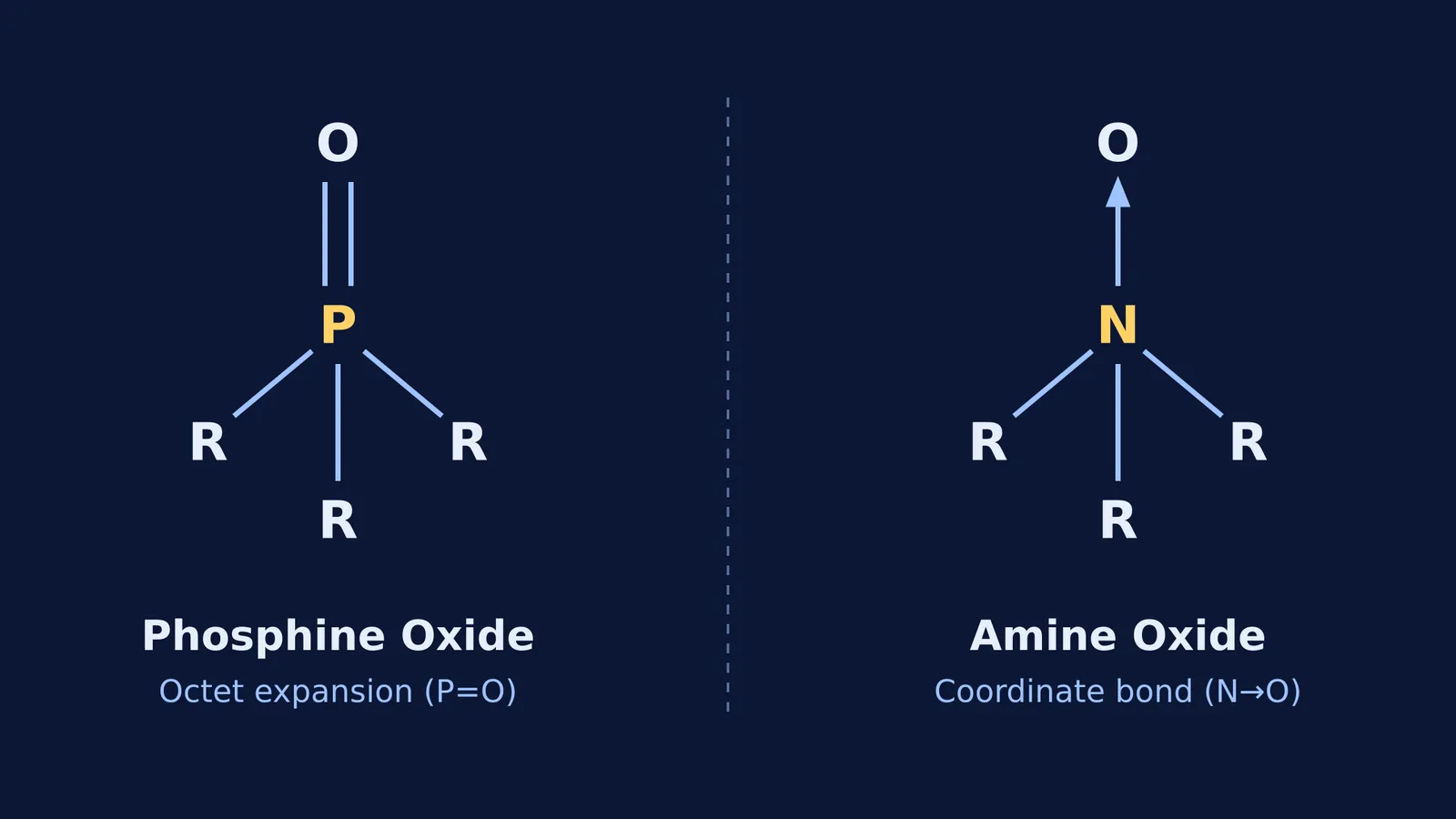
Group 15 elements often share chemical properties, but nitrogen and phosphorus diverge wildly when bonding with oxygen. You might write R₃P=O confidently in a reaction mechanism, but trying to draw a double bond for R₃N=O on an exam will lose you marks.
Why the difference? It comes down to available orbitals and the strict rules of the octet.
Why R₃P=O exists but R₃N=O does not form a double bond?
The core reason is the availability of d orbitals. Phosphorus sits in the third period of the periodic table, meaning it has vacant 3d orbitals. It can use these orbitals to accept electron density and expand its valence shell beyond eight electrons.
Nitrogen is a second-period element. It only has 2s and 2p orbitals available for bonding. With no d orbitals to hold extra electrons, nitrogen strictly obeys the octet rule and cannot form five bonds.
How does pπ–dπ backbonding work in phosphorus?
In phosphine oxides like triphenylphosphine oxide (Ph₃PO), the phosphorus atom forms three single σ bonds with the R groups and one σ bond with oxygen. This initial setup leaves oxygen with three lone pairs of electrons.
Because oxygen is highly electronegative and phosphorus has empty 3d orbitals, oxygen donates a lone pair back into the empty d orbital of phosphorus. This forms a pπ–dπ bond—a type of multiple bonding. The result is a true double bond (P=O). Measurements using X-ray crystallography show that the P=O bond length is approximately 1.48 Å. This is significantly shorter than a typical P–O single bond, confirming its multiple-bond character.
Why is nitrogen restricted to a coordinate bond?
If you try to draw a double bond for an amine oxide (R₃N=O), you force nitrogen to hold 10 valence electrons. Since nitrogen lacks d orbitals, this is physically impossible.
Instead, amine oxides form a coordinate covalent bond (often called a dative bond). Nitrogen donates both electrons from its lone pair to bond with oxygen. We usually write this as R₃N→O or R₃N⁺–O⁻. Because this is a single bond, the N–O distance in these molecules remains longer than a true N=O double bond.
A checklist for predicting double bonds vs coordinate bonds
When you face a new molecule in an exam and need to draw its Lewis structure, use this test:
Identify the central atom's period: Is it in Period 2 (B, C, N, O, F) or Period 3 and below (P, S, Cl)?
Count the valence electrons: Draw the single bonds first. If the central atom has eight electrons, stop.
Check for d orbitals: If you need to form a double bond to satisfy an outer atom (like oxygen), does the central atom have empty d orbitals? If it is a Period 2 element like nitrogen, it cannot expand its octet. You must use a coordinate bond (N→O).
Draw the pπ–dπ bond: If it is a Period 3 element like phosphorus or sulfur, it can expand its octet. Draw the double bond (P=O or S=O).
Examiners love testing your grasp of the octet rule through structural anomalies. The lack of d orbitals also explains why comparing bond angles like NH₃ and PH₃ shows a drastic drop from 107° to 93.5°. When you need to find the average bond order from resonance in other molecules, always verify if the central atom can form double bonds.
If you are unsure whether a molecule can form a double bond, the Fermi Concept Library explains molecular orbital theory and hybridisation rules, showing you exactly why certain structures are forbidden.


