

On this page
When you first learn calculus, the power rule for integration feels like a mechanical recipe: add one to the exponent, divide by that new exponent, and write + C. Yet behind that simple rule lies the core connection between differential and integral calculus. Understanding why the exponent increases, why division by the new power is necessary, and why the formula suddenly breaks down when n = −1 turns a memorised routine into an intuitive mathematical tool.
Why does integration add one to the exponent?
Integration is the inverse operation of differentiation. In OpenStax Calculus Volume 1, an antiderivative F(x) of a function f(x) is defined by the condition F′(x) = f(x). When you evaluate an indefinite integral, you are working backward: asking which original function produced f(x) as its rate of change.
In differential calculus, the power rule reduces the degree of any polynomial term by one:
d/dx(xᵐ) = m · xᵐ⁻¹
Because differentiation strips away one degree, the function you started with must have had an exponent one higher than the expression sitting inside your integral. If the integrand is xⁿ, its parent exponent m satisfies m − 1 = n, which gives m = n + 1. Adding one to the exponent is the direct reversal of the subtraction performed during differentiation.
In the CBSE Class 12 mathematics syllabus, where calculus carries 35 out of 80 marks in the annual board examination according to the CBSE Academic curriculum, integration is introduced through this exact method of inspection. For students who learned differentiation through limits, reviewing derivatives from first principles in Class 11 confirms how the binomial expansion originally created that one-degree drop.
Why do you divide by the new exponent?
Restoring the exponent to n + 1 is only the first step. When you differentiate xⁿ⁺¹, the exponent also steps forward as a multiplicative constant:
d/dx(xⁿ⁺¹) = (n + 1) · xⁿ
However, an indefinite integral like ∫ xⁿ dx asks for an antiderivative whose derivative produces exactly 1 · xⁿ, without any extra factor of (n + 1). To eliminate that unwanted multiplier, you must scale the expression by dividing by (n + 1):
d/dx [ xⁿ⁺¹ / (n + 1) ] = [ 1 / (n + 1) ] · d/dx(xⁿ⁺¹) = [ (n + 1) · xⁿ ] / (n + 1) = xⁿ
Dividing by the new exponent is the multiplicative inverse required to neutralise the coefficient produced by the derivative. The arbitrary constant C is added because any constant differentiates to zero, meaning an entire family of vertically shifted curves shares the exact same derivative.
The Fermi Concept Library covers every concept in mathematics with its own lesson and its place in the map, helping you trace how antiderivatives connect to limits and rates of change.
Why does n = −1 break the power rule?
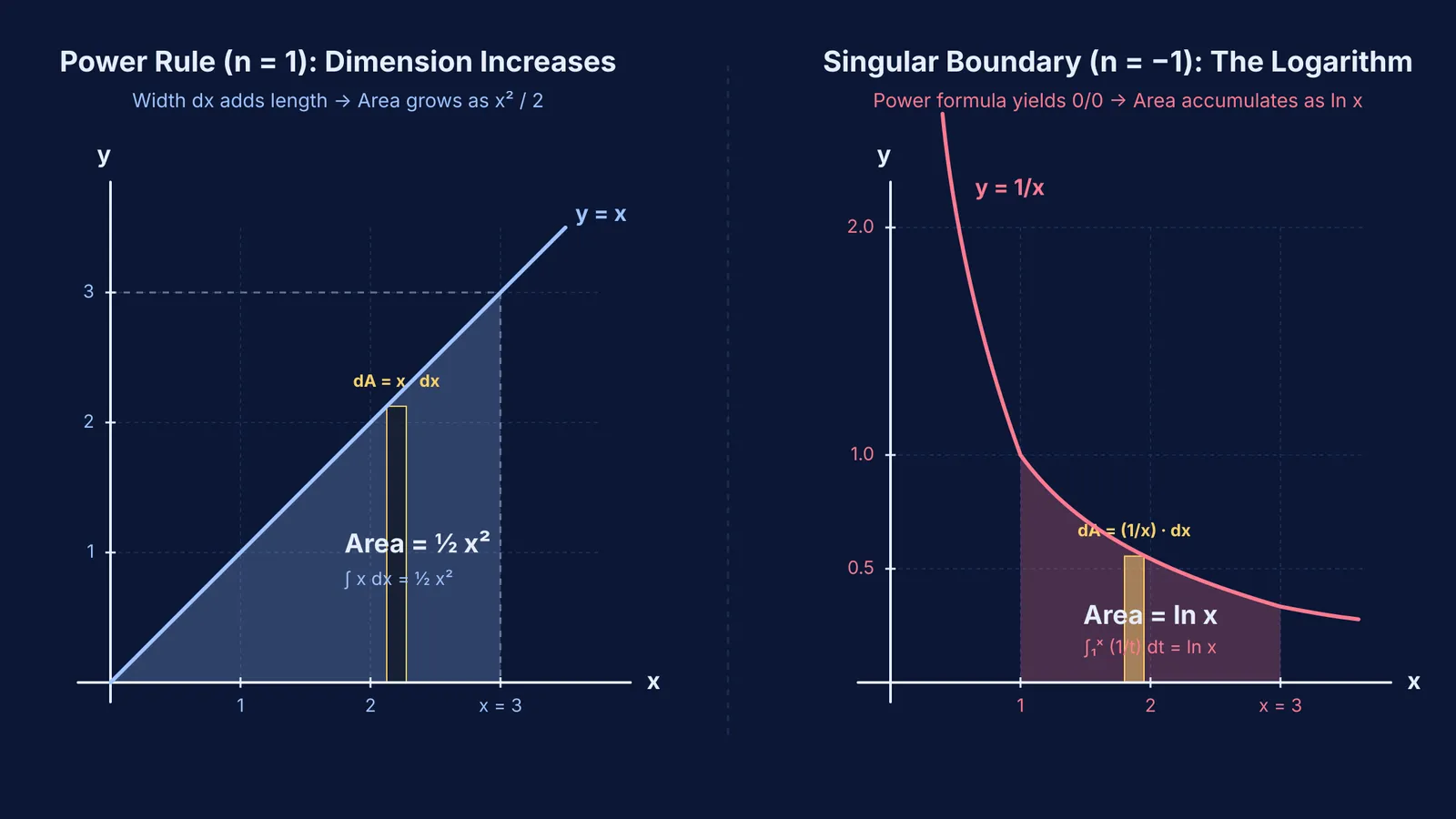
The power rule ∫ xⁿ dx = [xⁿ⁺¹ / (n + 1)] + C holds for every real number n, except for n = −1. If you attempt to substitute n = −1 into the standard formula, the mathematics collapses in two distinct ways:
The new exponent becomes −1 + 1 = 0, turning the variable into x⁰ = 1.
The denominator becomes −1 + 1 = 0, creating a division by zero, which is undefined in arithmetic.
Examining differentiation reveals why this algebraic hole exists. For any power function xᵐ to differentiate into x⁻¹ = 1/x, we would need its derivative exponent m − 1 to equal −1, which requires m = 0. But x⁰ is simply the constant 1. The derivative of any constant is zero, not 1/x:
d/dx(x⁰) = 0 · x⁻¹ = 0
The power rule for differentiation has a dead end at constant functions. Because differentiating a constant destroys the variable rather than leaving behind a negative power, no polynomial power can ever differentiate into 1/x.
How does ln|x| emerge when the power rule breaks down?
Because algebraic powers cannot produce 1/x, the antiderivative must come from an entirely different class of functions. As detailed in OpenStax Calculus Volume 1, that antiderivative is the natural logarithm:
d/dx(ln|x|) = 1/x, which means ∫ (1/x) dx = ln|x| + C
The absolute value bars ensure the domain of the antiderivative matches the domain of 1/x across both positive and negative non-zero values.
Historically, this connection was discovered geometrically rather than algebraically. In his 1647 work *Opus geometricum*, Flemish mathematician Grégoire de Saint-Vincent proved that the area under the rectangular hyperbola xy = 1 over any interval [a, b] equals the area over [c, d] whenever the ratio b/a equals d/c, as recorded by the MacTutor History of Mathematics Archive. Two years later, his student Alphonse Antonio de Sarasa recognised that an area function satisfying this multiplicative property is, by definition, a logarithm.
Rather than being an arbitrary patch, the natural logarithm is the continuous limiting form of the power rule. If you compute the definite integral of tⁿ from 1 to x, the antiderivative evaluates to:
∫₁ˣ tⁿ dt = (xⁿ⁺¹ − 1) / (n + 1)
In their 1964 study published in the Journal of the Royal Statistical Society, statisticians George Box and David Cox showed how this parameterised family behaves as n approaches −1. By applying L'Hôpital's rule with respect to the exponent, the limit as n approaches −1 of (xⁿ⁺¹ − 1)/(n + 1) is exactly ln x. Sketching area under curves makes this geometric convergence immediately clear.
How do you apply the power rule without making sign errors?
Most exam mistakes involving the power rule occur with negative exponents or fractional roots. Use this reliable three-step checklist:
Rewrite radicals and denominators in index form before integrating (for example, write 1/x³ as x⁻³ and 1/√x as x⁻¹/²).
Add one to the exponent, taking extra care with negative numbers (−3 + 1 = −2, not −4).
Divide by the new exponent by multiplying by its reciprocal (dividing by 1/2 means multiplying by 2).
Consider this worked example:
Evaluate ∫ (4x³ − 3/x² + 2/x) dx.
Term 1: ∫ 4x³ dx = 4 · (x⁴ / 4) = x⁴.
Term 2: Rewrite −3/x² as −3x⁻². Adding one gives exponent −1. Dividing by −1 yields −3 · [x⁻¹ / (−1)] = +3x⁻¹ = +3/x. The sign flips.
Term 3: The expression 2/x has power n = −1, so the standard power rule cannot be used. It integrates directly to 2 ln|x|.
Final answer: x⁴ + 3/x + 2 ln|x| + C.
This same integral appears repeatedly across Class 11 and Class 12 physics when integrating non-uniform forces or isothermal gas expansion, as discussed in the calculus you need for JEE physics. When working through multi-step calculus problems, the Fermi Problem Library offers worked problems with a step-by-step solver that explains the reasoning behind each algebraic transition rather than printing an answer.


