

On this page
Anyone who has cooked a curry knows the first step: fry the onions until they turn golden brown. But the change from sharp and crunchy to sweet and soft is not just melting; it is a rapid sequence of chemical reactions. For chemistry students, a frying pan is a high-temperature laboratory demonstrating biomolecule reactions in real time.
Why do onions need to lose water first?
Before any browning can begin, the temperature in the pan must rise. A raw onion is 89.1% water and contains about 4.24 g of sugars and 1.1 g of protein per 100 g (USDA FoodData Central). When you drop chopped onions into hot oil, the sizzling sound is water boiling into steam.
Until most of this water has evaporated, the temperature of the onion pieces cannot rise much above 100 °C, which is too low for the main browning reactions. This is why frying takes patience—you are dehydrating the onion to concentrate its sugars and proteins so they can react.
Why do fried onions lose their sharp bite?
Raw onions get their sharp bite and tear-inducing pungency from sulfur-rich compounds (Wikipedia). When you slice an onion, you break open its cells, mixing an enzyme called alliinase with amino acid sulfoxides. This forms sulfenic acids, which another enzyme then turns into syn-propanethial-S-oxide, the volatile gas that makes your eyes water.
However, these sulfur compounds are highly unstable at cooking temperatures. Long before the Maillard reaction or caramelisation begins, the heat of the frying pan breaks these molecules apart. The pungent sulfur gases evaporate into the air, while the remaining sulfur compounds degrade into much milder bisulfides. Without the harshness of the raw onion masking them, the natural sugars and newly formed melanoidins can take centre stage.
When does the Maillard reaction happen?
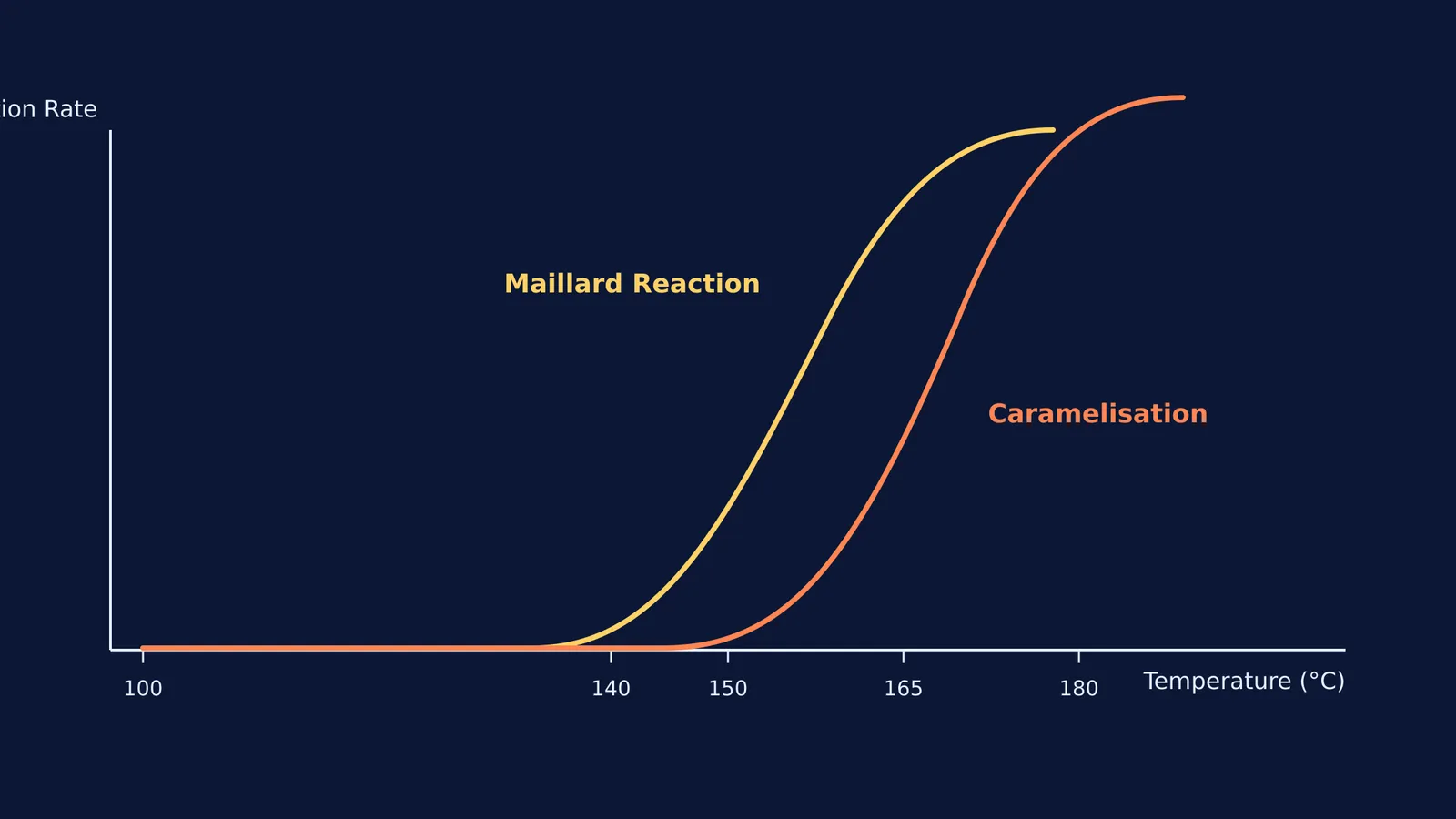
Once the water is gone and the temperature reaches between 140 °C and 165 °C, the Maillard reaction takes over (Wikipedia). This is the same process that gives bread its crust and roasted coffee its depth.
It begins when the carbonyl group of a reducing sugar reacts with the amino group of an amino acid. Through a cascade of steps including the Amadori rearrangement, the molecules form dicarbonyls and eventually condense into high-molecular-weight brown polymers called melanoidins. If you are studying reducing and non-reducing sugars or peptide bonds, the Maillard reaction is those functional groups in action.
At what temperature does caramelisation start?
As the temperature pushes past 150 °C, a second process begins: caramelisation. Unlike the Maillard reaction, caramelisation is the pyrolysis (thermal decomposition) of sugar, requiring no amino acids (Wikipedia).
The glucose in the onion starts breaking down at 150 °C, and its sucrose at 170 °C, isomerising and polymerising into larger molecules like caramelans. This releases sweet, nutty volatile compounds. At the same time, the remaining organosulfur compounds of the raw onion either break down completely or escape as gas, allowing the newly formed sweetness to dominate the flavour.
How can you visualise these changes?
If you turn the heat up too high, the temperature quickly rises and the sugars burn to carbon, leaving a bitter taste. If the heat is too low, the onions just boil in their own juice. When you are learning chemistry, picturing temperature-dependent reactions at a molecular level can be tricky. The Fermi Simulation Lab has interactive simulations for the ideas that are easier to see than to read, helping you trace how heat drives molecular changes.


