

On this page
You find an old chocolate bar in the back of the cupboard. Instead of a glossy brown surface, it is covered in a chalky, greyish-white film. Before you throw it away, take a closer look. That coating is not mould; it is a harmless physical change known as chocolate bloom.
Bloom is a visible example of phase transitions and solubility at work. It happens when the ingredients in chocolate—specifically the fat or the sugar—separate and recrystallise on the surface. Understanding why this happens gives us a perfect window into the physical chemistry of the food we eat.
Is the white coating safe to eat?
Yes, bloomed chocolate is completely safe to eat. The white coating is made of the exact same ingredients that were originally mixed into the bar. However, the texture might be slightly altered. There are two distinct types of bloom:
Fat bloom: Caused by temperature fluctuations that change the crystal structure of cocoa butter.
Sugar bloom: Caused by moisture that dissolves and recrystallises the sugar.
By looking closely, you can work out which scientific process has taken place.
What causes fat bloom?
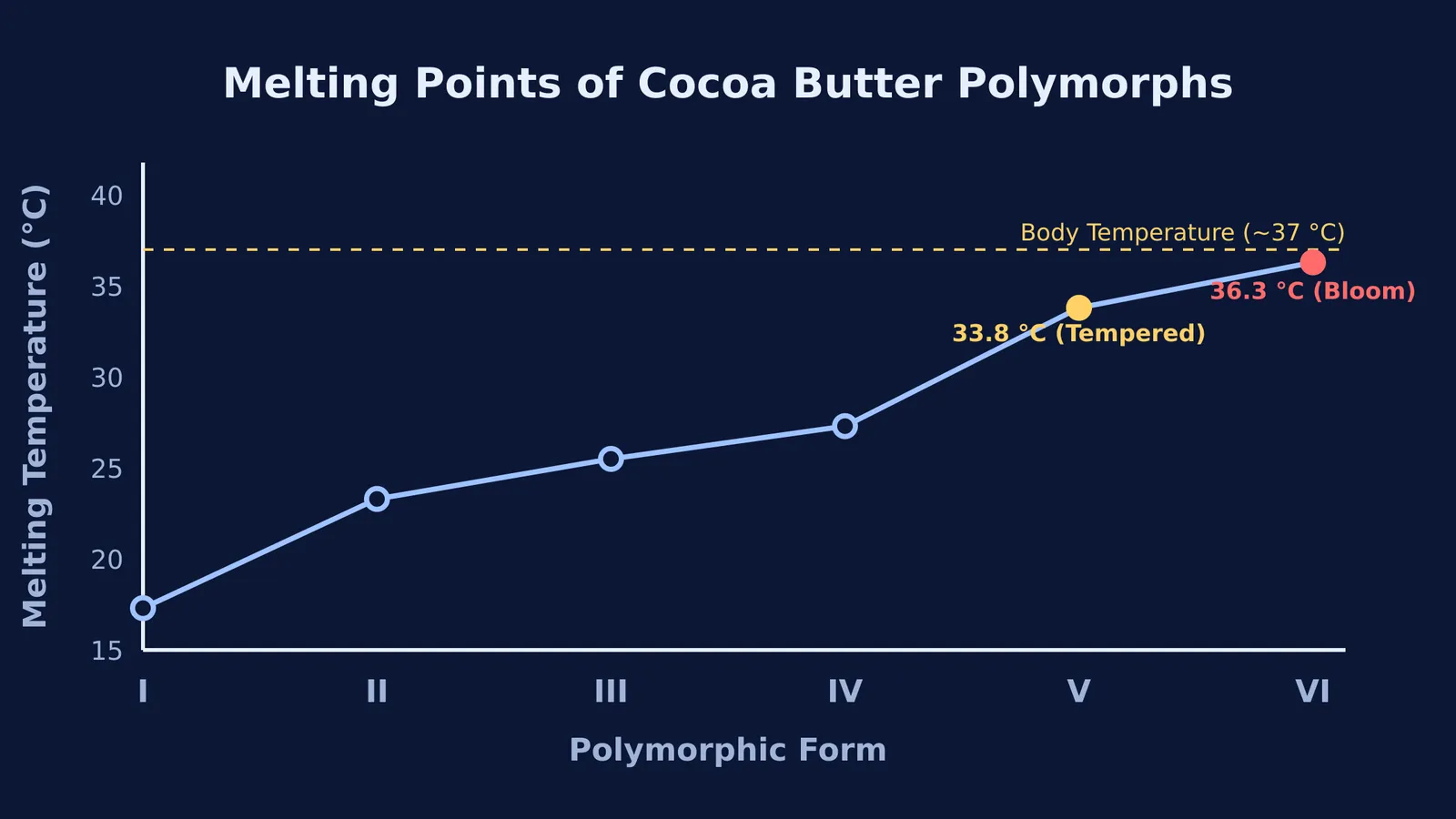
Fat bloom is the most common type, and it comes down to polymorphism—the ability of a solid material to exist in more than one crystal structure despite having the exact same chemical composition. Cocoa butter, the primary fat in chocolate, is famous for its complex polymorphic behaviour. According to ChemistryViews, it can crystallise into six different structural forms (designated I through VI) depending on how it cools.
When chocolatiers make a high-quality bar, they use a precise heating and cooling technique called tempering. The goal of tempering is to force the cocoa butter to crystallise exclusively into Form V. Form V crystals melt at exactly 33.8 °C, which is just below human body temperature. This gives the chocolate its signature glossy shine, its crisp snap when you break it, and its smooth mouthfeel.
However, Form V is not the most thermodynamically stable state for cocoa butter. Over several months, or if the chocolate is stored in an environment that is too warm, the cocoa butter begins to change. The fat melts slightly, migrates through the microscopic cracks in the chocolate to the surface, and recrystallises as Form VI. Form VI crystals have a much tighter lattice structure, making them more stable. They also melt at a higher temperature of 36.3 °C. These large, irregular crystals scatter light in all directions, creating the dull, hazy white film that we recognise as fat bloom.
Studying polymorphism and phase changes can feel abstract when you are reading from a textbook. The Fermi Simulation Lab has interactive simulations for the ideas that are easier to see than to read.
What is sugar bloom?
While fat bloom is an issue driven by temperature fluctuations, sugar bloom is an issue driven by moisture and humidity. If you store chocolate in the refrigerator and then bring it directly into a warm room, the sudden temperature difference causes condensation to form on the cold surface, much like a cold glass of water on a summer day.
The microscopic droplets of water from the condensation dissolve the fine sugar crystals that sit in the top layer of the chocolate. This process is a classic, everyday example of heterogeneous equilibria and solubility in action. The sugar leaves its solid phase and enters an aqueous solution on the surface of the bar. When the ambient temperature eventually rises and the water evaporates, it leaves the sugar behind. However, the sugar does not return to its original, finely milled state. Instead, it recrystallises into significantly larger, jagged grains that look like a dusty, matte coating.
How can you save bloomed chocolate?
If your chocolate has bloomed, you do not need to throw it away. Because the ingredients have only changed their physical state, you can reset the structure by melting the chocolate down. This breaks the crystal lattices and dissolves the separated sugar or fat back into the mixture.
Bloomed chocolate is perfect for baking brownies or making hot cocoa, where the heat will naturally recombine the ingredients. To prevent bloom in the first place, keep your chocolate in a dry cupboard between 15 °C and 18 °C (Michigan State University). This stable environment prevents the enthalpies of phase change from shifting your perfectly tempered Form V crystals into a messy white powder.


