

On this page
Look closely at almost any commercial aircraft parked at an airport gate, and you will notice a common theme: the fuselage is painted white. While airlines add their own logos and tail colours, the vast majority of the aeroplane remains a blank canvas.
This is not a lack of imagination. The decision to paint aeroplanes white is rooted in thermal physics, safety inspections and even wildlife behaviour. In an industry where efficiency and safety are paramount, every layer of paint serves a specific engineering purpose.
Why do aeroplanes need to reflect sunlight?
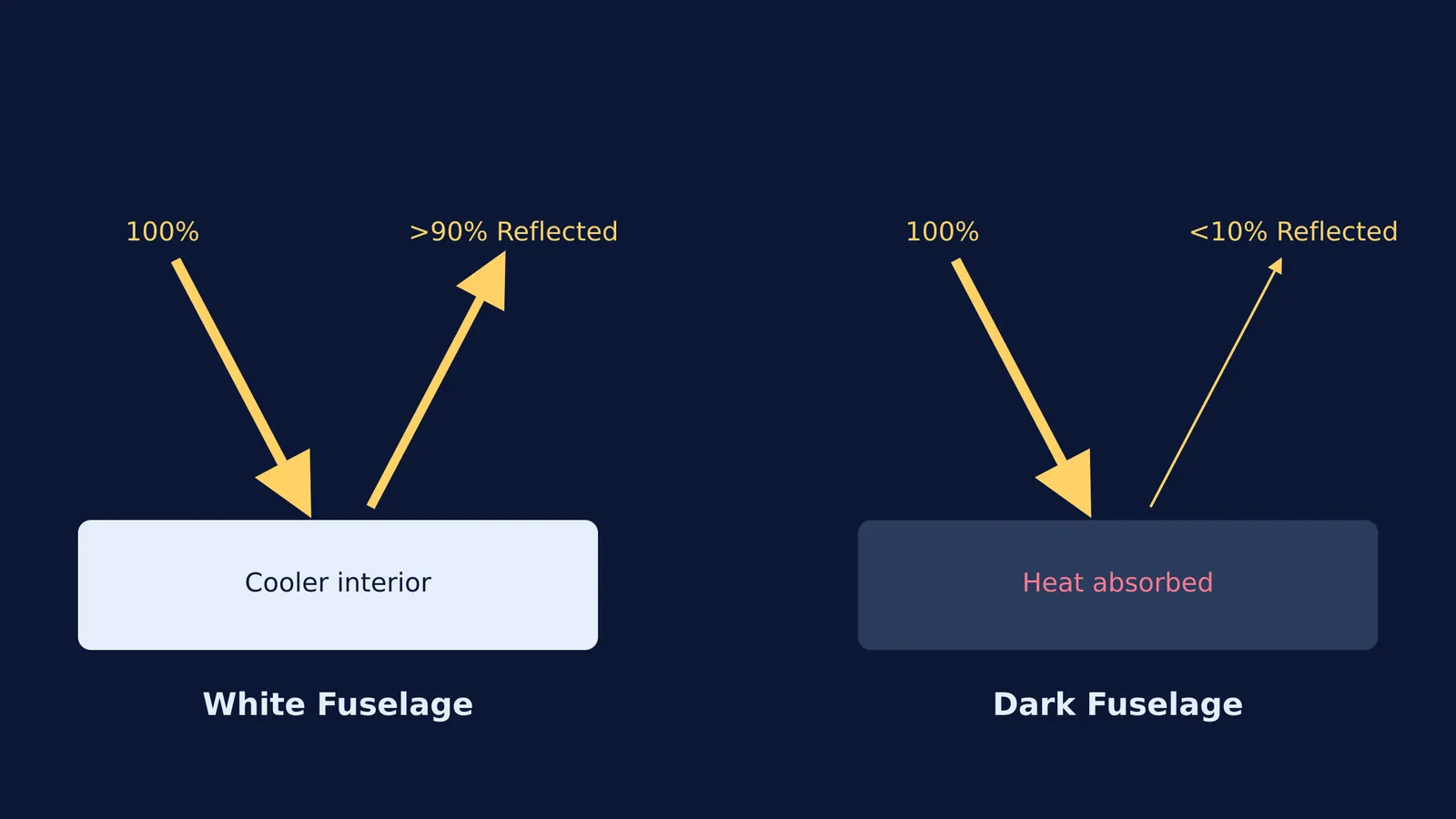
When an aircraft is parked on the tarmac, it is exposed to intense, direct solar radiation. White paint is highly effective at thermal reflection. While darker colours absorb sunlight and convert it into heat, a standard white fuselage reflects the vast majority of the light that hits it.
This high reflection of white light keeps the cabin significantly cooler before the engines are started, reducing the energy needed by the aircraft's air conditioning system. More importantly, modern aeroplanes are built using a high percentage of carbon-fibre reinforced polymers (CFRP). These advanced composite materials are incredibly strong and light, but they have strict thermal limits. If they absorb too much heat, the resin binding the carbon fibres can soften, compromising the aircraft's structural integrity. Painting the aircraft white ensures the surface temperature stays safely below these critical thresholds, even on a sunny day in the tropics.
Materials scientists are constantly trying to push this reflection even further. In 2022, researchers at Purdue University developed an ultra-white paint using hexagonal boron nitride. Their new formula reflects 97.9% of sunlight and is 80% lighter than earlier versions, making it an ideal candidate to cool future aeroplanes without adding excess weight.
Want to see how different colours absorb and reflect energy? In the Fermi Simulation Lab, you can explore interactive simulations for the ideas that are easier to see than to read—such as adjusting a surface's albedo and watching its temperature change under a light source.
Does white paint make leaks and cracks easier to spot?
Aviation safety relies on rigorous visual inspections. Ground crews perform a "walk-around" before every flight to check for structural fatigue and system failures. White paint acts as a high-contrast background for these vital checks.
Aircraft rely on complex networks of hydraulic fluids, lubricating oils and aviation fuel. When a seal fails or a line leaks, these fluids—which are often dark or vibrantly coloured, like the purple Skydrol hydraulic fluid—leave distinct streaks along the fuselage. Against a white belly, a fluid leak is instantly visible. Similarly, metal fatigue cracks, corrosion, and dents create dark shadows that stand out immediately against a bright surface. If the aeroplane were painted navy blue or black, these critical warning signs would easily blend in, forcing mechanics to spend significantly more time searching for faults with flashlights.
Beyond daily walk-arounds, aircraft undergo intensive scheduled maintenance checks. Having a white baseline colour speeds up the visual inspection phases of these heavy checks, ensuring that no micro-fracture or stress mark is missed.
Do birds see white aeroplanes better?
Bird strikes are a major hazard in aviation, and paint colour plays a role in preventing them. A 2011 study in *Human-Wildlife Interactions* analysed public aviation records to find the connection between fuselage colour and bird impacts.
Researchers Esteban Fernández-Juricic, Jim Gaffney, Bradley F. Blackwell and Patrice Baumhardt found that brighter planes, such as the Boeing 737, had lower bird-strike rates. The white fuselage provides a higher luminance contrast against the sky, making the aircraft more conspicuous to birds. Because avian vision relies heavily on detecting contrast to spot fast-moving threats, a brightly painted aircraft gives birds the extra fraction of a second they need to alter their flight path and avoid a collision.
Ultimately, while marketing departments might want vibrant, fully painted aircraft to stand out at the terminal, the laws of physics and safety dictate otherwise. White paint is simply the most efficient way to protect the aircraft from the sun, the elements, and even the local wildlife.


