

On this page
If you have ever been startled by a high-pitched buzz circling your pillow, you know how maddening a mosquito can be. That sound illustrates key wave mechanics and evolutionary biology. The whine is the sound of wings oscillating hundreds of times each second, creating rapid acoustic pressure waves that human hearing perceives as a sharp musical tone.
What causes the high-pitched buzzing whine of a mosquito?
In physics, sound is a longitudinal pressure wave created by vibrating objects. As wings vibrate back and forth, they periodically compress and expand surrounding air molecules. The wave frequency—cycles per second in hertz (Hz)—determines pitch. Higher frequencies produce higher notes, just as a sonometer wire vibrating under tension creates higher musical pitches when tightened.
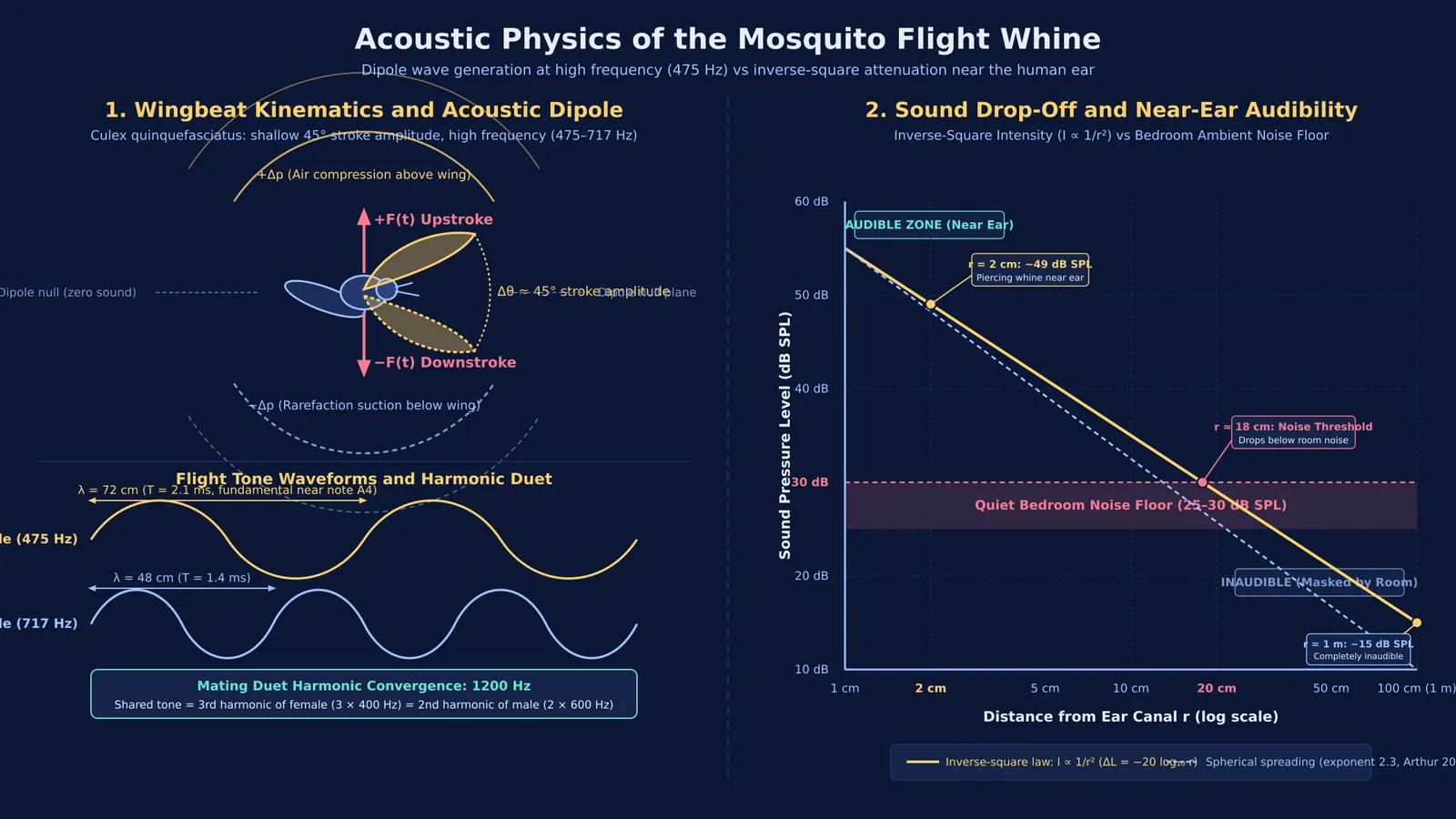
Mosquitoes flap at extreme rates compared to birds or bats. In Nature, Bomphrey and colleagues (2017) filmed Culex quinquefasciatus at 10,000 frames per second, finding stroke amplitudes of only 39° ± 4° for males and 50° ± 2° for females. To generate aerodynamic lift with such short strokes, females beat their wings at 475 ± 21 Hz, while males flap at 717 ± 59 Hz.
Because flapping wings exert periodic forces without volume expansion, they act as an acoustic dipole. Each half-stroke pushes air forward while drawing fluid in behind, creating directional pressure oscillations. At roughly 450 to 500 Hz, a female mosquito's fundamental tone sits near A4 (440 Hz), right where human hearing is acutely sensitive.
Why does the buzzing sound get loud only right next to your ear?
A mosquito across a bedroom is silent, yet it sounds piercing beside your pillow. This contrast stems from host-seeking biology and the inverse-square law.
Female mosquitoes seek blood protein to develop eggs, a habit central to female mosquitoes transmitting Plasmodium. In Current Biology, van Breugel and colleagues (2015) showed that mosquitoes track host cues hierarchically: carbon dioxide from 10 to 50 metres, visual shapes from 5 to 15 metres, and body heat within 1 metre. Because you exhale carbon dioxide, the plume directs the insect straight to your head.
Furthermore, a mosquito radiates barely a few nanowatts of acoustic power. Acoustic measurements by Arthur and colleagues (2014) in The Journal of the Acoustical Society of America showed that flight tones attenuate with distance to the power 2.3 along the front-back axis. Under the inverse-square law (I ∝ 1/r²), sound pressure at 1 metre is roughly 15 dB SPL, masked by a bedroom's 25 to 30 dB ambient noise. At 2 centimetres, sound pressure reaches nearly 50 dB SPL—comparable to quiet conversation.
How do mosquitoes use wingbeat frequency to communicate?
The whine also serves as courtship communication. Mosquitoes hear through Johnston's organ at the antennal base, where thousands of sensory neurons detect microscopic particle velocities.
In Science, Cator and colleagues (2009) found that flying Aedes aegypti perform courtship duets. While females flap near 400 Hz and males near 600 Hz, they adjust until converging at a shared 1200 Hz harmonic—the female's third harmonic (3 × 400 Hz) and the male's second (2 × 600 Hz). In Current Biology, Menda and colleagues (2019) confirmed that male antennal ears detect female flight tones up to 10 metres away, with sensitivity down to 31 dB SPL.
When wave concepts such as phase, interference, and harmonic multiples feel abstract on paper, the Fermi Simulation Lab provides interactive simulations for ideas that are easier to see than to read, letting you observe how changing oscillation frequency shifts wave patterns.
How do you calculate a mosquito's wingbeat wavelength and sound drop-off?
To calculate the wave properties of a mosquito's whine, consider a female flapping at f = 475 Hz, as measured by Bomphrey and colleagues (2017), in air at 20 °C (speed of sound v = 342 m/s):
Wingbeat period: The cycle period T is T = 1 / f = 1 / 475 s ≈ 2.1 ms, completing a full stroke cycle in just over two milliseconds.
Acoustic wavelength: With v = f × λ, the wavelength is λ = v / f = 342 / 475 ≈ 0.72 m (72 cm), spanning a desk width. To review how pressure waves propagate, see displacement and pressure waves in sound.
Sound level drop: By the inverse-square law (I ∝ 1/r²), moving from r₁ = 2 cm to r₂ = 100 cm reduces intensity by (1.0 / 0.02)² = 2500. In decibels, ΔL = 10 log₁₀(2500) ≈ 34 dB. A level of 49 dB SPL at 2 cm drops to 15 dB SPL at 1 m, consistent with spreading data by Arthur and colleagues (2014). Below a bedroom's 25 to 30 dB noise floor, the insect is inaudible until hovering beside your ear.
When working through wave numericals, the Fermi Problem Library offers worked problems with a step-by-step solver that explains the reasoning rather than printing an answer, while the Fermi Concept Library maps every concept in physics, chemistry, biology, mathematics and computing, each with its own lesson and its place in the map.


