

On this page
When you step onto a spinning merry-go-round, your body immediately feels an outward pull. As the platform speeds up, staying near the rim demands effort: your feet slide, your torso leans, and your hands grip the rails. To your senses, an invisible force is pushing you outward.
Yet an observer standing on the grass sees no outward force. No physical agent pushes you toward the edge. Instead, your body obeys inertia from Newton's laws of motion: an object continues along a straight line at constant speed unless acted on by a net external force.
At every moment, your velocity points forward along the circle's tangent. To keep you turning, the seat or handrail must pull you inward toward the axle. What feels like an outward push is your mass resisting this inward deflection as the ride curves beneath you.
Why do you feel pushed outward on a merry-go-round?
The sensation of being thrown outward is inertia in disguise. As described in OpenStax College Physics, this experience reflects the difference between stationary and accelerating reference frames. When a car turns left, your body presses against the right door because your torso continues straight while the car turns into you.
On a merry-go-round of radius r rotating at angular speed ω, your linear speed is v = ω r. Maintaining circular motion requires a continuous inward centripetal acceleration:
a_c = v² / r = ω² r
To provide this, the handrail or floor must exert an inward centripetal force of F_c = m v² / r. Your body feels the stress of this inward redirection.
Is centrifugal force a real physical force?
In physics, centrifugal force is classified as a fictitious or inertial pseudo-force.
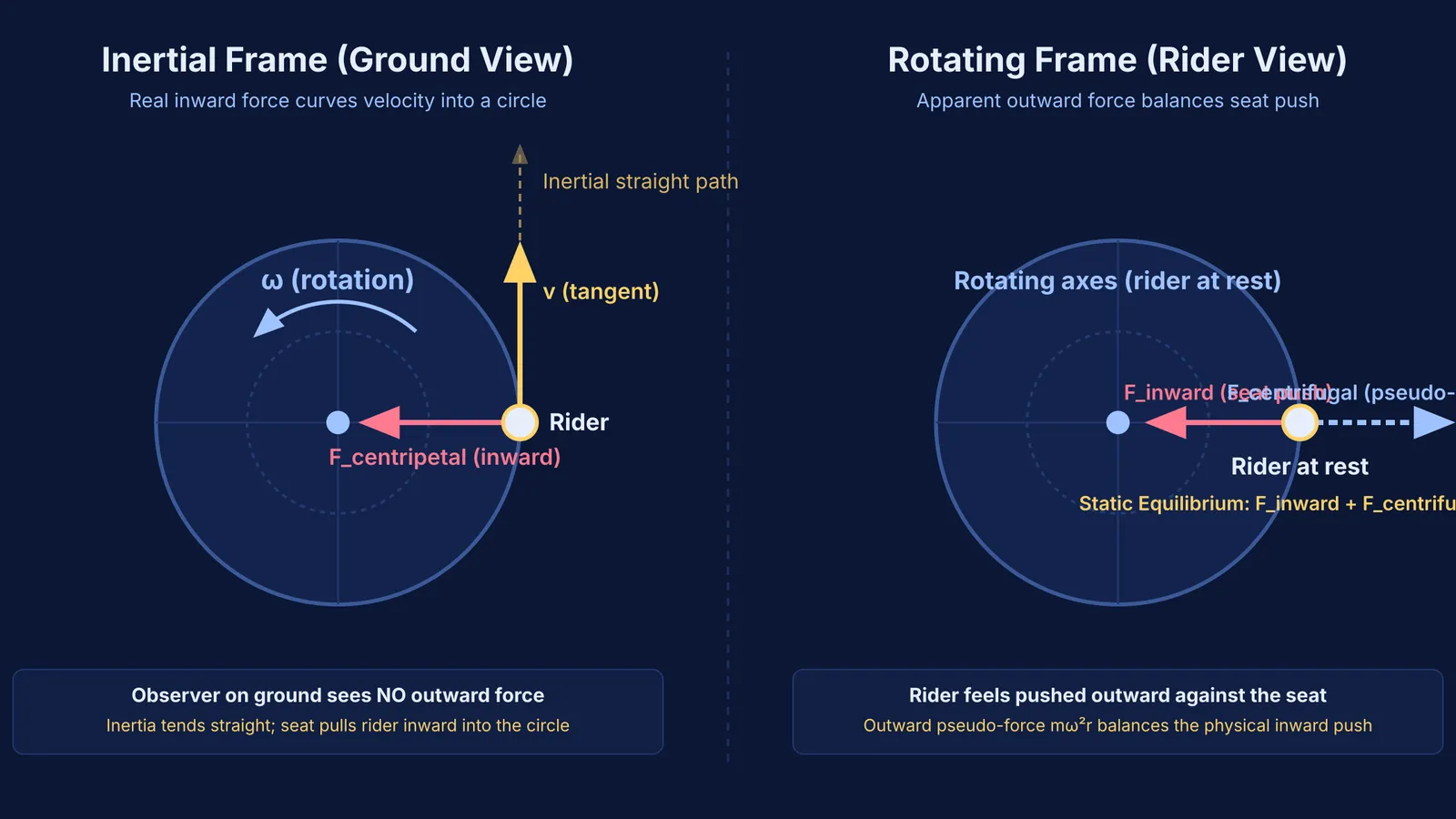
In an inertial ground frame, Newton's laws apply directly. Only real physical interactions act on you: gravity, normal force, and inward contact forces from friction or handrails. Centrifugal force does not exist here. The net force points inward, accelerating you toward the centre.
In a non-inertial frame rotating with the ride, the coordinate axes accelerate inward at ω² r. To use Newton's second law here, physicists introduce an outward pseudo-force of magnitude F_cf = m ω² r. While useful when solving mechanics problems from an accelerating frame, centrifugal force has no physical agent, no matter, and no Newton's third-law reaction pair.
What happens if you let go of the spinning platform?
A common myth is that releasing the bar flings you straight outward along a radius. In a landmark study in Science, McCloskey, Caramazza, and Green (1980) found that roughly 33% of students predicted an object leaving a curved path would continue curving, and over 50% showed non-Newtonian misconceptions. The Force Concept Inventory by Hestenes, Wells, and Swackhamer (1992) confirmed that students routinely expect outward centrifugal propulsion.
In reality, the moment you let go, the inward force drops to zero. By Newton's first law, you travel along the straight tangent line of your circular path at release speed. To an observer on the ground, your path is perfectly straight. It only looks curved to riders spinning past you on the ride.
Comparing both frames side by side makes this clear. The Fermi Simulation Lab provides interactive simulations for the ideas that are easier to see than to read, letting students toggle between ground and rotating frames.
How do you calculate the inward force on a playground ride?
Consider a 50 kg student sitting on a carousel at radius r = 2.0 m, rotating at 15 revolutions per minute (rpm), as formulated in standard rotational dynamics problems (see OpenStax College Physics):
Angular velocity: ω = 15 × (2π / 60) = π / 2 rad/s ≈ 1.571 rad/s.
Tangential speed: v = ω r ≈ 3.14 m/s.
Centripetal acceleration: a_c = v² / r = (3.14)² / 2.0 ≈ 4.93 m/s² (roughly 0.50 g).
Required inward force: F_c = m a_c = 50 × 4.93 ≈ 246.5 N.
To hold the student without handrails, static friction must satisfy f_s = μ_s m g ≥ F_c, requiring μ_s ≥ a_c / g ≈ 0.50. On a wet deck with μ_s = 0.20, friction yields only 0.20 × 50 × 9.8 = 98.0 N. The student's arms must supply the remaining inward tension:
F_grip = 246.5 N − 98.0 N = 148.5 N
How do you tackle circular motion questions in JEE and NEET?
Circular dynamics problems frequently appear in JEE and NEET questions on centripetal force and banked curves. Keep three rules in mind:
In an inertial frame, sum real inward forces and set them equal to m v² / r. Never draw centrifugal force here.
In a rotating frame, add an outward pseudo-force m ω² r in static equilibrium.
At constant angular speed ω, acceleration scales with radius (a_c ∝ r); at constant linear speed v, it scales inversely (a_c ∝ 1/r).
For structured practice on exam numericals, the Fermi Problem Library offers worked problems with a step-by-step solver that explains the reasoning rather than printing an answer.


